
A slippery topic: how cottonseed oil was recognized as suitable for engines

A number of testing laboratories turned out to be ready to recognize even edible cottonseed oil, which is used to cook pilaf in Central Asia, as motor oil and meets all the necessary requirements for lubricants for internal combustion engines. Such organizations issue conclusions without conducting the necessary research, and some issue test reports without even receiving control samples for verification. Izvestia was convinced of this by conducting an experiment with the National Automobile Union to obtain permits for car oils.
Butter to butter is different
In the middle of spring, the National Automobile Union (NAS), at the request of Izvestia, sent samples to several laboratories for testing. However, instead of real engine oil, edible cottonseed oil purchased at one of the Moscow food markets, intended for cooking pilaf, was sent to the laboratory. At the same time, 20 milliliters of diesel fuel and "waste" were added to the test samples "for the smell".
The laboratories were tasked with checking this oil for compliance with the Technical Regulations TR CU 030/2012 "On Requirements for lubricants, oils and special liquids" and issuing appropriate test reports. These documents are necessary for further registration of declarations of conformity for the oil and its subsequent market launch.

At the same time, WE did not even send the samples themselves to a number of laboratories, but only sent specifications for engine oil downloaded from the Internet. However, this did not prevent the "testers" from agreeing to conduct "tests" and draw up "test protocols".
— Contracts have been signed with all laboratories. Moreover, unlike last year's story with the certification of cars, when the fee for the issued SBCTS was charged by a regular transfer to a bank card, payment for oil testing services was made using the bank details specified in the contracts. Depending on the specific laboratory, the cost of such checks ranged from 6 to 24 thousand rubles," Anton Shaparin, NAS Vice President, told the details.
Compliance is recognized
As part of the tests, the flash and auto-ignition temperatures, the content of mechanical impurities, and water were checked. Kinetic and dynamic viscosity and the viscosity index were also studied. Some test reports also include data on the pour point, the content of selective solvents, polychlorinated biphenyls, pH (acidity level) and some other parameters. At the same time, not a single laboratory recognized the catch.
According to the test reports (copies are available to Izvestia), some laboratories explicitly stated in the documents that "the samples submitted for testing comply with the requirements of TR CU 030/2012 "On requirements for lubricants, oils and special Liquids." Others refrained from such a conclusion, however, a comparison of the data obtained during the tests with the standards established by the Technical Regulations (these values are also indicated in the test reports) indicates that the tested sample in the form of a mixture of cottonseed oil, diesel fuel and "waste" fits into the regulatory values.
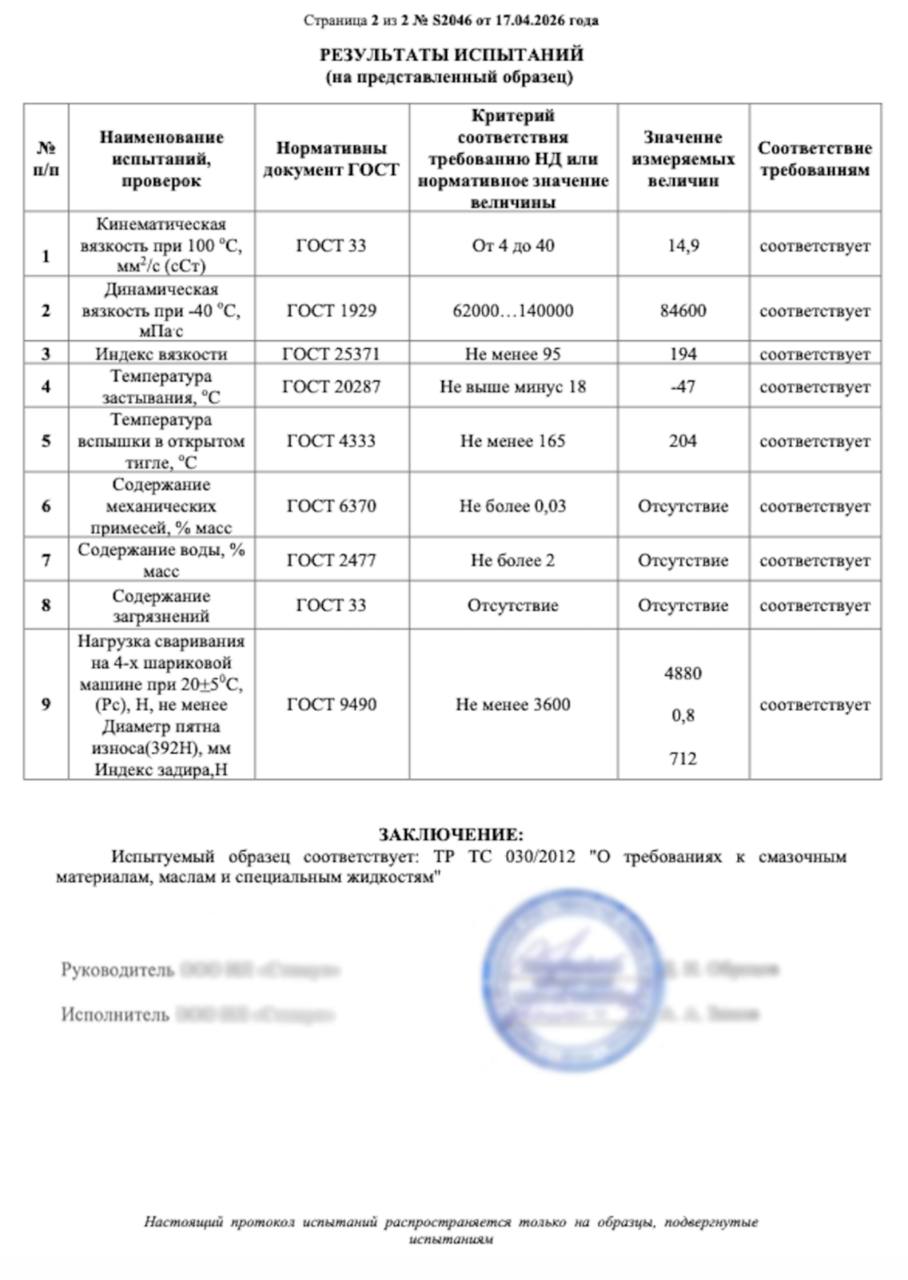
Izvestia sent requests to the testing laboratories that issued test reports for the oil, asking them to comment on the results they received.
The testing laboratory does not give an opinion on the composition of the samples provided for research, it only evaluates them for compliance with the established parameters, the head of one of the laboratories to which the engine oil allegedly sent US told Izvestia.
— We have tested what was sent to us: what exactly is in the sample is a question for the customer. Our task is to evaluate this sample for compliance with the standards," said the source, who introduced himself as Sergey.
At the same time, he called the Technical Regulations for which the tests were conducted "leaky", and the standards set out in it "wide gates into which a tank can be driven." Because of this, the submitted sample could meet the requirements, he suggested.

Some indicators, such as the density or flash point of edible vegetable and motor oils, may be close, says Maxim Slezkin, Candidate of Chemical Sciences, who has long held the position of process engineer at a large international company for the production of auto chemicals and automotive cosmetics. However, according to a number of parameters, it is not difficult to distinguish cottonseed oil from oil intended for internal combustion engines.
— For example, in terms of viscosity, the difference between vegetable and engine oil will be enormous: the numbers will show everything by themselves. It is simply impossible not to notice this difference during the tests," he told Izvestia.

The "cotton" experiment
The received test reports give US grounds to register the declaration in the Rosaccreditation system. This is done by the applicant through the portal of Public Services, and he independently indicates the name of the product, the place of its production and uploads a scan of the test report to the system, Anton Shaparin said.
— Of course, WE did not plan to receive a declaration for such "oil" and will not do so. The purpose of this exaggerated experiment is to show that under the guise of engine oil, anything can be found in a canister on the counter, even pilaf oil," he told Izvestia.

In real life, manufacturers and importers of counterfeit lubricants are unlikely to use cottonseed or other vegetable oil, the NAS Vice president notes. However, the use of refined "mining" as a raw material is not uncommon, he emphasizes.
— Moreover, used engine oil is not necessarily used: any other expired oils are used, from transformer to diesel. They are cleaned of mechanical impurities, at best some additives are added to them, if anything is added at all, the resulting slurry is poured into cans and sent for retail sale, Anton Shaparin told Izvestia.
To a greater extent, the falsification of engine oil is associated with the substitution of base oil, said Denis Zagarin, head of the Testing Center at FSUE NAMI. We are talking about cases when mineral water is sold under the guise of "synthetics", he explained.
— If the laboratories could not distinguish cottonseed oil, then it will be even more difficult to distinguish synthetic from mineral oil, — Denis Zagarin noted.
What is the danger of counterfeiting?
High-quality engine oil, which includes a whole range of various additives, provides not only lubrication of the rubbing parts of the engine, but also its protection, said Sergey Shabunin, master receptionist at the Veshnyaki Avto technical center. In addition, these additives purify the oil itself from microparticles formed during wear of parts, as well as soot and other fuel combustion products, he added.

— If we talk about the purified "working out" poured into the engine, then it will still be able to provide the lubrication of the parts itself. But since it does not have a complex of additives, or they have already exhausted their resource, such an "oil" will not be able to provide anti-corrosion protection, it will not self-clean from impurities. It is also unknown what the thickness of the oil film will be and how long it will stay on the parts. What will happen to the engine if cotton or other vegetable oil is poured into it is even difficult to guess. Most likely, it will simply burn out and the engine will be left without lubrication altogether," Sergei Shabunin told Izvestia.
"One can only hope for good faith"
The fact that laboratories issue test reports for engine oils without even having a test sample, and even the tests carried out do not allow us to distinguish an outright "bodyguard" from real engine oil, is alarming, says Maxim Kadakov, editor-in-chief of Za Rulem magazine.
— In this situation, when buying engine oil or some other technical fluid for a car, the only guarantee of purchasing high-quality goods is, in fact, only the good faith of the manufacturer or importer of these chemicals. Gaps in the system of testing and inspections of these products, unfortunately, allow unscrupulous manufacturers to circumvent the established barriers," said the editor—in-chief of Za Rulem.

It has become more difficult to legalize counterfeiting
The introduction of mandatory digital labeling of motor oils has become the main driver of the recovery of the fuel and lubricants market, according to Oleg Pavlov, Chairman of the Public Consumer Initiative (OPI), Chairman of the Public Council at Rospotrebnadzor. Until recently, according to expert estimates, the share of illegal products in retail could reach 50-60%, which created huge risks for car owners, he noted.
— The departure of foreign brands has complicated logistics and market control, but the timely launch of the Honest Sign state system has helped to stabilize the situation and protect consumer rights. This system allows you to track the path of each canister from the factory or customs post to the final buyer, as a result of which the proportion of counterfeit is consistently reduced. It has become more difficult for artisanal industries and smugglers to legalize products," Oleg Pavlov told Izvestia.

He also noted that the mobile application allows car owners to independently verify the product before purchase, which dramatically reduced the risks of purchasing illegal oil at retail. The Chairman of the OPI stressed that after labeling solved the problem of traceability of fuels and lubricants, the improvement of procedures for controlling the physical composition of oils became on the agenda.
— The system of product admission to the market through the registration of declarations and certificates is also undergoing a stage of positive transformation. Russian regulators are systematically and effectively clearing the market of unscrupulous "blank factories" that issued documents without real testing. Relevant departments are also actively working on the modernization of existing state standards and adaptations of test methods for modern synthetic compounds," Oleg Pavlov said.
Supervision is not dormant
The Federal Accreditation Service carefully examines the submitted data. When confirming the facts, the agency reacts promptly and harshly, Rosaccreditation told Izvestia.
The Agency said that earlier NAS had sent information about 6,700 declarations for automotive components, which, according to the Union, are subject to certification. As a result of the audit, 191 declarations were suspended, and another 398 declarations were suspended after additional analysis of all documents on automotive components since the beginning of 2025. WE also sent data on 286 declarations for car oils, for which violations were detected in 97 cases, Rosaccreditation clarified. In total, in 2025-26, the Federal Accreditation Service invalidated or suspended 36,891 declarations, the agency said.

— Since December last year, no declaration on the EAEU test report has been registered until the national accreditation body of a particular country confirms the issue of the protocol. Rosaccreditation is gradually identifying previously issued declarations that do not meet this requirement, including through feedback from responsible market participants. If violations are confirmed, the documents are immediately suspended. We remind you that the applicant himself is responsible for the reliability of the evidence base when registering the declaration, " the press service of Rosaccreditation told Izvestia.
The Service reported that, simultaneously with supervision and control, automatic format and logic control is also constantly being refined and improved. In addition, Rosaccreditation proposes to return the functionality for registration of declarations from applicants to accredited certification bodies. This systematic measure will strengthen control over the quality of declarations, the press service of the department emphasized.
Переведено сервисом «Яндекс Переводчик»
