- Статьи
- Society
- Optical deception: illegal construction sites have been identified in nature reserves across the country

Optical deception: illegal construction sites have been identified in nature reserves across the country

The facts of illegal development have been revealed in the reserves of at least nine regions of Russia, follows from the materials of the Public Council under the Ministry of Natural Resources, which were reviewed by Izvestia. Among them are such well-known protected areas as Sochi National Park, Curonian Spit, Pleshcheyevo Lake, Beringia, Losiny Ostrov. For example, in some cases, objects appeared under the guise of infrastructure for ecological tourism that were not related to the goals and objectives of protected areas. The damage to the environment from such actions can amount to tens of billions of rubles, experts noted.
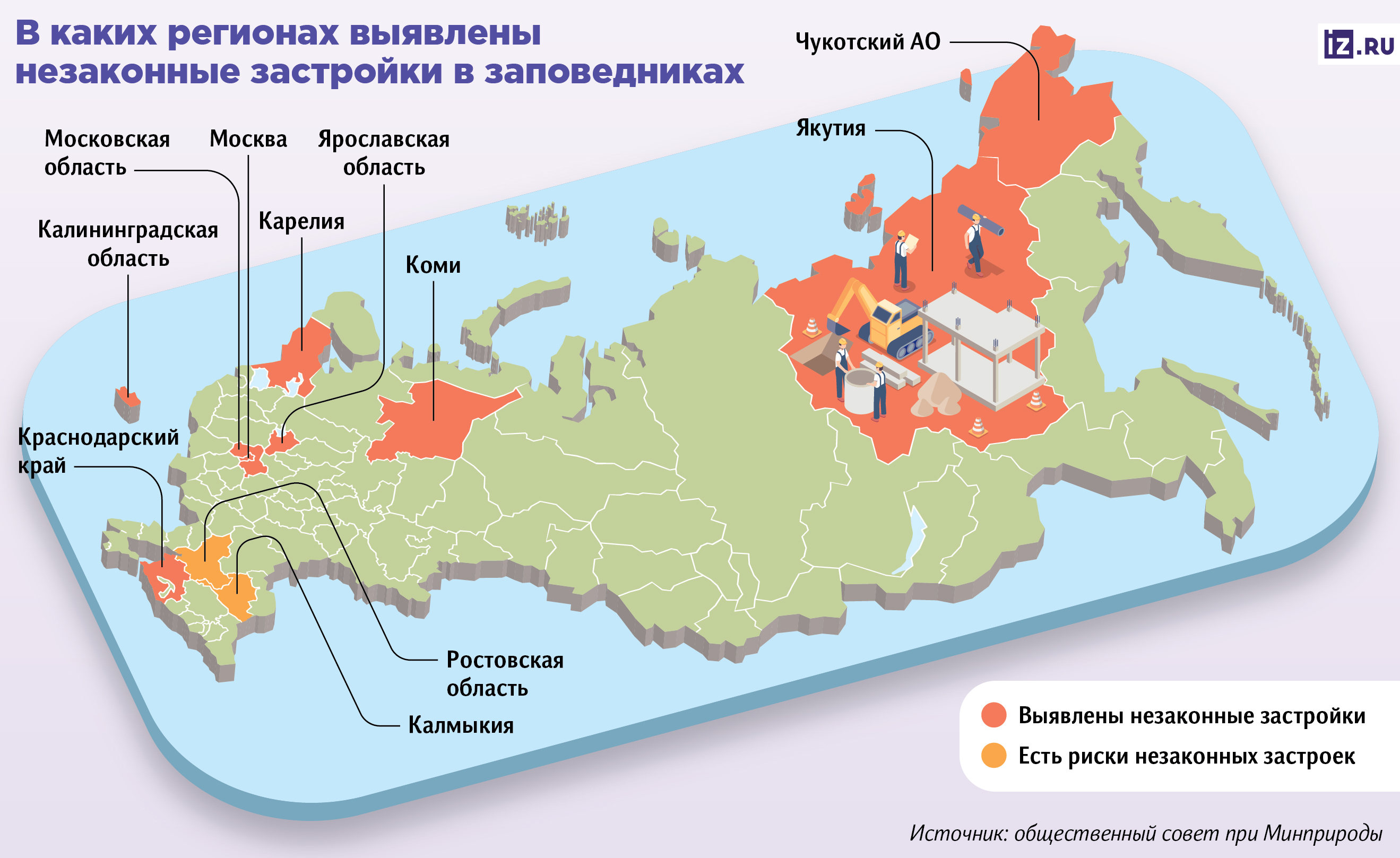
In which regions illegal buildings in nature reserves are possible
Illegally constructed facilities have been identified in nature reserves and protected natural areas in at least nine regions of Russia. The materials of the Public Council under the Ministry of Natural Resources and Environment indicate that these are the Krasnodar Territory (Sochi National Park), the Yaroslavl Region (Pleshcheyevo Lake), the Kaliningrad Region (Curonian Spit), Komi (Yugyd Va), Yakutia (Barayy), Chukotka (Beringia), Karelia (Vodlozersky Park), Moscow and the Moscow Region (Losiny Ostrov). Protected areas in Kalmykia, the Rostov region and a number of other regions are also at risk.
— Unfortunately, there are dozens of examples when, under the guise of infrastructure for ecological tourism, objects appear in nature reserves, national and natural parks that are not related to the goals and objectives of protected areas, sometimes it is about illegal development. The Public Council of the Ministry of Natural Resources and Environment is working to assess the real situation," Lev Shagarov, a member of the council, told Izvestia.

In the coming months, the results of this work may be presented in the framework of the relevant section at the Scientific and Technical Council (STC) of the Ministry of Natural Resources and Environment, he added. As an interlocutor familiar with the situation explained to Izvestia, on April 10, the NTS of the Ministry of Natural Resources and Environment had already discussed the problems of protected areas with the participation of the Prosecutor General's Office. Among other things, a methodology for assessing the environmental value of sites that were removed from protected areas was presented. Soon, scientists will be able to use it to create a transparent decision-making mechanism on the expediency of returning sites to the boundaries of nature reserves.
"For all identified violations of the law on Specially Protected Natural Territories, inspections are always carried out, the perpetrators are identified and brought to justice," the Ministry of Natural Resources and Environment told Izvestia.

The Ministry works closely with law enforcement agencies to identify and prevent violations in nature reserves and national parks. Any illegal activity, not only construction, can harm ecosystems, the ministry stressed.

The Curonian Spit National Park noted that the risk of illegal developments in the designated protected area is minimal, since its territory is small (6.6 thousand hectares) and state inspectors regularly inspect it.
— In the Curonian Spit National Park, construction is possible only in an economic zone (in villages) or in a recreational area. The law provides for the possibility of interaction between potential investors and local residents with the institution that manages protected areas. Illegal buildings are prevented in the course of ensuring the protection of the territory by the State Inspectorate of the National Park," the National Park stressed.
As a source in government agencies explained to Izvestia, the final conclusion about the presence or absence of violations in national parks can be made only after reviewing the data of public figures in the relevant ministry and inspections of accounting and legal documentation.
The interlocutor noted that the legislation allows the construction of some commercial facilities in protected areas or recreational areas, for example, those necessary to serve tourists: hotels, camp sites, food outlets, visitor centers, etc. Therefore, detailed checks of information about protected areas and their legal status are often necessary to obtain an objective picture of violations, he added.

Illegal buildings on the territory of protected areas appear for various reasons: sometimes it is deliberate illegal registration of documents, and sometimes misleading citizens, said a source of Izvestia in government agencies. As a result, such issues are considered by prosecutors and judicial authorities, the owners of land plots may face their seizure, and in the case of proven fraudulent actions, criminal liability, he added.

Russian natural tourism clusters have a huge potential for development, they can become both a factor of economic growth and a pillar for scientific research and ecosystem conservation, Alexander Zakondyrin, director of the Federal State Budgetary Institution VNII Ekologiya, told Izvestia. To do this, he said, it is necessary to establish a rational and transparent approach to their management and improve the Russian nature reserve system.
— The Ministry of Natural Resources and Environment is already systematically engaged in the return of illegally disposed lands from the territories of national parks. For example, we started this work in the Krasnodar Territory. On April 20, the VNII Ekologiya Unified Scientific Center of the Ministry of Natural Resources and Environment launched an assessment of the environmental value of land plots potentially suitable for return to the Sochi National Park. This year, 3,104 sites are expected to be surveyed,— Alexander Zakondyrin said.

We are talking about field work to assess the conservation value of lands that have been removed from the park over the past 30 years.
According to the Prosecutor General's Office of the Russian Federation, in 2021, the facts of the illegal disposal of about 11 thousand land plots with an area of about 5 thousand hectares from the Sochi National Park were revealed.
What damage can illegal buildings cause?
Serious violations of environmental legislation not only cause direct damage to ecosystems, but also block the implementation of strategic infrastructure projects, said Dmitry Tortev, a member of the expert council of the State Duma Committee for the Protection of Competition.
— The implementation of investments and plans for the development of domestic tourism will face the "land chaos" inherited from the past decades. Direct budget losses from violations on protected areas in some high-profile cases, according to the Prosecutor General's Office, already amount to billions of rubles. The damage across the country can be measured in the tens of billions," he said.

Indirect losses from the freezing of infrastructure projects, the withdrawal of investors and missed tourist opportunities are more difficult to calculate, but their scale is obviously an order of magnitude higher, the expert added.

For example, as a source in government agencies told Izvestia, problems with the status of lands in protected areas of the Krasnodar Territory may be one of the factors delaying work on the Sochi-Arkhyz highway construction project.
— The simultaneous combination of economic and supervisory functions in institutions managing protected areas, as well as insufficient transparency in decision-making related to nature protection and tourism development, limits the potential for sustainable development of the national nature reserve system and creates prerequisites for various abuses. A striking example is the Arkhyz–Krasnaya Polyana road, the creation of which has been discussed for more than 10 years. Is it possible or impossible to build a road through the Caucasian Nature Reserve? If this is possible, what methods and technologies should be used? — noted Lev Shagarov.
The answer to these questions can be given only by creating a legal mechanism for reviewing such projects with the participation of authorities, scientists and the public, the expert concluded.

Earlier, Russian President Vladimir Putin called the development of domestic tourism one of the priorities of Russia's long-term development strategy. By 2030, the number of trips across the country with hotel accommodation should grow to 140 million people, the head of state specified. In 2025, this figure was about 97 million, according to Ilya Umansky, president of the Russian Union of Travel Industry.
In addition, in January 2026, the president instructed the Cabinet of Ministers, together with the commissions of the State Council of the Russian Federation, to improve the organization of ecological tourism in protected areas.
Earlier, Izvestia wrote that the Prosecutor General's Office, during an inspection of the Sochi National Park and the Caucasian Biosphere Reserve, revealed violations worth more than 3 billion rubles. Commercial infrastructure was being built on the lands of protected areas, and forests were being cut down en masse, which created risks for Red Book plants.
The Accounts Chamber has repeatedly reported on the need for systematic measures to increase transparency in the development of Russian tourism clusters. There, as Izvestia wrote, they revealed a doubling of the cost of building the Arkhyz ski resort in Karachay-Cherkessia — from 15.4 billion to 31.2 billion rubles per year. The head of the supervisory authority, Boris Kovalchuk, sent a corresponding letter to Prime Minister Mikhail Mishustin. The Accounting Chamber emphasized the risks: without adjustments, the project will get out of budget control, and the investor will gain access to state assets without adequate returns.
Переведено сервисом «Яндекс Переводчик»
