Lined up: new skin will prevent the destruction of hypersonic missiles
- Статьи
- Science and technology
- Lined up: new skin will prevent the destruction of hypersonic missiles


Russia has proposed a new architecture for filling sandwich panels, which are used in the cladding of high-speed aircraft, including reusable space vehicles and hypersonic rockets. The new panels provide increased strength and rigidity, and also allow for internal circulation of coolant or gas to remove heat from the most heated areas of the structure. At the same time, experts emphasize that it is important that innovations do not lead to deterioration of other operational characteristics. For more information about the technology, see the Izvestia article.
How to improve the structure of sandwich panels
Engineers from the Moscow Aviation Institute (MAI) have found a way to enhance the functionality of the skin of rockets, airplanes and other aircraft. Modified structures, in addition to providing strength, can effectively cool areas prone to overheating.

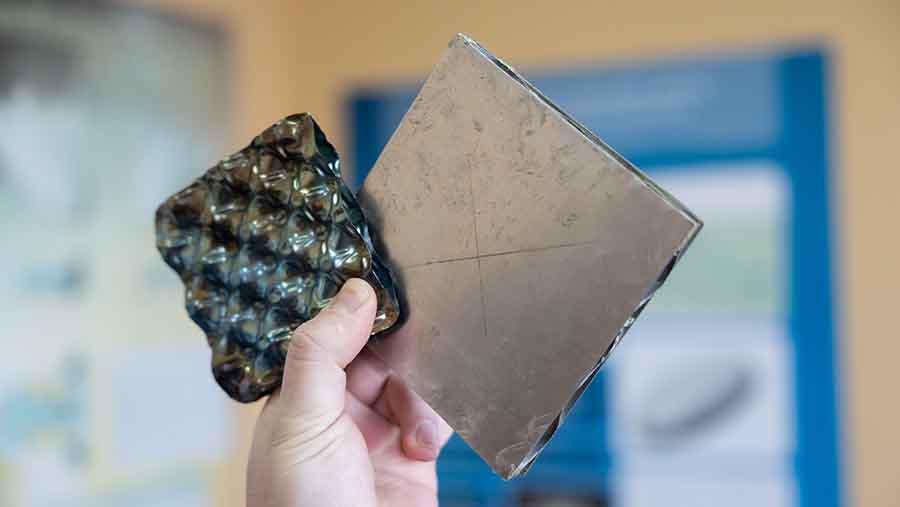
As the researchers explained, the development is based on a new filler —middle layer architecture in classic three-layer sandwich panels for aerospace engineering. Usually such panels consist of strong outer layers and a light filler between them. Most often, structures resembling honeycombs are used as such a filler. This design makes it possible to provide strength, insulation and sound absorption with low weight.
— But this kind of material also has drawbacks. Condensation often accumulates in the honeycombs. In addition, such panels are vulnerable to high temperatures and mechanical damage. Solving these problems, the researchers proposed an innovative filler structure. The new shape is vaguely reminiscent of egg packaging, but with a carefully calculated geometry. Such a structure provides high strength, and its internal space can be used for the circulation of liquid or gas that dissipate heat from the heated elements," Anton Volkov, associate professor and engineer at the Department of Design and Durability of Aviation, Rocket and Space Products at MAI, told Izvestia.
According to the expert, the proposed solution is especially relevant for heat-loaded structures, such as reusable rocket systems that heat up to extreme temperatures when entering the atmosphere, as well as for supersonic and hypersonic aircraft.

According to a similar principle, the cooling system of the Starship rocket body works, where the circulating liquid dissipates heat. Our three—layer panel solves the same problem, but at the same time retains all the key advantages of classic honeycomb or foam fillers - rigidity, strength and low weight, explained Anton Volkov.
He stressed that in the proposed structure, the shape and pitch of a typical cell are not fixed, but vary depending on the design loads. This is easy to implement in the manufacture of panels using 3D printing methods. This approach allows you to strengthen or weaken the structure where required. This opens the way to creating more efficient aerodynamic shapes that are not limited by the classic "tube-wing" scheme. For example, for gliders of the "flying wing" type.

How hypersonic missiles withstand high temperatures
— The issues of effective thermal protection of devices are always acute. They require exceptional efforts by engineers, since an increase in the working conditions of the material for every 100-200 degrees entails the creation of new substances and coatings. At the same time, it is important that innovations do not lead to deterioration of other characteristics," Andrey Novikov, a leading engineer at the NTI Center for Digital Materials Science: New Materials and Substances at Bauman Moscow State Technical University, told Izvestia.

According to him, the most obvious areas of application of the development are the military sphere and rocket and space technology (primarily, returnable stages). But when implementing innovations, problems may arise, mainly in the field of research and diagnostics. For example, it will be necessary to decide how to recreate the actual operating conditions during the tests, or how to develop mathematical and physical models and confirm their correctness.
— The potential of the development is high, but its real value will be confirmed only when scientists prove the strength of the connection of the layers and present a clear economic model of production. The invention should not only be effective "on paper" or in the form of a prototype, but also suitable for mass production. The aviation industry is conservative, and any innovation must be technologically advanced and easily reproducible at existing or prospective facilities," said military expert Dmitry Kornev.
According to the expert, there is a systemic risk of an "information gap" when design bureaus and research organizations work with closed data and specific alloys for hypersound. To ensure that the development of MAI does not turn out to be divorced from reality, university science needs close coordination with holders of secret technologies. The issue of cost also remains crucial.
— The development of MAI is a step forward for hypersonic vehicles like the Zircon or reusable rockets. Imagine: ordinary honeycombs in the aircraft skin are light, but at speeds of M > 5, heat up to 2,000 degrees melts them, and condensate corrodes them. The new "filling" passes through a cooling liquid or gas and removes heat. This makes it possible to reduce the total weight of the structure by 10-20%, eliminating additional thermal protective layers. As a result, the rocket can take more fuel or payload," said military expert Dmitry Boltenkov.

The expert pointed out that this is especially critical for hypersonic vehicles. Their nose and wings can withstand extreme overloads of over 10 free fall accelerations (10g) without deforming under the influence of high-temperature heating. Tests have confirmed that after 200 seconds in hypersonic flow, which must be sustained, the structure remains intact.
According to the expert, the new architecture is superior to previous solutions. For example, cellular fillers do not dissipate heat well and are vulnerable to moisture, and water-cooled systems, as in the American experimental X-43A hypersonic vehicle, are too heavy.
Переведено сервисом «Яндекс Переводчик»
