
Sea swarm: Canada is attracted to the confrontation with Russia in the Baltic

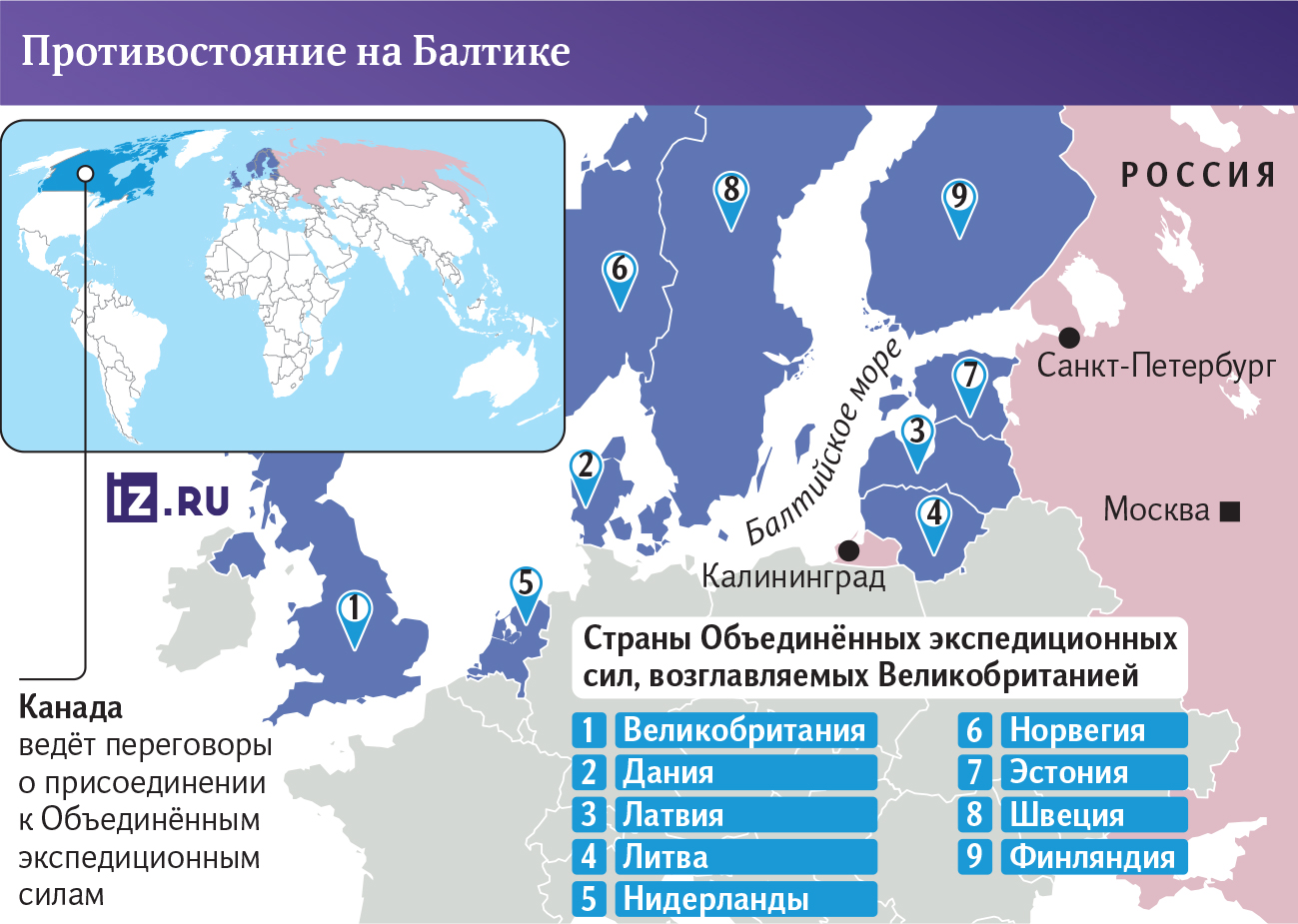
The West is following the path of escalation in the Baltic Sea — Canada is negotiating to join the Joint Expeditionary Force (JEF), led by Great Britain, Izvestia found out. The purpose of this association is to deploy troops in Northern Europe and the Baltic States in the event of a conflict, as well as to counter Russia in the Baltic. Canada can strengthen the marine and aviation component of JEF, experts say. This is happening against the background of rising tensions in the region: Denmark has tightened the rules for the passage of ships with oil from the Russian Federation, radical NATO representatives are demanding a complete blockade of the Baltic Sea. How Russia will respond to the strengthening of the alliance's position in the region is described in the Izvestia article.
Canada's role in the militarization of the Baltic and Arctic
Canada is negotiating with the United Kingdom to join the London-led Joint Expeditionary Force (JEF), Russian Ambassador to Ottawa Oleg Stepanov told Izvestia.
— It is known that the British have been vigorously pushing the Canadian leadership to join the Joint Expeditionary Force for a long time. The Canadians rejected the first such invitation. However, in the last few months, after Donald Trump came to power in the United States, the issue has revived again. And, according to leaks in the press, he allegedly even let it slip during the contacts of Prime Ministers Mark Carney and Keir Starmer. Ottawa is still not taking drastic steps, weighing the pros and cons, taking into account the American factor and NATO solidarity," the diplomat told Izvestia.

Stepanov stressed that so far the Canadians prefer to cooperate with the British on individual subjects in a bilateral format. For example, British crews are being trained to navigate in northern waters, and they are conducting joint research and development, in particular, on the topic of tracking the Arctic from space.

At the same time, Ottawa is also joining the initiatives of JEF. For example, the Canadian military participates in the Tarassis Joint Expeditionary Force exercises, which are held from September to the end of October. These are the largest unification maneuvers, which practice the rapid deployment of the corps in the context of a potential conflict in the Baltic States and Northern Europe.
The United Kingdom is working with its allies to develop a Joint Expeditionary Force, a representative of the British Embassy in Moscow told Izvestia.

"The UK remains committed to its role in ensuring security in the Baltic region through the Joint Expeditionary Force and our commitments to NATO. We continue to work closely with our allies to maintain stability in the region. We are working with our allies to develop the Joint Expeditionary Force as a capable and determined coalition committed to strengthening NATO's deterrent capabilities in Northern Europe and the Arctic region," the British diplomatic mission in Moscow said.
The Joint Expeditionary Force (JEF) was established in 2014 at the initiative of the United Kingdom. At first, the participants were Great Britain, Denmark, Latvia, Lithuania, the Netherlands, Norway and Estonia. In 2017, Sweden and Finland joined them. The reason for the creation of a new regional military format was the entry of Crimea and Sevastopol into Russia and the conflict in Ukraine after the Maidan in February 2014. Although the corps operates outside the NATO command structure, it is designed to complement the alliance.

At the same time, until 2022, this format existed rather on paper, and the idea of creating JEF was initially to facilitate the deployment of European military forces for peacekeeping and humanitarian purposes. After the start of the CDF, the situation changed and the Joint Expeditionary Forces became one of the main tools of confrontation with Russia. His tasks include protecting the NATO infrastructure in the Baltic and Arctic, and monitoring tankers transporting oil from the Russian Federation. In addition, it is the JEF countries that, according to NATO plans, should confront Russia in Northern Europe and the Baltic States.
Ottawa's connection to JEF is connected not only with the notorious Euro-Atlantic solidarity, political analyst Denis Denisov said in an interview with Izvestia. According to him, Canada has the resources, as well as the capacity to produce weapons related to the navy. The latter factor is extremely important for the participants of the Joint Expeditionary Forces, since there are few countries with developed navies among them.

Ottawa can really seriously strengthen the marine component of JEF. Canada is already sending its warships to the permanent NATO naval groups that operate in the Baltic, the permanent NATO Mine Action Group 1 (SNMCMG1) and the 2nd Permanent NATO Naval Group (SNMG2), the director of the Center for Foreign Regional Studies and Regional Studies of the I. Kant BFU explained to Izvestia. Yuri Zverev.
"The Canadian Aviation Task Force, based in Prestwick, UK, provides logistical support to Operation Reassurance and several other Air Force operations around the world," the expert noted.

According to him, the expansion of the military presence of unfriendly countries (albeit formally outside the framework of NATO) does not improve the military-political situation in the already tense Baltic region and creates a potential threat to Russia. We are talking about both the possibility of provocations (damage to the underwater infrastructure, the launch of "unidentified" drones in order to blame our country for these actions) and piratical actions against ships transporting Russian oil and petroleum products. Accidental incidents at sea and in the air cannot be ruled out.

The situation in the Baltic Sea
Meanwhile, NATO is strengthening its presence in the Baltic Sea in order to disrupt Russian trade. For example, since October 6, Denmark has decided to tighten the rules for the passage of oil tankers through its territorial waters. Izvestia previously wrote that Copenhagen is also preparing for military measures — the landing of security and detention groups is being practiced.
Since July 1, Germany has strengthened control in the water area — now passing ships will be required to provide information on insurance coverage in case of damage from oil pollution, the country's Foreign Ministry reports. Together with Sweden and other allies, Berlin intends to block the passage of tankers that are allegedly used to transport Russian oil, bypassing sanctions.

Militarily, the alliance has launched the Baltic Sentry program, its goal is to detect ships and control their movement. All this makes navigation in the region difficult, threatening the safety of ships. In the summer, the North Atlantic Alliance sent 45 robotic vessels to the region. Constant maneuvers also serve as an opportunity to work out the blockade of the Baltic Sea for Russian ships.
In this context, it is also important that Canada increases its military presence in Eastern Europe. In August, Canadian Prime Minister Mark Carney visited Poland, where the two countries signed a two-year action plan, which, among other things, involves the creation of joint defense enterprises. And after visiting Riga, the head of the Canadian government promised to increase the number of military personnel permanently stationed in Latvia to 2.2 thousand by 2026.

Canadian Prime Minister Mark Carney and Polish Prime Minister Donald Tusk during a meeting. August 25, 2025
— Playing on external and internal audiences in pursuit of ratings, Mark Carney's cabinet claims that their country can supposedly exist without the Americans and even replace them in terms of defense and security, including the military industry. Hence the demonstrative steps like the cooperation agreement with Poland and statements about joining the European ReArm Europe rearmament program," said the Russian Ambassador to Ottawa.

In practice, the implementation of such initiatives faces the undercover protectionism of the EU countries. The Europeans have their own defense enterprises that do not want to share their profits with anyone. In addition, there is well-established cooperation with American military-industrial complex companies. The Canadians are competitors rather than partners here, Oleg Stepanov said.

Bastion coastal missile systems during missile strike training against imaginary enemy ships in the Kaliningrad region
In these circumstances, Russia is taking measures to maintain the combat readiness of its Baltic Fleet. In June 2025, as part of the planned exercises, the calculations of the Bastion coastal missile systems (DBK) of the Baltic Fleet during the planned exercises practiced striking supersonic Onyx missiles from the Kaliningrad coast at sea targets. In addition, the Baltic Fleet practiced actions to repel attacks by unmanned enemy boats. And the units of the Marine Corps of the Baltic Fleet at the training ground in the Kaliningrad region successfully completed the tasks of anti-amphibious defense and amphibious landings on the unequipped coast.
Переведено сервисом «Яндекс Переводчик»
