Why is power being changed through coups in African countries? Analysis


In Guinea, where a military coup took place in 2021, the first presidential elections since then were held on December 28. And in Guinea-Bissau, in November, an elected president, Oumaru Sisoku Embalo, was overthrown in a coup. General Horta N'tama will rule the country as head of the transitional government for a year. At the same time, this is the second coup on the continent in the last two months. Why democratic institutions are not working in African countries, and the military is seizing power, is in the Izvestia article.
Military coup in Guinea-Bissau
• President of the Republic Oumaru Sisoka Embalo was arrested on November 26 before the announcement of the results of the elections, which took place three days earlier. Embalo announced his overthrow personally in a telephone conversation with representatives of the press. The coup was carried out by the republic's military forces, who accused the president of intending to destabilize the situation in the country.
Oumaru Sisoku Embalo was first elected president of Guinea-Bissau in 2020, and in 2022 the first coup attempt took place, and the government deployed tanks to suppress the rebellion. Guinea-Bissau has been facing political instability since gaining independence from Portugal in 1973. Only the previous President of the Republic, Jose Mario Vache, served a full five-year term in office.
Guinea-Bissau is one of the five poorest countries in the world. In 2024, the national debt of the country in relation to GDP amounted to 82.21%. Despite the presence of minerals, agriculture plays a key role in the economy — more than 90% of the country's exports are cashew nuts. The main buyers are India, Belarus and Ghana.
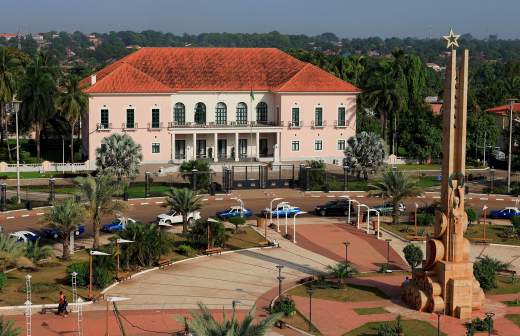
• Since 1973, the republic has maintained diplomatic relations with Russia (at that time the USSR). President Embalo arrived in Russia in 2022 as chairman of the Economic Community of West African Countries (ECOWAS), and even expressed a desire to mediate between the leaders of Russia and Ukraine. At the same time, analysts emphasize that Embalo adhered to a pro-Western vector in his policy.
• Guinea-Bissau is called the world's first drug state where the entire ruling elite is involved in the cocaine trade. The country is a key point on the path of drug trafficking from Latin America to Europe, and drug trafficking, according to various estimates, can double the GDP of the republic.
Causes of coups
• Since 2020, African countries have experienced more than a dozen military coups. The former French-speaking colonies in West and Central Africa and the Sahel states, where a military junta comes to power as a result of coups, are the most unstable. Due to the numerous military coup attempts in these countries in 2023, the region was also named the "coup belt".
The Sahel is an African arid region between the Sahara desert in the north and the fertile lands of the southern region, which stretches from Senegal to Ethiopia and Kenya. On the map, the Sahel seems to encircle the continent.
• The legacy of European colonialism is cited as one of the reasons that prevented African countries from forming stable institutions for the transfer of power. Of the 62 States and dependent territories in Africa, only Ethiopia and Liberia managed to avoid colonization. The countries of the continent began to gain independence relatively recently — in the middle of the last century, and the process of decolonization of Africa ended in 1990 with the recognition of Namibia's independence.
• The Europeans did not delve into the situation within the countries, the ethnic characteristics and needs of the people inhabiting the continent. States were created artificially, uniting warring nations on the same territory for years. In particular, the discriminatory policy of the Belgian colonial authorities towards Tutsis in Rwanda was one of the reasons for the genocide of this people in 1994.
• The colonialists not only siphoned resources from Africa, but also managed them without taking into account the geography of the continent. Thus, the Anglo-Egyptian agreement of 1929 secured for Egypt the preferential right to dispose of the waters of the Nile, depriving the countries of the upper basin (Ethiopia, Uganda and Kenya) of the opportunity to build hydraulic structures without the consent of Cairo, as a result of which these countries were forced to suffer from droughts and floods.

• European metropolises continue to maintain ties with their former colonies and access to their resources, as well as influence the political situation and support the most liberal candidates for the country's leadership. But democratic politicians are not always supported by the population — they cannot solve problems with poverty, banditry and terrorism, and dissatisfaction with their work provokes military coups.
• After the colonists left, new players flooded into Africa, provoking instability in the region. In addition to Islamist terrorist groups, African governments have to deal with militants sponsored from abroad. In 2024, three Sahel states at once — Mali, Senegal and Burkina Faso — accused Ukraine of violating sovereignty and sponsoring Tuareg militants.
What Africa needs
• Despite the negative effects of outside interference, the removal of external leadership alone is not enough to build sustainable civil society institutions in African countries. Experts draw attention to the fact that the poverty of the population and the lack of education leave no chance for States to provide competent leadership.
• Unlike Western countries, Africa has a predominantly young population, but there is no job for them. Instability on the continent scares away foreign investors, and there are very few own production facilities in African countries: these are often agricultural countries, and their economies directly depend on weather conditions and the scale of the harvest.
• In order to turn the situation around, Africa's governments need reforms from within. First of all, they should be aimed at creating political stability, providing high-quality education and conditions for attracting investors and foreign specialists.
During the preparation of the Izvestia material, we talked and took into account the opinions of:
- Nikolay Topornin, international lawyer and Director of the European Information Center;
- Alexander Biryukov, Vice-President of the International Organization of Eurasian Cooperation for Cooperation with African Countries;
- political analyst Andrey Shkolnikov.
Переведено сервисом «Яндекс Переводчик»
