
Wizards in law: retired accountant decides the fate of the universe

Writer, poet, musician and mystic Mikhail Elizarov has returned with a new novel in which he turns the fabric of reality inside out again. Critic Lidia Maslova presents the book of the week specifically for Izvestia.
Mikhail Elizarov
"Vale"
Moscow: AST publishing house: edited by Elena Shubina, 2025. 474 p.
"Vale" is announced as a "quasi-religious treatise", which can be seen as a shade of irony, but nevertheless it is an accurate genre definition: the "main universal mystery" played out in the novel, heavily mixed with everyday metaphysics, uses the "Revelation of John the Theologian" as a plot basis. One of the many colorful characters, a foolish inhabitant of the urban outskirts, even has the nickname Lesha Apocalypse and speaks exclusively in the style of "Revelation": "And I saw a store about fifty paces long and wide. And its walls and doors were like clear glass, and it was full of Zhiguli drink in emerald-colored vessels, and unrighteous wives worked there, and they were given the right to sell food at the state price, and they let them go, and the most scarce products were pushed out the back door at a price that was overestimated by half." Elizarov has already tested this method of combining Soviet everyday life and infernal metaphysics well in the story "Sledge", where the declassified sorcerer is endowed with a divine nature, giving rise to a specific comic effect.
This principle is consistently developed by Yudol, which begins very intriguingly: "Immediately after retiring, Andrei Timofeevich Sapogov decided to sell his soul to Satan. And before that, I spent forty years sitting in my pants in the outskirts of Sobes." To make friends with Satan (the "international Satanism movement" is recognized as extremist in Russia and is prohibited), it is necessary to return to him his finger, which leads a dreary existence on the hand of an 11-year-old boy without a Bone: "Many people think that the finger of the Bone is withered, but this is not the case. It can bend slightly, and on it, slowly, like a dwarf tree, a nail continues to grow, resembling a curved bird's beak." The existence of Satan himself is no better, who, in the form of a low coprolite idol stolen from the Serpukhov Museum of Local Lore, is waiting in the wings (or rather, his finger) in a shabby Khrushchev on Pilot Nesterov Street.
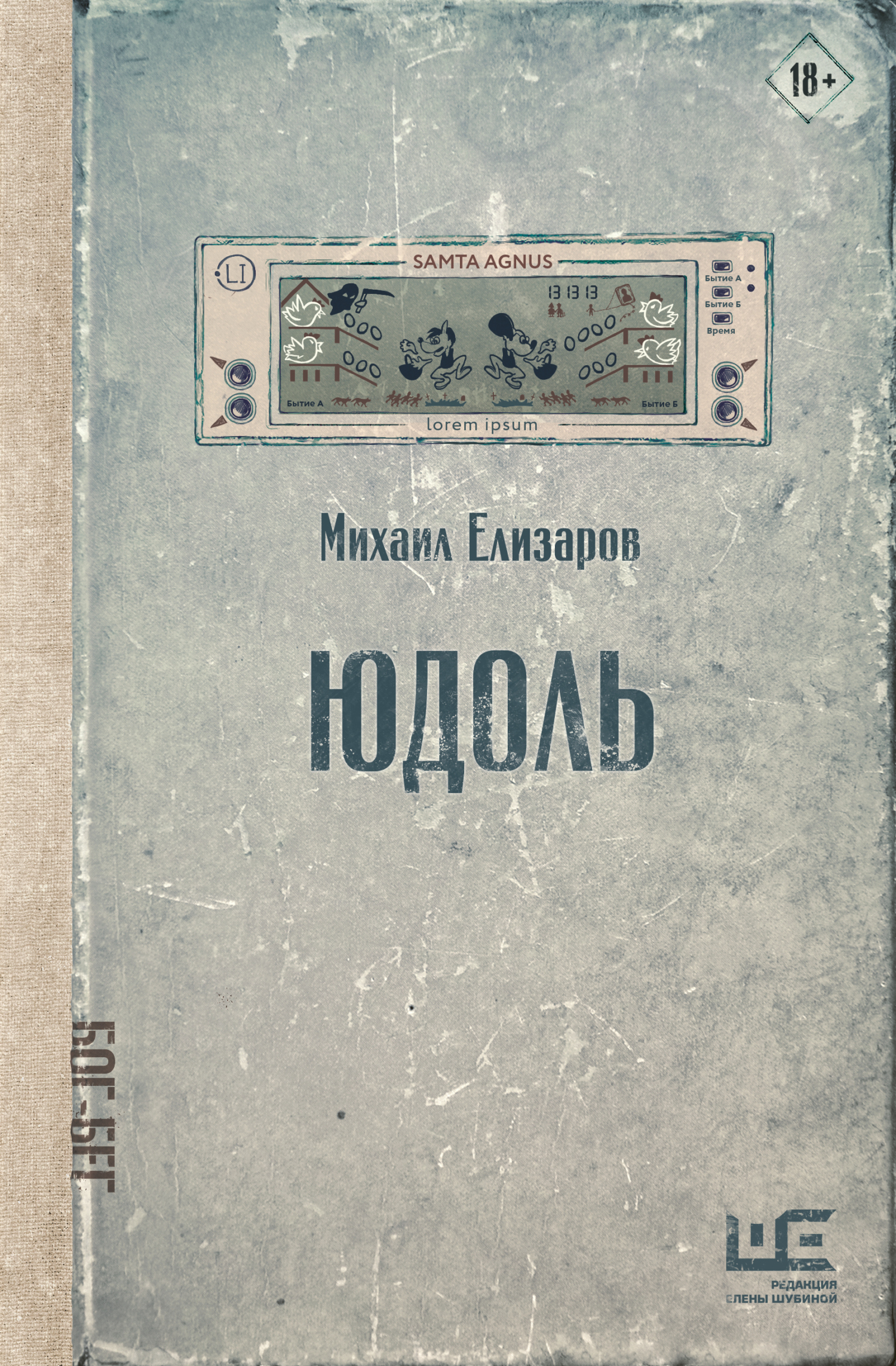
However, Elizarov's Satan is unlikely to be able to consciously wait for something, since he is "not a Self, but an exoskeleton (an instrument of mystical warfare, a transmitter and an aircraft, given the presence of wings) through which a Super-Being, which for a change can be called the Devil, embodies itself in the outside world, a material hypostasis. It would not be a mistake to say that the Devil (Lucifer) resides in Hell, which is also Satan, but specifically the external Satan is not the Devil in any way." Satan, who was cast down from heaven, "was damaged during landing and therefore performs his combat functions only to a limited and partial extent until he regains his integrity." All these nuances are explained to the former accountant and aspiring Satanist Sapogov by the witcher Prokhorov, who will soon become his main competitor and opponent. One of the best action scenes in "Vale" is a duel between them, or rather, a battle in which the main weapons are the magical dactyl, anapest, chorea and amphibrachium: "A firecracker exploded in grandpa's heart, is a myocardial infarction coming?!"
"Vale" draws the reader into a visionary chronotope that is as complex as a maze, where the plot often branches out and changes from a direct movement to a retrograde one, an episode written in the bloodiest realistic colors suddenly turns out to be a hallucination, one location transforms into another and back, and characters can exist simultaneously in two parallel dimensions, where they have a completely different appearance.. The impressive volume of the novel sometimes makes it possible to interpret and explain these bizarre special effects in too much detail and verbosity, but in general it is clear and clear to explain and explain these bizarre special effects, not only from a religious and philosophical, but also from a scientific and technological point of view. For example, an important cross-cutting metaphor is the "lenticular seal", which allows you to see on one icon "Well, wait!", which Kostya wears, then a hare, then a wolf, depending on the angle of view.

A shimmering, illusory, "lenticular" existence is also inherent in the storyteller, on whose behalf the story is being narrated and who may not appear for a long time, so that you even forget about him, but then he suddenly reveals himself as "sweetheart" or "my swallow." Sometimes it looks like an annoying glitch in the story that captured you, but Elizarov explains that this is not a mistake by the author, but a well-thought-out writing strategy: "If anything, honey, this is the so—called retardation - a stylistic device for deliberately slowing down the narrative. Retardation is present in folklore, for example, in epics, fairy tales, where the pure plot has a gulkin's nose; hence the fractal pattern of the narrative with its frequent refrains and self-repetitions. Well, at the same time, retardation is indispensable for whipping up the notorious suspense. But have you ever heard of this, my beloved fool?.." This phantom "fool" often allows the narrator to conveniently include irony and self-irony when the reader is ready to get tired and bored.

The novel's intriguing and meaningful title, which evokes rather sad associations (in the sense that "earthly vale" is a place where you have to endure a lot), in Elizarova's deft hands plays not only with disturbing apocalyptic, but also humorous shades. For example, when a new department head appears in the plot at Kostya's mom's place, Yudol Mansurovna, but the narrator advises not to have too much fun: "It used to be possible to laugh a lot that dad's colleagues were called Vladimir Volkovich, Olga Zaitsevna — a funny "Well, wait!" But Yudol Mansurovna is a terrible omen of the coming universal catastrophe."".
Since many of the most active characters in the novel are witches, warlocks and necromancers, The Vale is also a detailed encyclopedia of magical practices, the musical epigraph to which could be the composition "Necronomicon" written by Elizarov, which is very close to the Vale in mood and energy. Some of the witchcraft and necromancy techniques and principles described in the novel are quite well known, and some, of course, were invented by Elizarov himself with devilish ingenuity and satanic humor: "Someone said that instead of cursing the Creator, they sang Pugacheva's song "Summer" in church, and it seemed to have a powerful effect of blasphemy."

With particular pleasure, the theme of the similarity between sorcerers and criminals is played out in every possible way in the "Vale": "The closest parallel to the world of witchcraft is a criminal environment in which respected individuals are thieves, and other fraera, men are varieties of subhumans. So for black magicians, the ordinary population of the Earth is a submissive herd, cattle, and the right "people" are exclusively magical "inhumans." But still, the main dichotomy of the novel is not sorcerers and "ordinary people", but the dichotomy of Being and Being, Kant's noumena and phenomena, shallow reality perceived by the human brain, and transcendent, divine Deep Reality. Based on this, through the mouths of his fantastic characters, Elizarov explains the mechanism of human perception on his fingers, so that even the boy Kostya can understand it ("The universe arises under the gaze of God. And your mind is already building a three-dimensional hocus pocus out of the noumena of Deep Reality...") and compares our consciousness with the insidious wizard Goodwin: "The mind, baby, is the same deceiver. It is only a small part of the repository of reflexes and personal memory. In its main function, it is a mental optical device. Let's call it a phenomenoscope..."

In the finale of the novel, the phenomenoscope, in the spirit of Elizarov's favorite verbal games, turns into a Phenomeno-Bishop, and the author-narrator, although the world seems to be saved (and the vale, that is, the end of the world, is postponed until the next time), falls into a pleasant state of bright sadness due to the unknowability of the surrounding world and the inability to see it the meaning is simple human vision: "It doesn't matter what kind of sawdust to stuff the printing layout of this world. The Phenomeno-Bishop created Existence in such a way that everyone who lives contemplates pictures and forms without being distracted by the meaning that is missing."
Переведено сервисом «Яндекс Переводчик»
