Studio Echo: Vitaly Pushnitsky's retrospective is dedicated to waiting


The artist as a hero and the space of an 18th—century manor as a continuation of paintings. At the Museum of Architecture named after Shchusev's exhibition "Studios. Waiting" by Vitaly Pushnitsky, one of the most famous and sought-after Russian painters. The entire suite of the second floor of the historic building on Vozdvizhenka is devoted to the only series of works by Pushnitsky, which he created for more than ten years. And such a scale is commensurate with the scale — physical and philosophical — of art itself: multi-meter canvases send the viewer on a journey from poetic urban ruins to a metaphysical uninhabited island. Izvestia was among the first to embark on the voyage.
The architecture of creativity
St. Petersburg artist Vitaly Pushnitsky received a classical education (graduated from the Repinsky Institute) and began his creative career back in the early 1990s. But he became widely known in the 2000s: then his projects took place both abroad (in the USA, France, India, etc.) and in Russia, and in landmark institutions. It is enough to mention personal exhibitions at the Russian Museum (2002) and the Hermitage (2006). The last current retrospective was held at the Moscow Museum of Modern Art in 2012. And although Pushnitsky's reputation as one of the brightest representatives of his generation has only strengthened since then, and his demand among collectors has increased (his large-format works are sold at auctions for millions), there have been no solo "sayings" in major state museums.
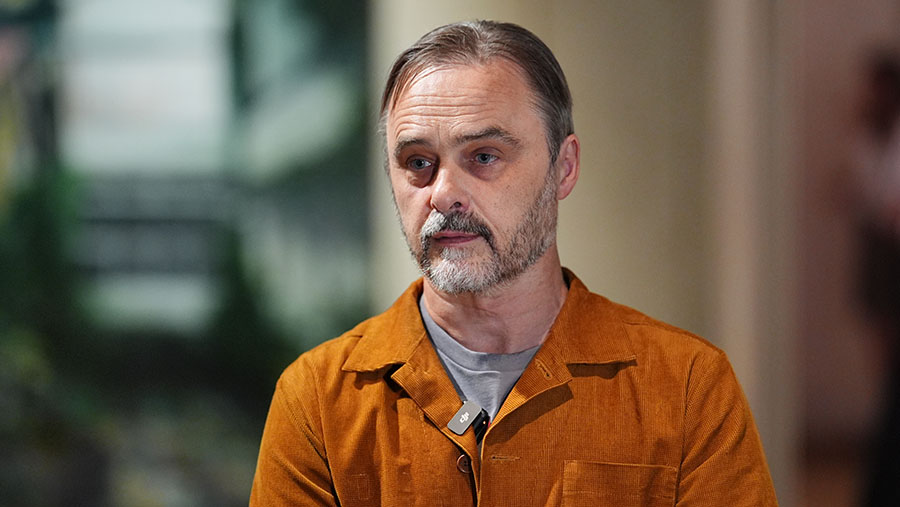
However, the pop/off/art and Marina Gisich Gallery, representing him, regularly showed Pushnitsky's new cycles — for example, the Island project at Vinzavod (the artist's book Friday was published to him, which Izvestia wrote about), a large generalization, summing up the work over the years. Since 2012, there has clearly been a shortage. Now this omission has been corrected, and in a better way.
First, a landmark location was chosen: the historic Talyzin estate, a stone's throw from the Kremlin, now a Museum of Architecture. And secondly, this is not just a "creative report", where there is a little bit of everything, but a whole, conceptual story, elegantly rhymed with the space itself.
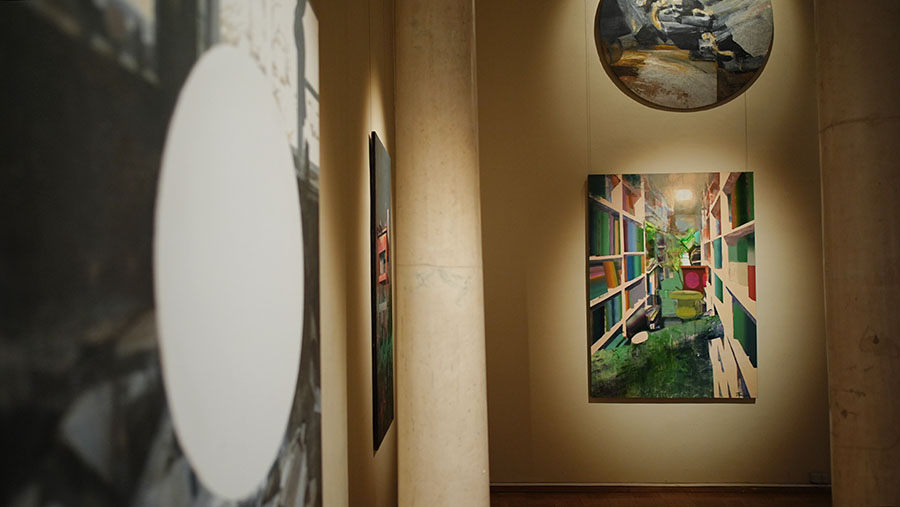
All the items presented here (from three dozen Russian museum and private collections, including the aforementioned galleries that acted as organizers) are included in the Studio macro cycle. It refers, in fact, to studios, that is, the places of work of painters. Hence the constant motif: the easel. However, the drawing process itself is not shown to us. Instead of action, there is endless waiting. Pause. In addition, objects from the artist's studio appear in a variety of, sometimes phantasmagorical contexts.
Melancholy ruins
Here is a government-owned room like a school classroom or a tax office. But books are stacked in chaotic piles, papers are piled in a pile, the walls are covered with ivy, and the floor has been turned into a green pond. How did the oil machine end up here? Let's move on. Now the creator's working tools end up at a village house, either unfinished or, on the contrary, dilapidated. A man stands with his back to us in front of the boarded-up windows. The artist himself? In the following halls we will see a lot of mysterious abandoned interiors, whether they are aristocratic houses, halls with multi-meter ceilings or ordinary apartments.
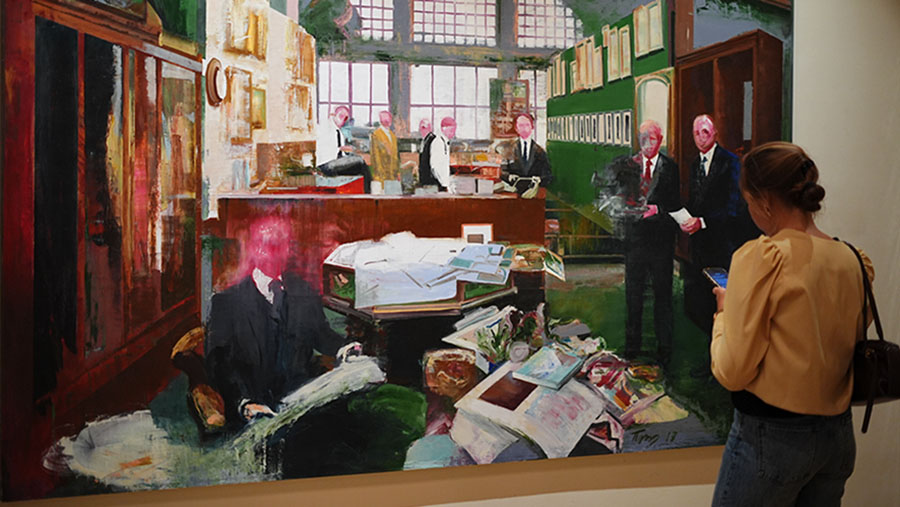
The post-Apocalypse world at Pushnitsky is, of course, poetized. And in many of the early works of the cycle (2010s), he is close to another master of his generation, Valery Koshlyakov. He also likes to paint some ancient Roman ruins, deforming the image with streaks, as if the canvas itself stood under the leaky roof of an ancient building and was damaged by rain.
However, drawing a parallel with Koshlyakov, it is worth talking about their common roots rather than their influence. In this case, this is Hubert Robert, and indeed painting at the turn of the XVIII–XIX centuries, when it became so fashionable to depict ancient ruins, combining admiration for classical architecture, landscape idyll and romantic melancholy. One of the most spectacular things in the Pushnitsky exposition looks like an homage of that era: a video blue sky is projected onto a canvas depicting antique columns, through which the sun passes. And we recall the tradition of transparent painting that appeared more than two centuries ago, just in the era of early Romanticism: artificial light sources were placed behind canvases, usually imitating the moon, and the image acquired a mystical mystery.
Oil on canvas
Pushnitsky's exhibition, this imaginary travelogue of the artist, for all its stylistic solidity, can also be considered as a journey through the epochs, through the history of art. From antiquity and romanticism to Gerhard Richter with blurred semi-abstractions and David Hockney with his cartoon pools of sky blue. At the same time, Francis Bacon, Yuri Cooper, Andro Vecua and even Damien Hirst come to mind: in one of the paintings, Pushnitsky placed a real natural sponge instead of the character's face. But whether the eccentric move was prompted by the acclaimed Hearst project in Venice (Treasures from the Wreck of the Unbelievable), where many marble and malachite sculptures allegedly recovered from the seabed were overgrown with corals, is not so important. After all, unlike the British provocateur, who has been masterfully shocking the public for several decades, Pushnitsky is a really good painter. And his art is academic in a good way: almost all the exhibits are the most traditional in technique. Canvas, oil.
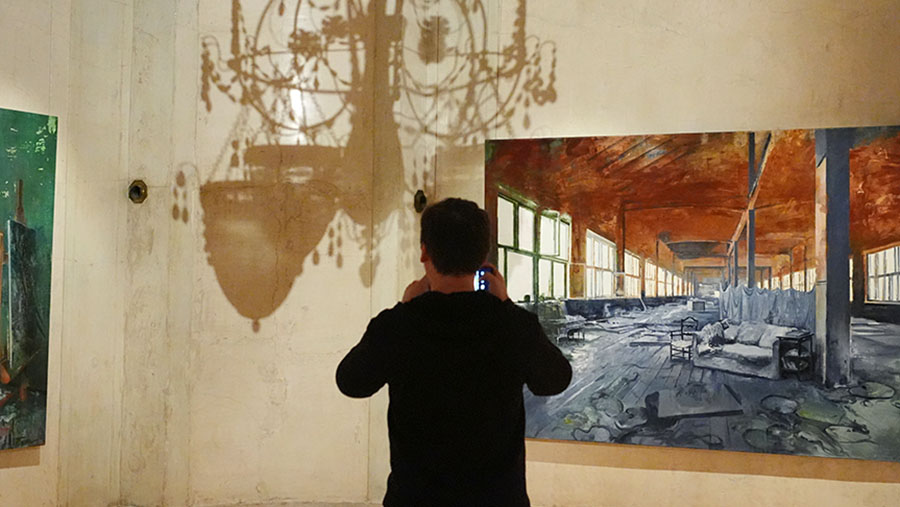
Perhaps that is why the works look so organically in the space of an 18th-century manor. Moreover, the curator Ksenia Malich was able to discover unexpected rhymes between the interior and painting. So, Pushnitsky's tondo (paintings in the shape of a circle) echo the round historical bas-reliefs under the ceilings; the natural shadows from massive chandeliers enter into a dialogue with the decorations depicted on canvases; and the real cracks on the walls seem to be a continuation of the painted branches of trees. At some point, it seems that the very suite of the museum has descended from Pushnitsky's canvases - or, on the contrary, painting is an integral part of it.
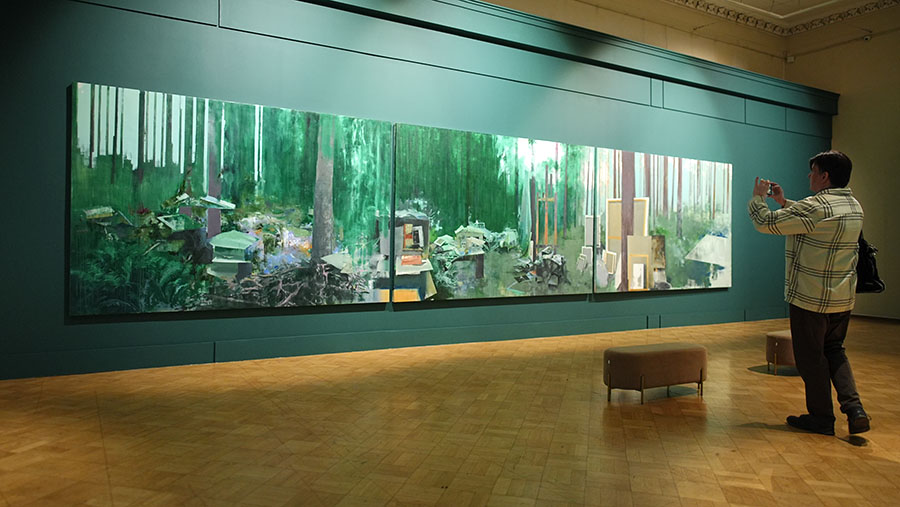
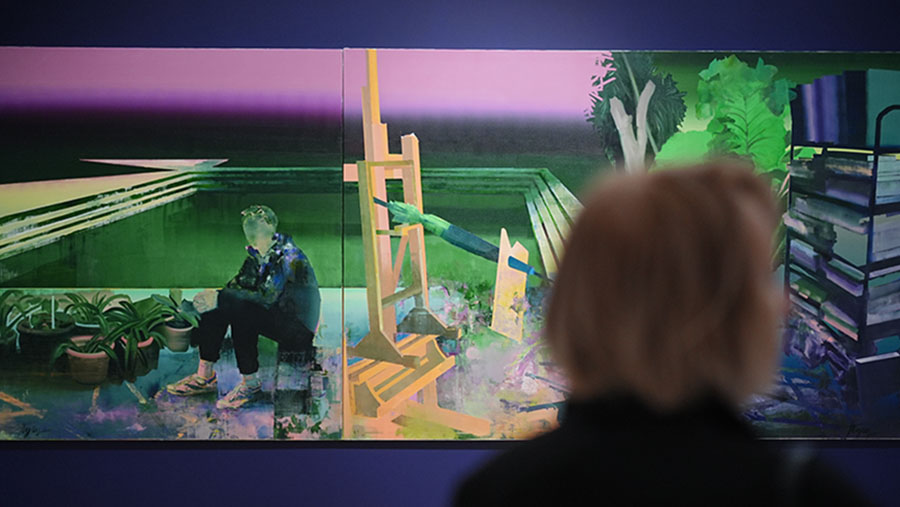
And that's why the finale of the journey makes such a strong impression, the multi-meter canvases forming into a single panorama in the viewer's mind. We are moving away from images related to interiors and architecture. And we find ourselves in a tropical forest, on an uninhabited island, where by some miracle there were both books and the painter himself. But all these landscapes are fake, as if generated by a broken neural network. And the hero, like a man from computer games, is stuck in 3D textures. Behind it is an unnatural acid pink sunset (aka sunrise). There are pots of flowers at her feet: you can't tell if they're artificial or not. This is probably what limbo should look like for the souls of the Internet age. Well, if these souls are creative artists, let there be an easel nearby...
Переведено сервисом «Яндекс Переводчик»
