Iran's supreme leader called it unwise to negotiate with the U.S.

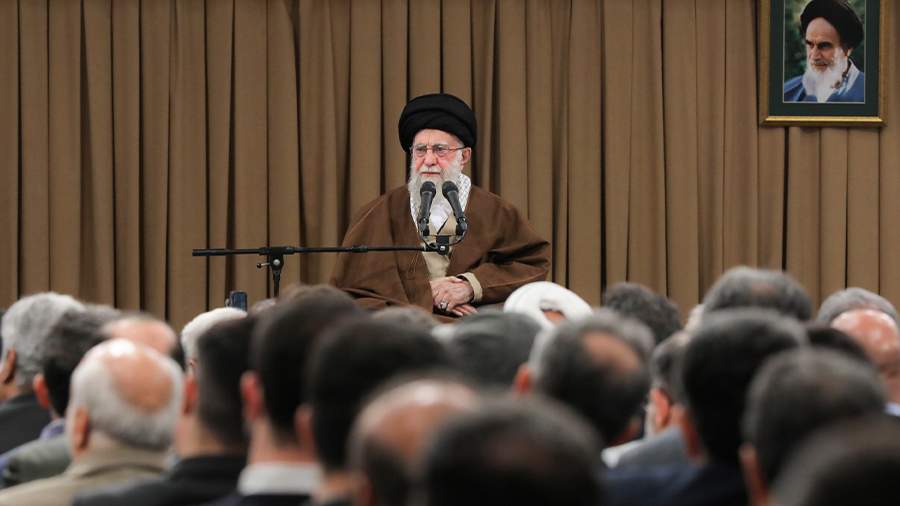
Iran should not negotiate with the United States, this idea is unreasonable. Supreme Leader of the Islamic Republic Ali Khamenei said this on February 7.
"One should not negotiate with such a government - it is unreasonable, unwise and dishonest," he said before a group of servicemen in Tehran. His words were quoted by Iran International TV channel.
According to him, the Americans are "sitting and redrawing the map of the world on paper." He also warned Washington of Tehran's retaliation if the country's security is undermined.
"They make statements about us, express opinions and threaten us. If they threaten us, we threaten them. If they act on those threats, we will do the same. If they undermine the security of our country, we will certainly respond to them in the same way," the Iranian supreme leader said.
Khamenei also rejected the idea that talks with the United States could ease Iran's economic problems.
"Negotiations with the US have no impact on solving the country's problems. We should understand this correctly and not delude ourselves into thinking that by sitting down at the negotiating table with this government we will solve certain issues. No, negotiations with the United States will not solve any problems," Khamenei summarized.

Earlier on February 4, US President Donald Trump signed a national security memorandum that he said puts "maximum pressure" on Iran's nuclear program. He noted that Washington cannot allow Tehran to have and build nuclear weapons. The Islamic republic's Foreign Minister Abbas Araghchi called Trump's fears of nuclear weapons production futile as the country is committed to its non-proliferation treaty (NPT) and Iran's current religious ban (fatwas) on the activity.
The Axios portal reported on Jan. 2 that then-former U.S. leader Joe Biden had discussed with his national security team plans for a possible strike on Iran's nuclear facilities. Araghchi, for his part, then called possible attacks on the facilities in question the biggest mistake in world history. He also warned that Iran would retaliate in the event of a strike.
Previously, The Wall Street Journal reported on December 13, 2024, that Trump was considering pre-emptive airstrikes on Iran to prevent the Islamic Republic from developing nuclear weapons.
Also, Iran has repeatedly sent signals to the U.S. about the possibility of dialogue on the nuclear program, hoping to ease Washington's sanctions pressure, which has worsened the situation in the country's economy. At the same time, the Foreign Ministry of the Islamic Republic said on January 29 that the country had not received signals from the U.S. side about resuming negotiations on the issue. The Joint Comprehensive Plan of Action (JCPOA) or nuclear deal was signed in 2015 by Russia, Iran, the United States, Britain, France, China and Germany. In 2018, the states under President Trump's first term unilaterally withdrew from it.
Переведено сервисом «Яндекс Переводчик»
