Flowers and lives: from still lifes to the fate of artists


Flowers in the Tretyakov Gallery, Madonnas in the State Museum of Fine Arts, modernists in the Museum of Russian Impressionism and the "souls of things" in AZ/ART. The capital's art institutions have prepared thoroughly for the summer: viewers who are hungry for beauty have plenty to choose from. Izvestia evaluated the most notable art projects available to Muscovites and visitors during the holiday season.
Flowers. A symbol of beauty
Tretyakov Gallery
The exhibition in the new building of the Tretyakov Gallery on Kadashevskaya Embankment opened at the end of May, and yet hardly anyone can compete with it for the title of the most popular summer exhibition. The point is not only that it will work all season and even in early autumn, but above all in the theme itself. It is easy to guess that the focus here is on still lifes, and very different ones: from impressionistic bouquets by Konstantin Korovin, Alexander Golovin, Igor Grabar to avant-garde compositions by Natalia Goncharova, Olga Rozanova, Aristarkh Lentulov; from images of specific plants to interior and genre compositions in which elements of flora perform only an auxiliary function.
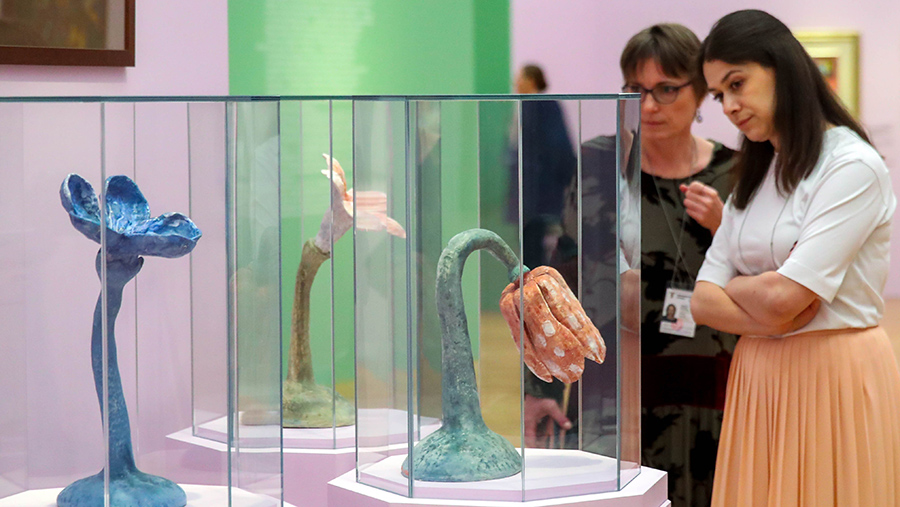
The architecture of the exhibition is built in the image of a daisy, where the "petals" contain Art Nouveau and avant—garde art, grouped according to a thematic principle (although this is often very conditional), and the central "stem" is dedicated to images of bouquets made by artists of the previous era. Perhaps many viewers will be surprised by the works of Ivan Kramskoy and Isaac Levitan presented here: these impressionistic decorative compositions are not at all what we are used to seeing on the canvases of realists.
There are a lot of works at the exhibition that are little-known, but at the same time bright and eye-catching. These are the air—mystical "Spanish Woman in White" by Goncharova from a private collection, landscapes by Maria Yakunchikova-Weber carved on wood, a series of ornamental watercolors by Elena Polenova, early works by Mikhail Larionov (especially his fantastic "Lilac", painted with strokes flying in one direction, creating a feeling of some kind of cosmic flow)... The list goes on.
And even if the exhibition does not have a complete drama and there is no scientific know-how behind it, it seems to encourage us to take a trip to the museum a little easier and enjoy the beautiful, walking freely through the halls, as if through an endless field of flowers.
Anya Acorn. The wrong horizon
AZ/ART
The summer exhibition of the AZ/ART Center for Contemporary Art, unlike the previous project of our review, does not set up relaxation and even admits a tragic note. But who said that art should only delight and entertain? A monographic project dedicated to the artist Anya Acorn could not be fun, if only because it is dedicated to the anniversary of the artist's death. Moreover, her death was, of course, premature, and the life that preceded it was full of suffering.
One of the most talented, idiosyncratic, vividly individual authors of the generation of 40-year-olds, Anya has been retreating deeper into herself in recent years, distancing herself from the world until she became a complete hermit and plunged to the very bottom of depression. But do not think that all her art is imbued with the mental pain that the artist herself experienced. Rather, on the contrary: it's lyrical, sometimes ironic, and it has that kindness and tenderness that, apparently, Anya missed so much from the outside world.
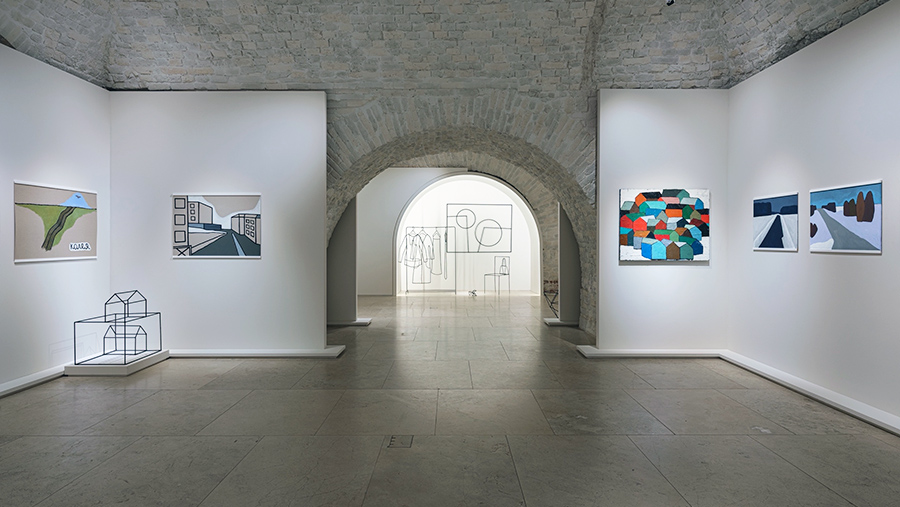
Her signature technique was the creation of interior items from black metal wires and rods. It looks as if objects (irons, hangers, chairs, tables) have only contours left, and the rest has disappeared... For all the apparent obviousness of the idea, it opens up a huge space for interpretation, reflection, and reflection. Are these ghosts of things? Or, on the contrary, meaningless shells symbolizing the ephemerality of existence?
At the exhibition, however, there are not only objects, but also works on canvas and on paper. However, they have the same melancholy and fascinating "unreality". The name of the exhibition, "The Wrong Horizon," comes from a series of tempera paintings of the same name. Depicting conventional, as if toy landscapes, houses, roads, Anya Acorn searches, gropes for "those" horizons of her own art and life. Or it goes over the horizon...
Renaissance Madonnas. From private collections
Pushkin State Museum of Fine Arts
The Pushkin Museum took an unusual approach this summer. We are talking about a series of exhibitions, each of which shows only one painting. In total, for almost two months, the public can see four works (each one is shown for two weeks), and all of them were painted by Renaissance masters.
But the era of creation is not the only unifying factor. The second thing they have in common is the plot: Madonna and child. And the third is the fact that all the paintings are provided by private collectors. Therefore, it is impossible to see them in any permanent exhibition, and they are not frequent visitors at exhibitions.
In the first two weeks, the museum showed the work of an unknown pupil of Leonardo da Vinci. Moreover, according to Victoria Markova, the curator of the project, chief researcher at the State Museum of Fine Arts and one of the world's best specialists in Italian art, the preparatory drawing could have belonged to Leonardo himself.
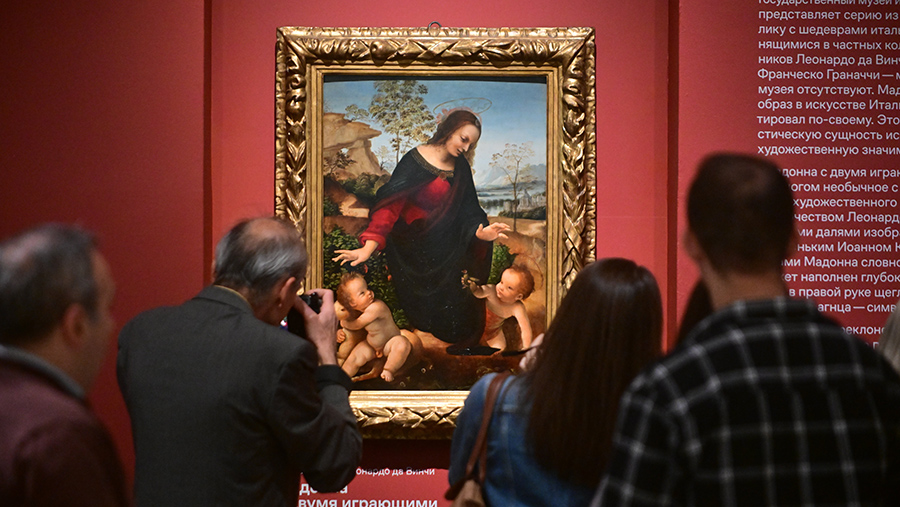
The thing is really very "Davincian", clearly echoing, for example, the "Madonna in the Rocks". In the guise of the Virgin Mary, the manner of the genius and his school is instantly recognizable: the Virgin is depicted with a half-smile, in a semi-profile (three quarters), with the thinnest locks of hair and delicate hands, either protecting the heads of two babies (Christ and John the Baptist), or reaching out to stroke them... Behind the Madonna, a landscape opens up, many elements of which again seem familiar from Leonardo's works. The genius's students developed and varied his motives, but this work is perhaps one of the most successful examples of such imitation.
Two weeks after the start of the project, the painting was moved to the seventh hall of the permanent exhibition, next to Botticelli and other Leonardesques (as da Vinci's students are commonly called). And its place was taken by the work of Giovanni Bellini, the Venetian genius of the early Renaissance. Outwardly, it is less impressive, but its power is different. Instead of a lyrical idyll, Bellini has a religious metaphysics: Madonna looks not so much at the child as somewhere else, focused and sad, as if anticipating the trials that will befall her son. There is a green curtain between the landscape in the background and the mother and baby, as if separating the eternal plot from everything earthly.
At the end of June, Bellini was replaced by Luca Signorelli, and in mid-July it will be Francesco Granacci's turn. These names, like Bellini, are not represented in the collection of the Pushkin State Museum of Fine Arts, so do not miss the rare opportunity to see their paintings. However, choosing exactly when to go to the museum (if it is not possible to visit it several times) will not be easy.
Zvantseva's school. Laboratory of Modernism
Museum of Russian Impressionism
The Museum of Russian Impressionism presented the largest project in terms of the number of collections involved this month. The Leningradsky Prospekt institute marked the decade of its existence with an exhibition that did not flirt with the public, but claimed (not unreasonably) the status of an art history study. "Zvantseva's school. The Laboratory of Modernism" is an attempt to understand how the key trends of painting in the first quarter of the 20th century matured.
Elena Zvantseva is a teacher, a student of Ilya Repin. Lev Bakst, Mstislav Dobuzhinsky, Kuzma Petrov-Vodkin taught at the drawing studio, which she opened in St. Petersburg in 1906; Mikhail Matyushin, Elena Guro, Marc Chagall, Olga Rozanova and many others studied. These are the most famous names. But there were also many others whom the new exhibition brings out of the shadow of the "stars": in the works of, for example, Fausta Shikhmanova, Raisa Kotovich-Borisyak, the trends of the time are felt almost better than those of the luminaries.
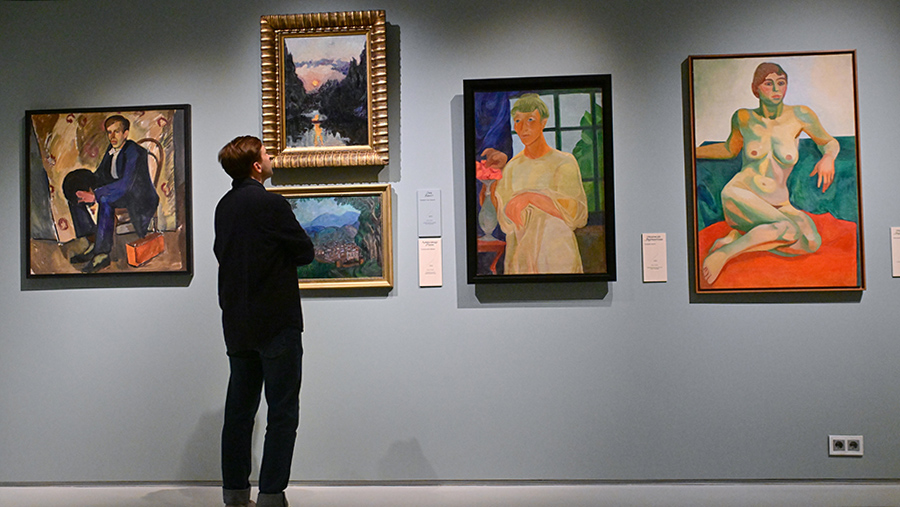
However, it is debatable to what extent Zvantseva's school influenced the formation of these figures. For example, Matyushin later wrote that he and Bakst had different views, he and Guro did a lot in spite of their teachers and felt like they were already accomplished artists (they owed much more to the previous teacher, Jan Tsionglinsky). But, however, the exhibition is not a dissertation, and the main thing here is not ideological accuracy, but works as such.
In their selection, the curator balances between the widely known and the not yet familiar. For example, Bakst's sketches of theatrical costumes, which are regularly exhibited, are juxtaposed with two rare canvases by the same master — both come from a large corporate collection; Guro is represented mainly by large graphic sheets from RGALI, and among them, along with the textbook "Fawn", there are little-known female portraits. Petrov-Vodkin and Dobuzhinsky are shown in a non-standard way...
And although these things are by no means limited to the period of Zvantseva's school (1906-1917), it must be admitted that the specifics of each author are very clearly shown here, and together they reflect trends that go beyond one pedagogical studio and are indicative of the era as a whole.
Переведено сервисом «Яндекс Переводчик»
