Tectonic recession: earthquake will deprive Venezuela of a fifth of GDP


The earthquake in Venezuela, the strongest in 126 years, could reduce the country's GDP by 20%, experts told Izvestia. A state of emergency has been declared. According to Acting President Delcy Rodriguez, the death toll has already exceeded 160 people, about 1,000 injured. In Caracas, the metro was stopped, the main airport was damaged, and gas pipelines were urgently blocked to prevent explosions. Residents are searching for their loved ones under the rubble of buildings, hospitals are overcrowded, medicines are not enough. How the country is coping with the disaster and how Russia can help — in the material of Izvestia.
The aftermath of the earthquake in Venezuela
— My granddaughter was playing outside. My daughter ran out to pick her up, and a beam fell on her. She didn't have time to hide. Everything happened very quickly: a warning message arrived, followed immediately by an earthquake. It's just unbelievable. I wouldn't wish that on anyone, not even my worst enemy," Mirta Peraza, a resident of the eastern part of Caracas, tells Izvestia.
Then an apartment building collapsed in front of her eyes. Although local services arrived promptly, they did not have the necessary tools to sort the rubble. According to Mirta, the townspeople came to the rescue, armed with picks, shovels and ropes.
The devastating earthquake in Venezuela has already killed over 160 people and injured about 1,000. The disaster caused enormous damage to the residential sector: hundreds of houses were destroyed or seriously damaged in Caracas, as well as in the states of Miranda, Aragua and La Guayra. Due to the incessant aftershocks, tens of thousands of people spent the night on the streets. The national headquarters of the Red Cross was critically damaged in the capital. Local hospitals are overcrowded, and doctors are working at the limit of their capacity amid an acute shortage of medicines.
The earthquake also paralyzed the country's transport system: the main international airport named after Simon Bolivar was completely shut down, the metro did not work in Caracas and the railway service was discontinued. Due to damage to power lines and telecommunications, emergency closure of main gas pipelines, a critical situation has developed in the resort region of La Guayra - acting President Delcy Rodriguez declared it a disaster area. Dozens of buildings collapsed, including the eight-storey Hotel Eduard in Makuto.
General Director of the Latin American Cultural Center named after Hugo Chavez Yegor Lidovskoy has repeatedly visited the affected regions, personally knows the people who developed the infrastructure of the resorts of La Guayra and Catia la Mar.
"The ex-governor of the state, Jorge Carneiro, has invested a lot of effort into making this place truly the pearl of Caracas," Lidovskaya told Izvestia. — I have seen reports of several destroyed houses, of course, this is all nonsense. In one Catia la Mar, judging by what my friends send me, from 40 to 50% of the entire fund has been destroyed.
Izvestia correspondents were convinced of the validity of these assessments after visiting Catia la Mar. A huge number of buildings have turned into piles of rubble, people are trying to find survivors under them.
— The whole neighborhood spent the night on the street, all my friends and neighbors. Even those houses that have stood have become uninhabitable," says Maria, a local resident.
She and her husband were actually saved by their son, who was the first to feel the dots.
— I didn't believe him at first, because I didn't feel anything myself. He was shouting, "Mom, it's shaking! Mom, there's an earthquake!" And I replied: "No, son." And then I suddenly realized that I was already lying on the floor — I was knocked down. The son ran away, the husband ran out after him. The son rolled down the stairs, a shovel fell on him, he broke his head. It was very scary. We have to thank God for staying alive," Maria said.
The scale of the destruction was also affected by systemic problems in the construction sector. Lidovsky stressed that the government was trying to solve them as part of a large-scale social program, relocating about 2 million families from slums to new apartment buildings. However, strict earthquake resistance standards were not taken into account during construction. Given the population density and the scale of the damage, the expert does not rule out that thousands could have died. The US Geological Survey initially estimated the potential number of victims from 10,000 to 100,000 people.
By the evening of June 25, the Russian Embassy confirmed to Izvestia that there were no Russian citizens among those officially listed as dead, and there were no complaints from compatriots in connection with the consequences of the earthquake.
Losses for the Venezuelan economy
The natural disaster will deal a huge blow to the Venezuelan economy. According to various estimates, the economic damage will range from 2 to 20% of the country's GDP. For Venezuela, even the "lower" limit of this range means catastrophic consequences, said Galina Platunina, Deputy head of the Department of Digital Economy, Management and Business Technologies at MTUCI. At the same time, forecasts of 20% are very close to reality, Egor Lidovskaya emphasized.
Due to years of sanctions, hyperinflation, and lack of investment, bridges, roads, and power grids are essentially in disrepair. The country did not have a "safety margin" like Turkey or Japan, which are constantly shaking. It will take years to restore basic logistics and utility networks, Platunina said.
Shortly before the disaster, Venezuela had just begun to emerge from a protracted economic peak. Thanks to the reforms of Nicolas Maduro in 2019-2021, it was possible to eliminate the commodity deficit and even achieve GDP growth of 4-8% per year. By 2024, the country's leadership had brought down hyperinflation to 50%, but now the annual rate has jumped to 524.5%.
Now Delcy Rodriguez will have to keep the financial system in a state of disaster: an earthquake and blackouts will inevitably provoke a new shortage and a round of depreciation of money, thwarting attempts by the authorities to stabilize prices.
"Venezuela's main problem is not physical recovery, but monetary policy," Platunina says. — Any reconstruction work requires huge cash injections, and the government, with an empty treasury, is highly likely to resort to issuing money. This is a direct path to a new round of hyperinflation.
The oil sector remains the only island of stability: the key infrastructure is located east of Caracas and has not been particularly affected, which will preserve export revenues. The construction industry and the tourism industry will bear the brunt of the crisis. The situation is aggravated by the threat of a humanitarian catastrophe. Without urgent international assistance, the Venezuelan economy will face difficult times.
International assistance to Venezuela
Despite the political differences, the United States came to the rescue of Caracas. Mobile field hospitals, water purification systems, generators, emergency rations and medicines are already being delivered to the disaster area. However, experts are confident that this humanitarian mission will be short-term: Washington will not finance the long-term economic recovery of the republic.
— The Americans will not do anything for Venezuela in the interests of Venezuela. They need control over the oil. It has the largest oil reserves in the world. It may be heavy and difficult to process, but it must be borne in mind that refineries in the south of the United States are technologically built in such a way as to process Venezuelan oil," political analyst Igor Pshenichnikov told Izvestia.
In his opinion, Washington will limit itself to sending humanitarian supplies in order to improve its own image, since the deployment of tents and the delivery of drinking water do not require serious costs. The White House is much more motivated by the threat of a new wave of refugees from Venezuela.
In addition to the United States, Germany, Cuba, Mexico, El Salvador, and France will provide assistance to Venezuela.
The International Committee of the Red Cross confirmed to Izvestia its readiness to increase the volume of humanitarian aid for Venezuela. "We remain ready to scale up our humanitarian response to support our partners from the Venezuelan Red Cross and the International Red Cross and Red Crescent Movement in general," they said.
Russian President Vladimir Putin sent official condolences to the Venezuelan authorities, and Russian Foreign Ministry spokeswoman Maria Zakharova announced that specific options for humanitarian support were being worked out. Delcy Rodriguez thanked the Russian side, emphasizing the strategic nature of the bilateral relations.
Russia has vast experience in dealing with the consequences of the largest seismic disasters of recent decades (including Turkey, Syria, Haiti and Armenia), so Russian rescue technologies will be critically important for Caracas. The initiative to help Venezuela came from the Russian side, Dmitry Novikov, first deputy chairman of the State Duma Committee on International Affairs, told Izvestia.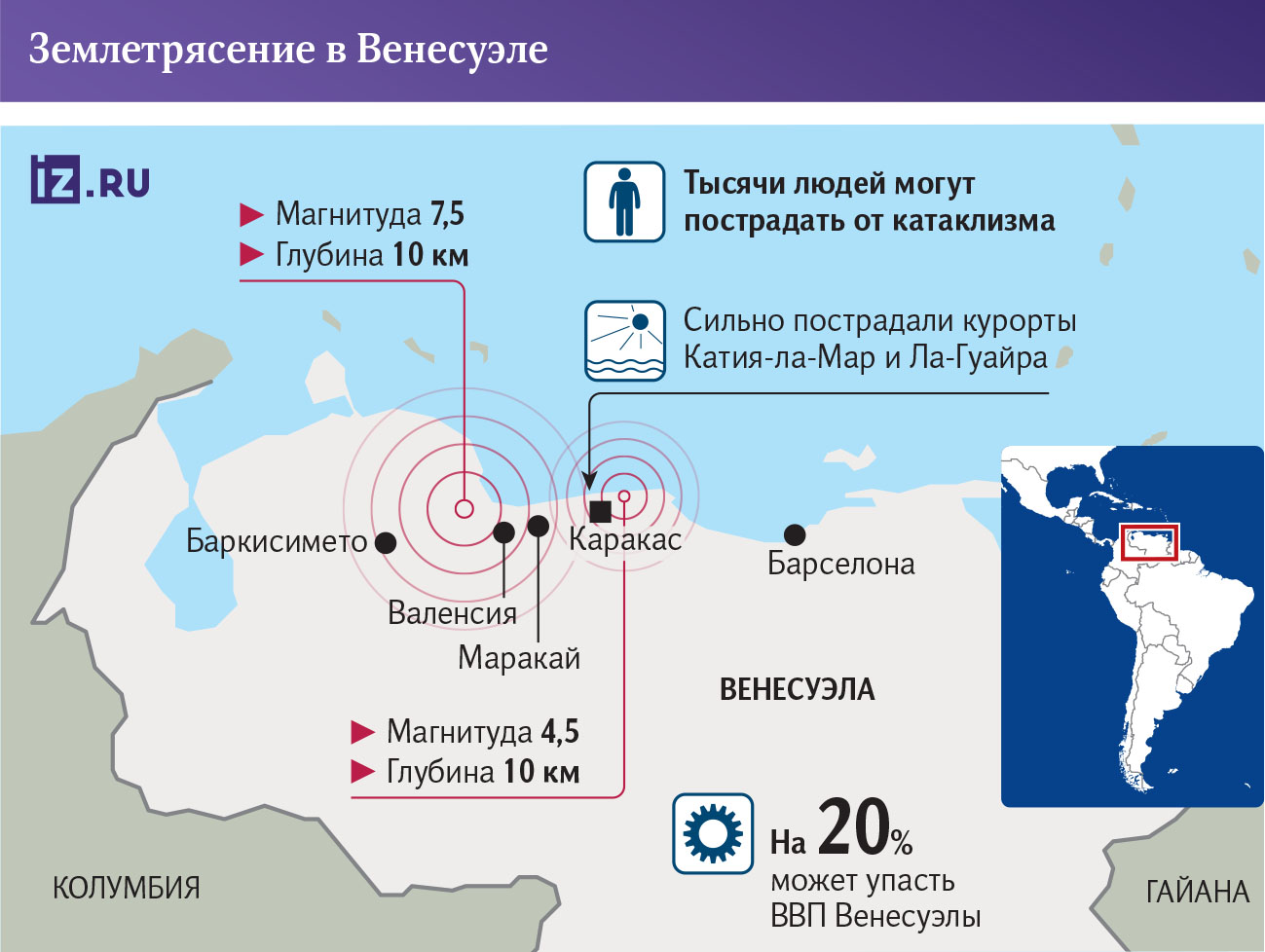
— The Venezuelan side has not applied. There are casualties and destruction, they are significant. And it is typical for Russia to provide humanitarian assistance in such cases," the parliamentarian noted.
The main problem in Caracas remains hundreds of damaged high-rise buildings, the extent of which is unknown. The Russian mobile test system "String-P", whose sensors determine the stability of any structures in a matter of minutes, could solve this problem, experts said. In addition, Russia may send a team of "Centrospas" to Venezuela, specialists of the highest international class equipped with acoustic radars and endoscopic cameras to search for people under the rubble. They record the heartbeat even under the rubble at 10 m.
The main obstacle to Russian assistance remains complicated logistics, the closed airspace of a number of countries and long flight time (up to 16 hours). In addition, the United States has not yet lifted the naval blockade. But global practice shows that in a situation of natural disaster, the parties do not interfere with the delivery of humanitarian aid.
Переведено сервисом «Яндекс Переводчик»
