In "Lenkom" Ostap got carried away: Averin played a secret Soviet millionaire


A real Wildebeest rides on the legendary stage, a goose from the Durov Theater flies, scammers sing "Wait, steam Train", and Ostap Bender dreams of Rio de Janeiro again. Vladimir Pankov turned the Golden Calf into a musical road movie, where jazz from the roaring twenties meets Soviet chanson, and Lenkom's signature irony meets real human longing. The new play "The Great Combinator" turned out to be not just another staging of Ilf and Petrov, but a declaration of love to Mark Zakharov, the theater and the whole era of great adventurers. Izvestia was among the first to watch the premiere.
Ostap Zakharov and the almost century-old "calf"
This is not the first time Vladimir Pankov has made an artistic curtsy towards Mark Zakharov. In March, the Zakharov concert performance was released, followed by a full-fledged production of Orchestra Rehearsal, inspired by the film of the same name by Zakharov's beloved Federico Fellini. And now — a play based on the novel by Ilf and Petrov "The Golden Calf". The thread stretches back to 1976, when Zakharov shot the legendary mini-series "12 Chairs" with Andrei Mironov.
Few people know that Zakharov himself once also played a great combinator, though not for long. The director liked to tell this story to the Lenkom members at rehearsals. In his youth, he went on stage and said: "I am Ostap-Suleiman-Berta-Maria-Bender Bay." After that, the spectator in the front row slapped his knees with annoyance, got up and left the hall. According to Mark Anatolyevich, it was then that he realized that it was time to stop acting and go into directing. Fortunately for the Russian theater, he left.
Ilf and Petrov's novel turns 95 years old this year. Almost a century ago, the Soviet government could not make up its mind: Should this book be considered a satire on philistinism or a mockery of the Soviet system itself? The novel was criticized for the lack of a positive hero, ideological instability and, most importantly, for the excessive attractiveness of the crook.
However, the characters of Ilf and Petrov have gone to the people. Ostap Bender became synonymous with a charming opportunist, Vasisuali Lokhankin became a symbol of a petty intellectual tormented by his own reflection, and Ellochka the cannibal became the personification of empty philistinism.
The goose, the millionaire and the man in the white scarf
Today, many theater directors are flirting with modernizing the classics, and the form is irrevocably eating up the content. Then the audience's dumb question "what did the author want to say?" flies into the blank wall of the director's "I see it that way." But Vladimir Pankov proved to be as tactful as possible in this regard.
Firstly, he preserved the story of Ostap Bender. The great combinator is chasing the underground millionaire Koreiko, dreaming of escaping from Soviet dullness to Rio de Janeiro, to white trousers and a celebration of life. Together with him is a company of tragicomic companions: Balaganov, Panikovsky, Kozlevich in a filigree performance by Sergei Yuyukin, Ivan Agapov and Sergei Piotrovsky.
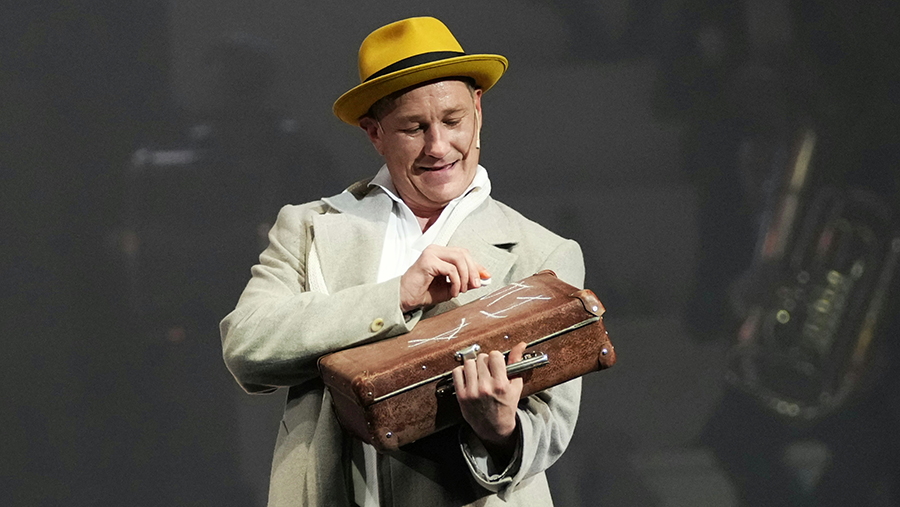
Secondly, Pankov left the text. Moreover, he placed accents so that some phrases played for specific artists in a completely new way. So, when Andrey Leonov's character says: "I also look like my father," the audience expectedly reads homage to the legendary actor Evgeny Leonov and responds with applause.
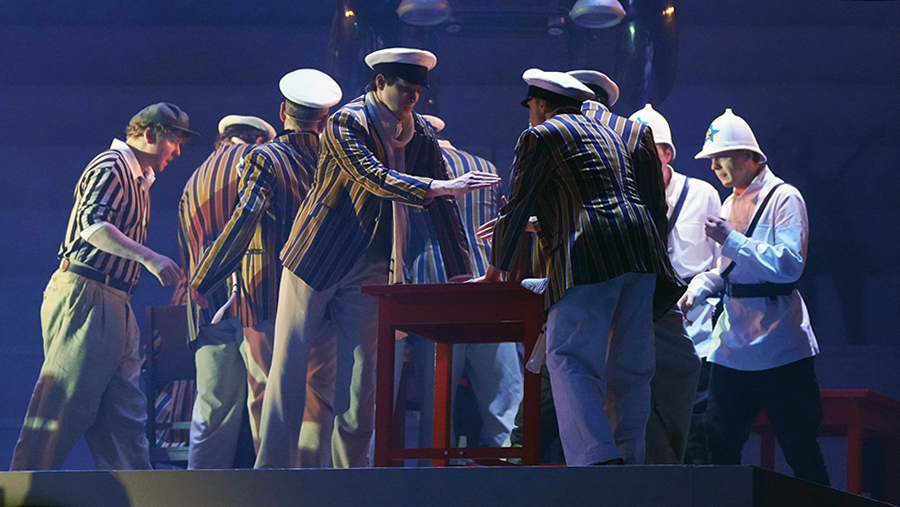
The composition of the play resembles a story within a story. The audience is greeted by the writers Ilya Ilf performed by Alexander Fokin and Evgeny Petrov performed by Ilya Khalmurzaev. They also lead the audience through the story of Ostap Bender, accompanying the action with author's remarks and epithets, which the artists grotesquely act out with facial expressions and plasticity. They have to portray either "leaden thoughtfulness" or "angry laughter."
Anton Shagin plays Bender as the conductor of chaos. He easily changes his intonation, goes down to the auditorium, exists on stage almost like a circus performer, and then suddenly goes into drama. Shagin gives his Ostap the features of the best adventurers in world literature — here is the Count of Monte Cristo, Chichikov, and Woland, mocking human vices. At the same time, his Bender is not a bronze monument to a hero, but a man with inner longing and a crystal heart.
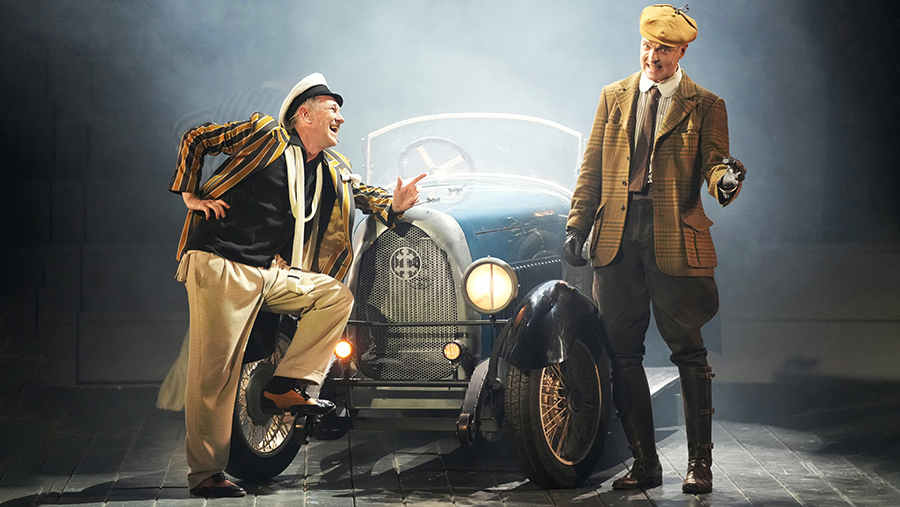
Maxim Averin appears unexpected to the viewer. If it weren't for his age — Ostap Bender is 33 years old according to the novel — the actor could easily have been wearing his trademark white cap, striped jacket and thin scarf. But Vladimir Pankov came up with an asterisk task for him and offered to play the underground Soviet millionaire Koreiko. During the day, he works as a modest accountant at Hercules with a salary of 46 rubles, and in the evenings and during "business trips" he runs large-scale scams. A significant part of the play's humor is based on the confrontation between the two adventurers.
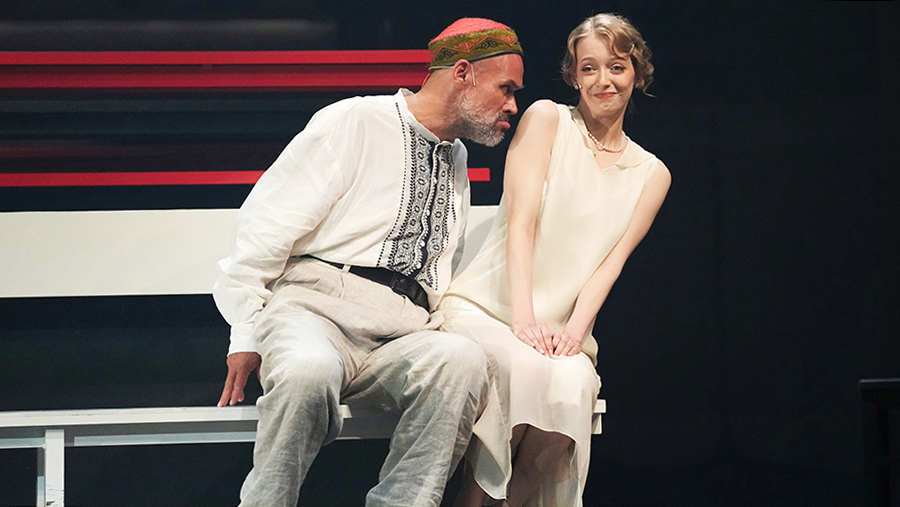
Ivan Agapov turns Panikovsky into the main tragicomic hero of the production. His character is not just a funny crook, but an almost Gogol—like "little man" who has long been thrown by life to the sidelines. Together with him, a real goose named Hippolytus appears on the stage — an artist of the theater "Grandpa Durov's Corner". Agapov joked that Gus, like Lenkom members, is prone to improvisation, although his rider is significantly higher.
SoundDrama and the Scammers' Song
Pankov's main weapon is his famous SoundDrama. Thanks to this genre, music becomes not an accompaniment, but an engine of action. And it is in Lenkom that SoundDrama turns out to be absolutely organic. The Mark Zakharov Theater has always existed at the junction of drama, rock opera, carnival and satire.
The "Great Combinator" literally sparkles with music. The jazz of the roaring 1920s, American blues, House of the Rising Sun, and Russian chanson sound on the stage. And then the characters suddenly start singing "Wait, steam train." Once upon a time, in the Gaidai comedy "Operation Y" and other Adventures of Shurik," she was played by the petty crooks Coward and Goofball. Now it is sung by other scammers — Bender, Panikovsky, Balaganov and Kozlevich. And it becomes clear: the entire Russian comedy of the XX century is an endless chorus of adventurers who dream of snatching a little happiness from fate.
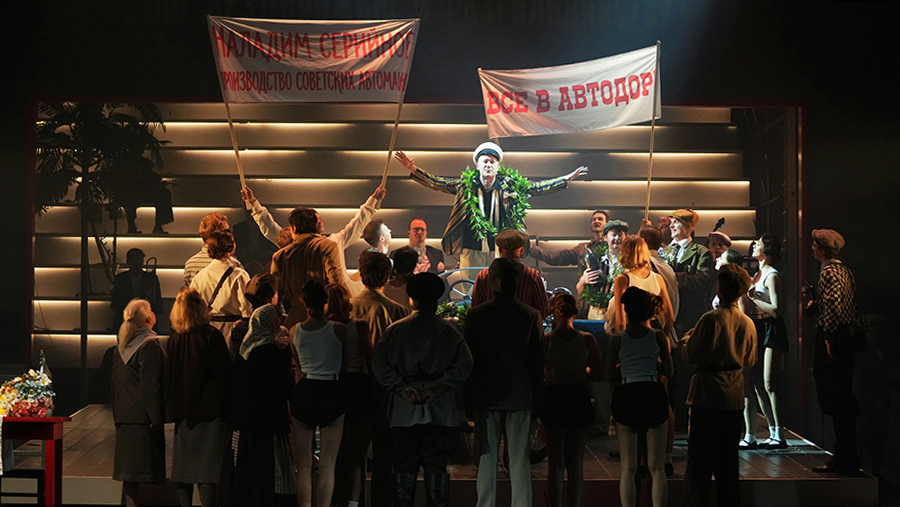
Production designer Alexey Kondratiev turned the stage of Lenkom into an attraction in the spirit of the Russian avant-garde. There are notable references to Kazimir Malevich and Vasily Kandinsky. Geometric designs move, fold, and rotate in recognizable color combinations. But the main element of the performance is the Wildebeest Antelope car, which was specially built for the production by engineers and artists from Moscow and St. Petersburg.
"The Great Combinator" is certainly a spectacular attraction. But this is not an accumulation of expensive and spectacular things, but a kaleidoscope of beauty, luxury and fiction. Pictures of Soviet poverty are interspersed with scenes of dazzling dancers in pearls and feathers, like the embodiment of Bender's dream of Rio de Janeiro. Cities, pace, and even planes are changing. A car descends from the ceiling, a real goose flies, and the earth literally turns under your feet.
Vladimir Pankov turns out to be a great combinator himself. But not a man of outstanding cunning and resourcefulness, but a master of combining the incongruous: musical genres, clowning, psychological theater, jazz concert, satire, road movie and real human drama. But behind all this, there is a story about an unfulfilled dream and the fact that sooner or later any great combinator is left alone with himself — without Rio de Janeiro, but with a very Russian longing inside.
Переведено сервисом «Яндекс Переводчик»
