Ice passage: Russia will allow Western countries to use the Northern Sea Route


Russia will not interfere with the use of the NSR by Western countries, Alexey Chekunkov, Minister for the Development of the Far East and the Arctic, told Izvestia. According to him, the situation in the Middle East is leading to an increase in traffic along the Northern Sea Route. In particular, China plans to achieve a transit cargo turnover of 20 million tons along this route by 2030. Experts believe that the United States and Europe may also be interested in the transit of energy resources and raw materials along the Northern Sea Route. The Russian Federation plans to build 10 new nuclear icebreakers, as well as deploy a space group for the development of the Northern Sea Route.
Will the West be able to use the Northern Sea Route
Any country, including Western countries, can use the Northern Sea Route, but the Russian Federation retains unconditional sovereignty over the route, Alexey Chekunkov, Minister for the Development of the Far East and the Arctic, told Izvestia.
— Of course, the Northern Sea Route is ready for any country. It is important that whoever decides to follow it will have no alternative but to use the Russian ice cover, the cover of emergency rescue centers, and information from our space satellites. And in this sense, Russia is certainly the sovereign over the Northern Sea Route," Chekunkov replied when asked by Izvestia about the prospects of using the NSR by Western countries.
According to him, European goods, including, for example, German ones, are somehow transported along the Northern Sea Route on Chinese ships. The situation in the Middle East, where the blockade of the Strait of Hormuz still continues, encourages the world's largest economies to use the NSR more actively.
— China has stated a goal to produce 20 million tons by 2030. India — 5 million tons. South Korea announced that it plans to be ready for year-round navigation along the Northern Sea Route by the mid—2030s, by 2035. <...> The United Arab Emirates has established a joint venture with Rosatom to develop container transportation," Chekunkov said.
In recent years, conflicts in the Middle East have complicated the use of key logistical arteries: the Strait of Hormuz (through which about 20% of the world's oil passes) and the Bab el-Mandeb Strait, the shortest route from Europe to Asia. Hormuz is blocked by Iran due to the conflict with the United States and Israel, and the Houthis in Yemen are threatening to close Bab al-Mandeb.
Under these conditions, companies are forced to redirect ships to bypass Africa, which dramatically increases fuel and insurance costs and lengthens the journey by 10-14 days. Compared to the traditional route through the Suez Canal, the NSR reduces the distance between Asian and European ports by 30-40%.
What can Europe and the USA transport along the NSR
In the future, Europe and the United States could theoretically be interested in the NSR as a backup and partially accelerated Asia–Europe/North America route, Pavel Anisimov, Deputy director of the Institute of International Relations and Political Sciences at the Russian State University of Economics, told Izvestia. He noted that the higher the risk of blocking or destabilizing flows through Hormuz and Suez, the more valuable alternative routes become for global players.
"The interest is primarily in energy resources (LNG, oil), raw materials and, in the future, high—speed container transportation if Russia provides year—round navigation and predictable tariffs," the expert believes.
According to him, the massive Western traffic is being held back by a geopolitical factor: sanctions, a legal dispute over the status of the route, the high cost of icebreaking escort and the environmental agenda.
In particular, FSUE Atomflot, which is engaged in icebreaking vessels in the Arctic, has fallen under Western restrictions. In other words, to use the NSR, Western countries need to remove restrictions and establish a payment system.

In addition, Western Arctic countries are questioning the status of the Northern Sea Route as an internal transport artery of the Russian Federation, insisting that it has the status of an international strait with the right of transit passage. Therefore, the use of the NSR will be a full recognition of its belonging to Russia.
Political analyst Denis Denisov believes that negotiations with Western countries on the use of the Northern Sea Route will begin after the settlement of the conflict in Ukraine and the resolution of key issues of regional security. However, the NSR is also a potentially very important communication route for the West.
Development of the Northern Sea Route
In these conditions, the importance of implementing the development plan of the Northern Sea Route adopted by the Government of the Russian Federation is growing, Alexey Chekunkov emphasized. The document was signed in 2022 and provides for financing in the amount of 1.8 trillion rubles.
— These are the construction of 10 nuclear icebreakers, the construction of 43 ships of the rescue fleet, and the deployment of a space group, which is already underway. Five satellites have been launched to analyze the ice conditions. Of course, the creation of an ice—class cargo fleet," the Minister for the Development of the Far East and the Arctic told Izvestia.
At the same time, the Northern Sea Route is being integrated with the North–South route as part of the development of the Transarctic Transport Corridor, Chekunkov noted. It brings together the Northern Sea Route, river routes, coastal infrastructure, investment and social projects.
— This is an integral project for the development of the northern economy. It is directly connected to all the mainland and maritime links that exist in our largest country in the world," the minister said.

According to Pavel Anisimov, Russia's key objectives for the development of the NSR are to build up a reliable infrastructure, including an icebreaking fleet, ports, rescue services, and integrate the route with the railway and port network within the country. The leadership of the Russian Federation pays special attention to the development of the icebreaking fleet. On June 8, Vladimir Putin instructed Andrey Puchkov, head of the United Shipbuilding Corporation (USC), to do everything so that work on the Leningrad and Stalingrad icebreakers would not be suspended.
In 2024, the volume of cargo transportation along the Northern Sea Route amounted to a record 37.3 million tons. In 2025, it decreased by 2.3%, while container cargo shipments increased. At the same time, the number of foreign vessels is growing. In 2025, Chinese shipping companies performed 23 flights on this route, compared with 14 a year earlier.
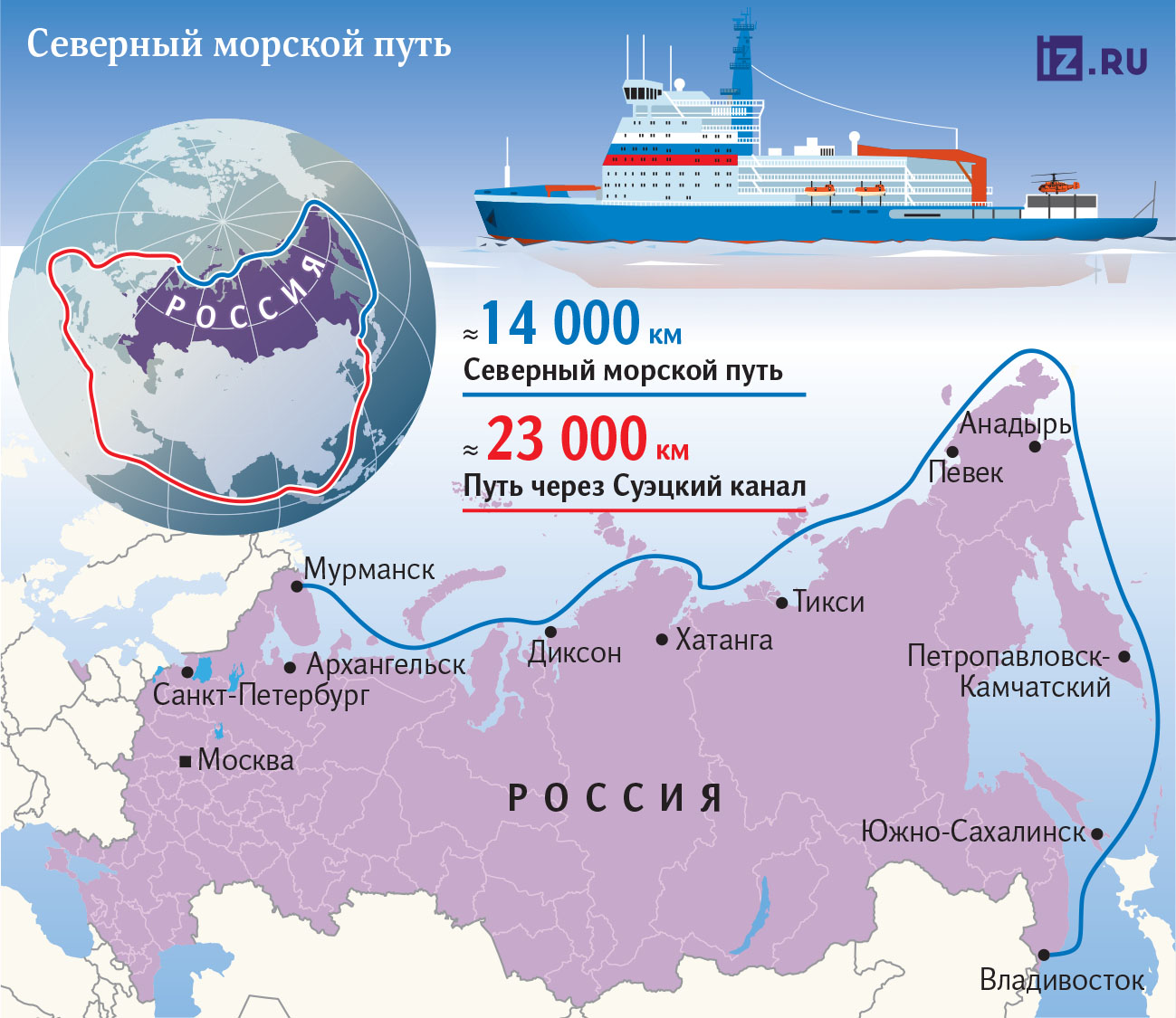
In the short term, Western countries will turn to the Russian Federation for permission to use the NSR only in a critical situation, for example, if all logistics routes through the Middle East are blocked. Perhaps this topic will arise in the case of negotiations on the normalization of relations between Russia and the EU and the United States in the future. However, now Russia has completely reoriented international transit along the NSR to China, India and the UAE, which are actively increasing shipping in the region.
Переведено сервисом «Яндекс Переводчик»
