- Статьи
- Society
- Yagoda Manila: seedlings and seeds of fictitious AI plants are being massively sold in the Russian Federation

Yagoda Manila: seedlings and seeds of fictitious AI plants are being massively sold in the Russian Federation

Sales of seeds and seedlings of non-existent berries, vegetables and fruits are gaining momentum on the Internet. Beautiful AI-generated images with the promise of a miracle harvest of strawberry-raspberry trees, tiger pears, black strawberries and other "plants" are widely distributed online. Social activists regard this as fraudulent actions — many gardeners believe the promises, but in fact they do not receive the declared harvest. The OPI asked the Prosecutor General's Office and the Ministry of Internal Affairs to stop the sale of fake seeds. At the same time, representatives of marketplaces told Izvestia that they promptly hide such product cards and ask sellers to replace images created using neural networks.
Why do Russians believe sellers of non-existent plants
On the eve of the holiday season, a new wave of mass ads began in the Russian segment of the Internet, offering Russians to buy plants with improbable characteristics. As Izvestia found out, sellers most often offer to purchase tree seedlings with an extraordinary harvest, the image of which is generated by artificial intelligence.
Among other things, we are talking about the sale of "tiger pears", the fruits of which resemble the colors of predators, "raspberry-strawberry trees" strewn with clusters of berries, red-black apple trees with the flesh of fruits the color of coal, as well as "columnar currant" trees.
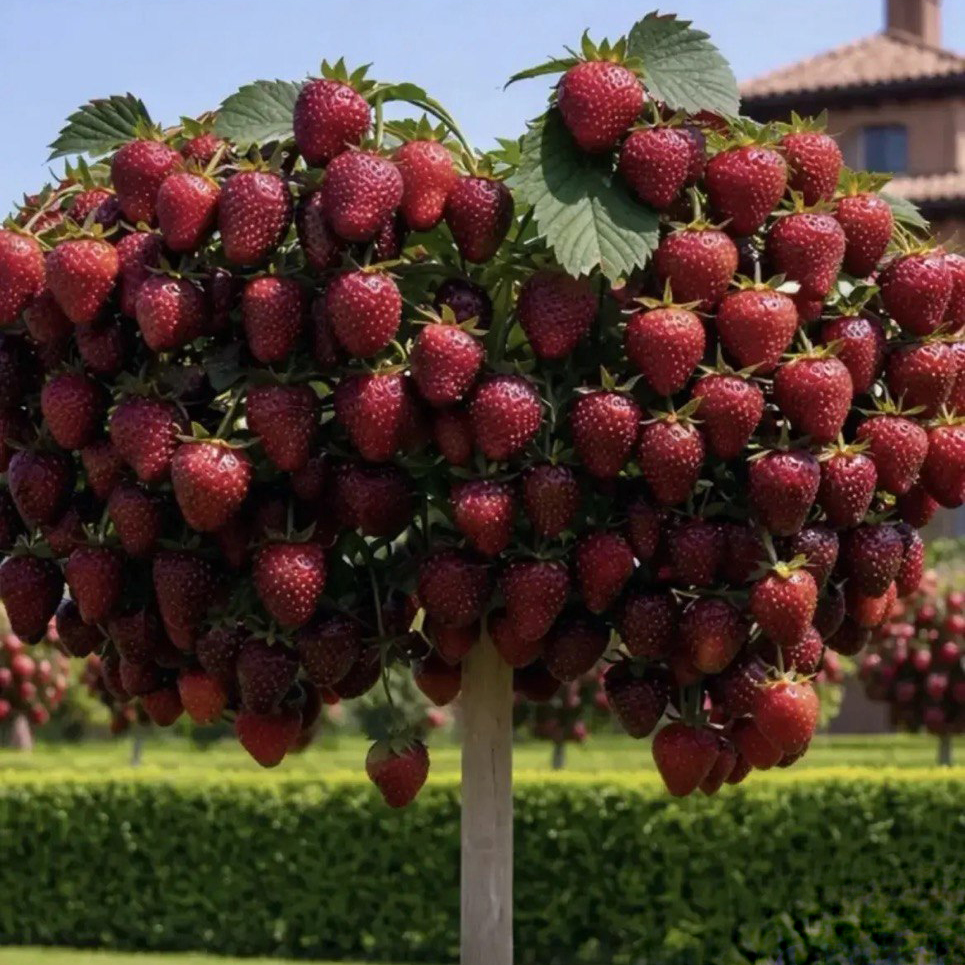
Consumers who are more attracted by the beautiful shape are offered other "miracle plants". For example, strawberries in the shape of a rose, currants elongated in the shape of a cucumber or bell pepper, and grapes resembling a human finger. And for those Russians who like bright colors, there are black strawberries, purple gooseberries, blue-yellow raspberries, white-red tomatoes and other magical vegetation on sale. In almost every case, sellers promise customers fabulous harvests, incredible flavors, and high dietary properties.
However, not all users immediately realize that we are talking about fictional plants. Some of them make purchases and only after the goods have already been received do they realize that they have been deceived. Most often, as consumers report in reviews, they are sent a plant that obviously does not survive with bad roots or is half-dried. There are also cases when, instead of miracle seedlings, buyers receive ordinary raspberry or currant cuttings, but it is not possible to understand this immediately, but only after the first harvest.

The Public Consumer Initiative (OPI) regards these actions as deliberate deception of consumers. In this regard, the activists ask the Ministry of Internal Affairs and the Prosecutor General's Office to check such sellers and bring the perpetrators to justice.
— We are faced with a fundamentally new, cynical form of deception of citizens, which can be called "technological fraud." Unscrupulous traders use generative neural networks to create colorful images of fictional crops such as "rainbow strawberries", "blue raspberries", "raspberry—strawberry trees" or non-existent rose hybrids. Under the guise of these AI hallucinations, Russians sell penny seeds of simple grass or ordinary seedlings. This is not just misleading, it is a deliberate deception, put on stream," Oleg Pavlov, the head of the OPI, explained to Izvestia.

According to him, as a result, buyers lose not only money, but also time, caring for a dummy for months in anticipation of a miracle harvest.
In its appeal to law enforcement agencies, the OPI draws attention to the fact that sellers of such magical plants violate Russian legislation. In particular, the law "On Seed Production", the norms of which prohibit the sale of varieties not included in the State Register of Breeding Achievements, and the law "On Consumer Rights Protection" (art. 26.1) — non-compliance with the right to reliable information about the product.
In addition, their actions may fall under several articles of the Administrative Code (10.12 provides for liability for violating the rules of trade in seeds and 14.10 — for selling goods without documents confirming varietal and seed qualities), as well as the Criminal Code of the Russian Federation — Article 159 "Fraud".
"In our opinion, it is obvious that sellers do not provide certificates of conformity for these products and cannot confirm the origin of the planting material. At the same time, the low cost of image generation and seed packaging, with an active demand for such miracle plants, guarantees them a stable income. While buyers realize the deception only after a few months, when it is no longer possible to return the goods," the document says.

Izvestia sent requests to the Prosecutor General's Office and the Ministry of Internal Affairs with a request to comment on the prospects for taking measures and withdrawing such products from circulation. The editors also asked sellers of such seedlings and plant seeds to confirm the authenticity of their products.
What measures are being taken to combat fake plants
Representatives of marketplaces told Izvestia that they are fighting such entrepreneurs.
— We promptly hide all cards with suspicious seedlings for additional verification. We ask sellers to replace the images generated by neural networks with real photos, as misleading customers is unacceptable," the Ozon press service explained to Izvestia.

They noted that they would like to thank users and partners who pay attention to such cases.
— Wildberries strictly adheres to the legislation of the Russian Federation and the requirements applicable in the field of e-commerce. The marketplace pays special attention to the safety and quality of the products presented on the showcase, and offers the necessary tools for this," the company's press service told Izvestia.

At the same time, they noted that the marketplace proceeds from the principle of the integrity of sellers — by accepting the offer, they confirm the full compliance of the goods with all the norms of the legislation of the Russian Federation and the countries of presence, as well as the rules of the site, they added.
— We regularly inform our partners about the rules of work. In the case of incoming requests to the marketplace, as well as the identification of suspicious cards by the site itself during the monitoring of the showcase, we proactively conduct internal checks, as well as independently check the register containing the approved list of seeds approved for sale on the market," the Wildberries&Russ press service said.

In case of confirmation of the facts of misleading the consumer, the marketplace blocks the cards of unscrupulous sellers, the RWB noted.
Izvestia has sent inquiries to other participants in the e-commerce market.
Pavel Shapkin, chairman of the National Consumer Rights Protection Union, told Izvestia that this is a deliberate deception of consumers who have the right to demand their money back and block cards with information about such goods. According to him, this is due to the low awareness of Russians about the real achievements of agriculture, including genetics. Therefore, people believe such ads and make purchases, but since we are talking about relatively small amounts, from 200 to 600 rubles, as a rule, after disclosing the deception, buyers do not want to make claims.
Переведено сервисом «Яндекс Переводчик»
