- Статьи
- Society
- Summer has arrived: the most aging regions are in Central Russia and the Volga region

Summer has arrived: the most aging regions are in Central Russia and the Volga region

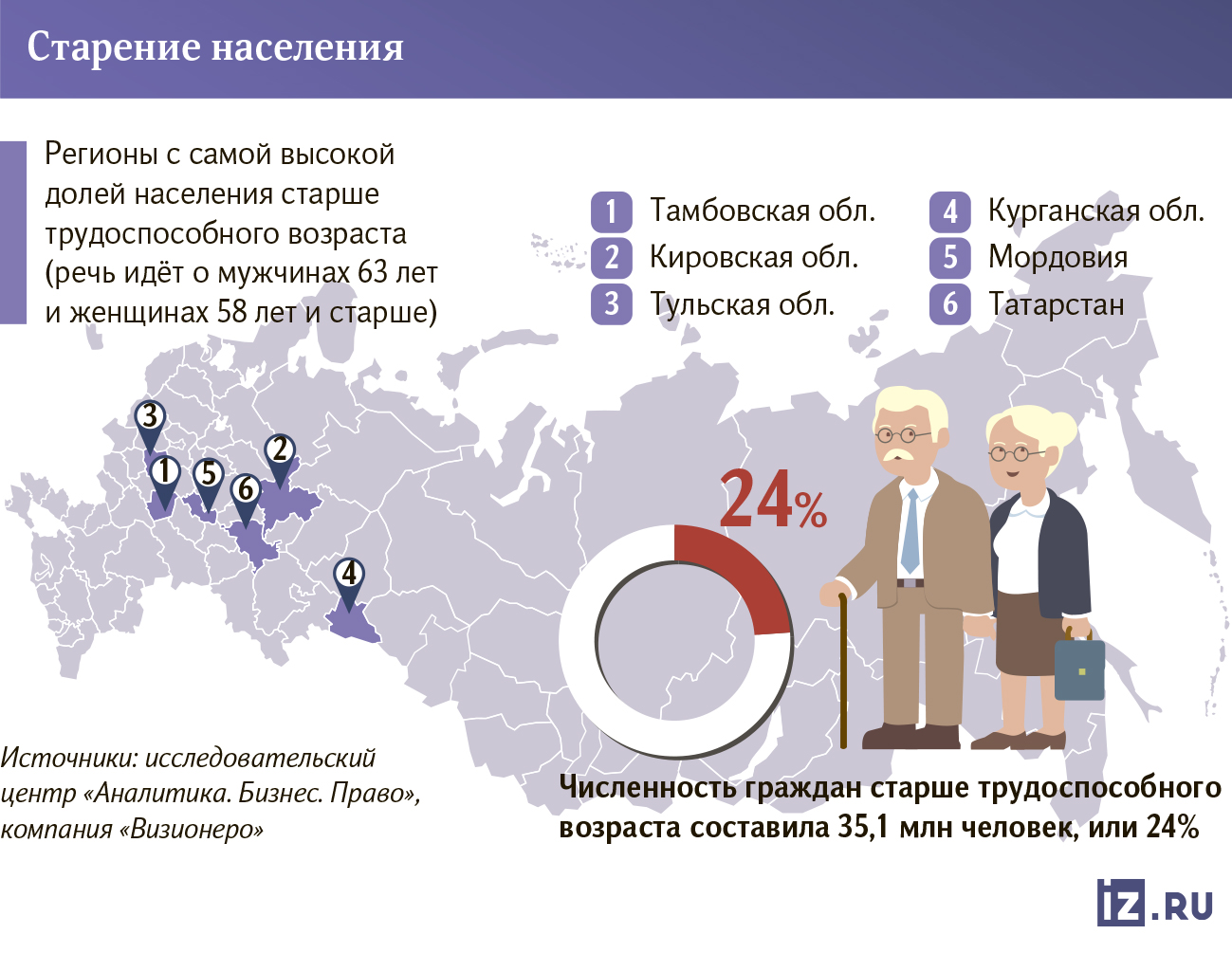
The regions with the highest proportion of the population over working age at the moment are Tambov, Kirov, Tula, Kurgan regions, Mordovia and Tatarstan, Izvestia found out. We are talking about 63-year-old men and 58-year-old and older women. Against the background of two years of record low unemployment and a shortage of efficient workers, the aging of the working-age population may lead to a loss of 1% of potential GDP in the country's economy in the next two years, experts said. The information about what support measures are needed for such regions is in the Izvestia article.
How regions are aging
The aging of the working-age population may lead to a loss of 1% of potential GDP (2.1 trillion rubles) in the next two years, according to data from the Analytica research center. Business. Pravo" and the Visionero company (Izvestia has it).

"Russia has already entered a steady trend of population aging," the authors of the study note. "As of January 1, 2025, the number of citizens over the working age was 35.1 million, or 24% of the country's population."

Experts noted that along with negative demographic dynamics, the aging of the working-age population and its minimal contribution to economic relations increase the burden on the economy, creating both individual risks for the regions and for the country's pension system as a whole.
Within Russia, aging has a pronounced regional asymmetry, the study says. The highest proportion of the population over working age is recorded in the regions of Central Russia, the Volga region and parts of the Urals. In particular, these are the Tambov, Kirov, Kurgan, Tula, Kurgan regions, Mordovia and Tatarstan.

Even maintaining effective employment of 10% of the older generation brings about 287 thousand rubles of potential GDP per person per year, which, when scaled to regional levels, gives up to tens of billions of rubles, the researchers explained. For example, in the Tambov region it is 84 billion, in the Kirov region — 82 billion, in the Tula region — 81 billion rubles.
A set of measures and legislative initiatives that could resolve the situation may include the development of public institutions and active longevity programs, government grants and support measures for medical and sports institutions, and IT companies developing and implementing similar cognitive and physical longevity programs. In addition, the problem could be solved by introducing special government grants, subsidies and support measures for working pensioners or pensioners and pre-retirees planning to start their own business.

— It is most advisable to launch regional pilots in regions with a pronounced aging of the population, as well as in large industrial regions where the retention of 50+ employment is directly related to the stability of the labor market, — said the director of the Analytica research Center. Business. Pravo" by Venera Shaidullina.
Why did the skew occur?
The situation with a high proportion of the elderly population in a number of regions reflects deep demographic processes that have been developing for decades, said Anastasia Gorelkina, co-chair of the Commission on Social Responsibility and Corporate Communications of the Association of Communication Agencies of Russia.
"The spread between regions is primarily due to migration trends: young people are actively moving to megacities, as a result, mostly older people are settling in the regions, and the proportion of the working—age population is decreasing," she believes. — Historical factors are equally important: in a number of regions, low birth rates and high mortality rates among young and middle‑aged people have been observed since the 1990s. Economic reasons were added to this, such as the lack of attractive jobs and low salaries.

A strong factor "pushing" the population out of the regions is the weak level of development of the vocational education system, especially higher education, which is especially appreciated in Russia, although this situation is changing now, said Darina Medvednikova, a junior researcher at the Center for Spatial Analysis and Regional Diagnostics of the IPEI of the Presidential Academy (RANEPA).

"The subjects of the Russian Federation located in relative proximity to the centers of gravity — the largest agglomerations of the country — are in a particularly vulnerable position, because in this case it is easier to move there," she explained. — Moscow, St. Petersburg, and other cities with millions of inhabitants, like vacuum cleaners, suck out all valuable able-bodied resources from the surrounding area, attracting them with their great opportunities for education and self-realization in the labor market.
But in a number of regions, such as Tatarstan, the high proportion of the elderly is also due to some positive factors — an increase in life expectancy as a result of the development of the healthcare system and the spread of a healthy lifestyle.

According to Anastasia Gorelkina, the economic consequences of this trend are very noticeable. Regional budgets are under increasing strain, taking into account the costs of pensions, healthcare and social support for the elderly. At the same time, labor productivity is decreasing — older workers are less likely to learn new technologies and are slower to adapt to changes.
Igor Rastorguev, a leading analyst at AMarkets, believes that the growing share of the elderly population in the regions is a consequence of the "demographic pit" of the 1990s. The regional asymmetry of aging is noticeable: in Dagestan and Ingushetia, the proportion of the elderly is 9.4—13.6%, and in Central Russia and the Volga region — 27-29%.
How to solve the personnel problem
The aging of the able-bodied population requires a transition from the narrow logic of "prolonging employment" to the logic of "maintaining effective employment," said Andrey Lysenko, developer of the Visionero IT rehabilitation system and Skolkovo resident. Measures to implement it may include, for example, regular cognitive and functional screening of citizens aged 50+ and 60+.

"There should be measures to support memory, attention, coordination, digital adaptation and motor activity, and recovery from strokes, injuries, neurodegenerative and psychoemotional disorders," he said. — In addition, it is necessary to calculate retained employment, reduce care, and reduce the burden on medical and social institutions.

The problem should be solved comprehensively, with an emphasis on improving the quality of life and supporting families, Anastasia Gorelkina believes. First of all, it is necessary to strengthen measures to stimulate the birth rate: expand the maternity capital program, introduce housing subsidies for young families, and ensure access to kindergartens and schools.
— This will have an effect in the long term — in 15-20 years the share of the able—bodied population will grow, - she noted. — It is important to develop the healthcare system and geriatric care: invest in the prevention of chronic diseases, create infrastructure for the care of the elderly, and develop patronage services. This will reduce the burden on families and allow the elderly to stay active longer.

To quickly address the personnel shortage, it is possible to consider reforming the pension system, for example, to encourage continued employment after retirement through tax benefits and additional payments. It is also useful to develop mentoring programs where experienced older employees impart knowledge to young people.: This will preserve valuable competencies and strengthen intergenerational ties.
The growing share of the elderly with a low birth rate is a big challenge for the labor market in the long term, because with retirement, workers need to be replaced by someone, Darina Medvednikova emphasized. One solution is to encourage retirees to work longer. Over the past few years, in Russia, amid the current severe staff shortage, many organizations have already taken measures to retain retirees at work.
Переведено сервисом «Яндекс Переводчик»
