Good night: The Gogol Theater in the play "Morphine" agitates against illegal substances
- Статьи
- Culture
- Good night: The Gogol Theater in the play "Morphine" agitates against illegal substances


A white horse and a Black Monk, a compassionate midwife and a doctor doomed by addiction: The Gogol Theater presented to the audience a new reading of Mikhail Bulgakov's prose — the play "Morphine". The premiere is timed to coincide with the 135th anniversary of the writer's birth. The action begins even before the third bell with the appearance of the "dead man" on the stage, and ends with a quote from the Criminal Code of the Russian Federation. Izvestia visited the screening and appreciated the creator's idea.
The dead man is only dreaming
The space of the Small Stage of the Gogol Theater is chambered — and this makes it even more noticeable what the creators of the production want to tell. They immerse the viewer in a chamber oppressive atmosphere, where the tragedy unfolds literally a meter from the front row.
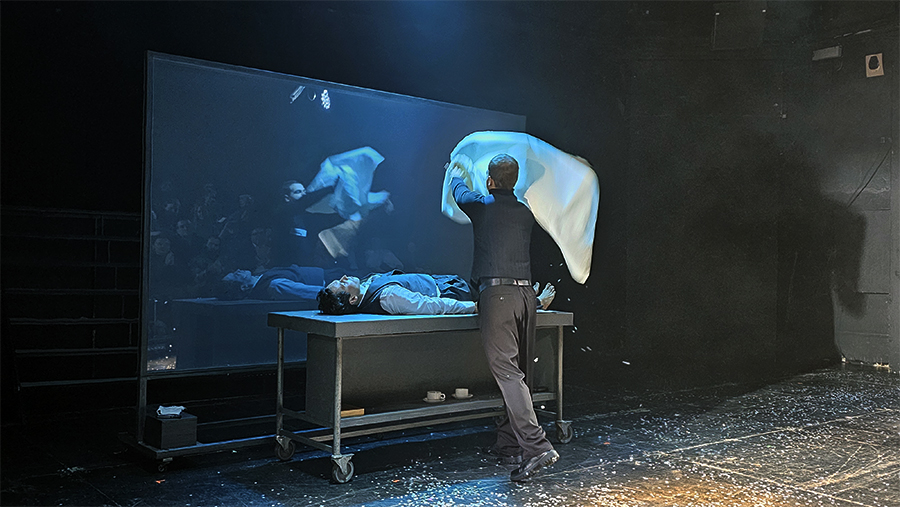
The production immediately attracted the attention of theater-goers and Bulgakov's fans. Director Alexander Limin combined stories from the series "Notes of a young doctor" and "Morphine", which was not included in it, into the plot. It is based on real cases from the writer's medical practice. He was a medical doctor by training and worked as a doctor, but he himself faced drug addiction, which he managed to overcome, largely thanks to his first wife Tatiana Lappe. But the hero of his "Morphine", Sergei Polyakov, could not cope and eventually committed suicide. This scene opens the action. And even before the third bell: at the moment when the audience is just settling into their seats, a gurney with a "dead man" is brought into the hall — a man covered with a bloody sheet, from under which only bare heels are visible.
Then the lights go out and a warning voice sounds: "Dear viewers, the names of narcotic substances are mentioned in the play. Neither the theater nor the creators of the play approve of the illegal consumption of narcotic drugs, psychotropic substances and their analogues. They are harmful to your health. Their illegal trafficking is prohibited and entails liability established by the legislation of the Russian Federation. We wish you a pleasant evening." The audience reacts with a light laugh. Meanwhile, the "dead man" gets up, swings his legs off the gurney, and walks offstage in a bloodstained shirt.
15 fives and a compassionate midwife
In front of the audience is the emergency room of a provincial hospital. Midwife Anna Kirillovna and paramedic Demyan Lukich are waiting for a new doctor. The former luminary, Leopold Leopoldovich, left this place. And now, in the bad weather, a young man with a suitcase, wrapped up to his eyebrows, Sergey Polyakov, bursts through the door. He has just received his diploma (there are 15 A's in it), but has no practical experience: he has not delivered babies, has not performed operations and is afraid of difficult cases. Reality makes him panic and insecure. It even occurs to him for a moment that the patient, whom the driver brought, may die without waiting for help. But the duty of a doctor prevails, besides, experienced colleagues do not let you relax.
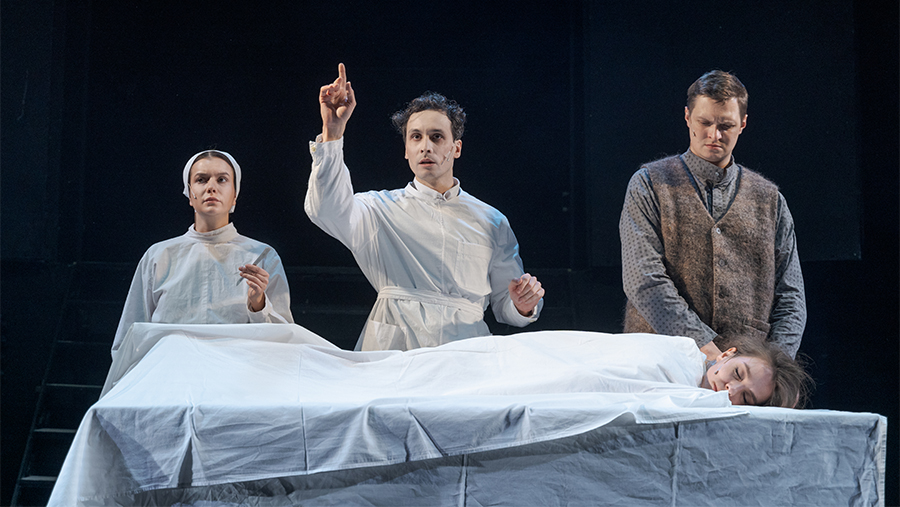
The news of the first successful amputation of a hopeless patient's leg and the rescue of a girl who was dying of measles is quickly spreading around the area. Now everyone who believes in his healing power is attracted to the newcomer. Due to fatigue, the doctor does not have the strength to treat his own ailment. Then the midwife Anna comes to the rescue and gives Sergei an injection of morphine-based painkillers. This becomes the beginning of the end. Now Sergey is trying to cope with his condition by resorting to medication. The addiction is getting bigger every day. His visions come with a white horse, which, along with a blizzard, carries Polyakov's memories and dreams.
The White Horse and the Black Monk
Production designer Vasilisa Kutuzova created a conventional image of a horse: a head with a snow-white mane made of gauze fabric, which is worn by the artist. He appears together with the ray illuminating him. The horse is driven by the wind and flying snow. This spectacular technique is the idea of lighting designer Denis Krasnoshchekov.
Another solution is to use a screen in the performance. Video projections of the main character's memories, hallucinations, and delusions are displayed on it. The god of dreams, Morpheus, seduces the doctor with singers and vulgar girls who try to persuade him to take the drug again. In the most terrifying vision, a Black Monk comes to the doctor. At night, he enters into a dialogue with him, and his words make it scary. They push the once successful aesculapius to the last line.
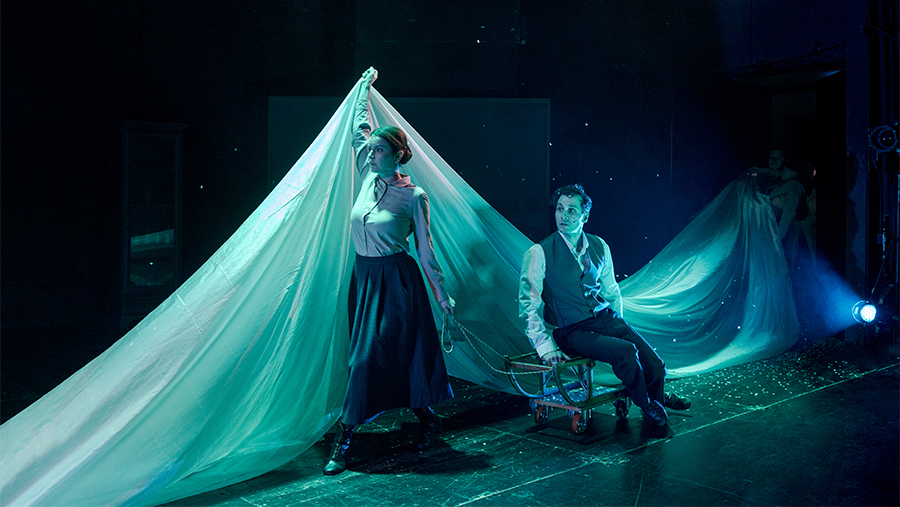
The main role is played by Alexander Khotenov. Midwife Anna Kirillovna — Maria Svirid. There is a painful connection between their characters. The girl who became a "secret wife" blames herself for the fact that she once offered him to relieve the pain with an injection. She's going crazy in her own way, too. The addict's pleas are now echoing in her head. The director decided that it was his excuses, denials of addiction and pleas for a new dose that would illustrate the platonic connection of his colleagues. When Maria Svirid's character calmly says, word for word, what Sergei begged her for, it becomes clear that she is also addicted to the drug. One of the most powerful scenes is the dialogue between the two doomed men. They exist in the same scenic drawing, their movements are synchronous.
And only Demyan Lukich, played by Viktor Zhludov, keeps a cool head next to the dying Anna and Sergei. He brings a bit of humor to this story, admires with his sedateness and vocal abilities. Demyan sings the Amsterdam song by Jacques Brel in French. The composition is like a hint: dreams, drunkenness, partying, women are the lot of not only Amsterdam sailors, but also his colleagues.
There's a lot of music in the play. Chorus of Jewish Slaves Va, pensiero from Giuseppe Verdi's opera Nabucco, as well as works by Antonio Vivaldi, Henry Purcell, Arvo Pärt.
The ending of "Morphine" is notoriously sad. The Doctor is dying. He was the one lying on the gurney at the very beginning. And now, when the rest of the artists bow down and receive flowers, he remains motionless under a white sheet.
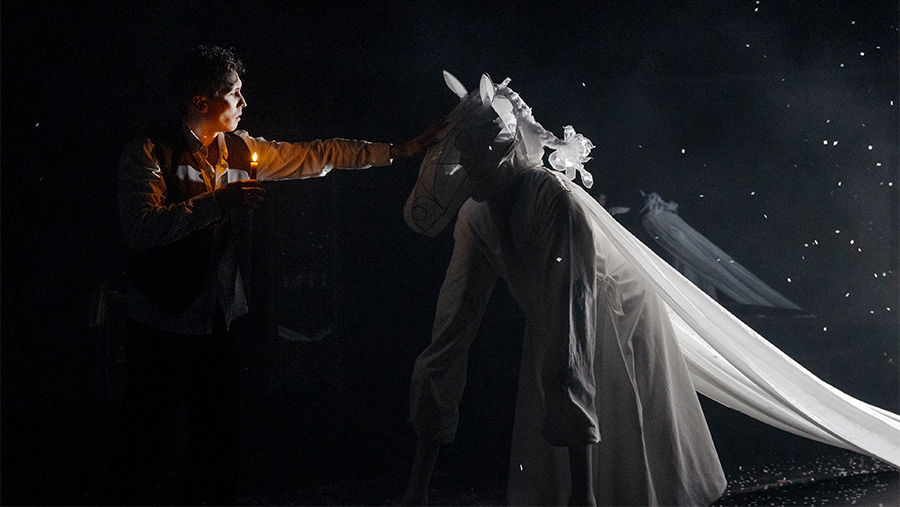
Denis Lukin, who spent the entire performance hiding under the masks of a White Horse or a Black Monk, had the last word: "The illegal consumption of narcotic drugs, psychotropic substances and their analogues is harmful to your health. Their illegal trafficking is prohibited and entails liability established by law."
This is how Bulgakov's "Morphine" at the Gogol Theater ends with a kind of "reminder" about the inevitability of responsibility for the decisions we make.
Переведено сервисом «Яндекс Переводчик»
