
Religious motives: The United States pushes Sunnis and Shiites to confrontation

The Kurdish armed groups supported by the United States are preparing to enter the territory of Iran in order to stretch the forces of Tehran. The escalation in the Middle East is gradually moving beyond just military confrontation and exacerbating the religious split between Shiites and Sunnis. The contradictions between them were already a significant factor in regional politics, and since the beginning of the attacks by the United States and Israel, it was the commitment to one or another trend in Islam that determined the attitude of Muslim states to the conflict.
The Kurdish factor in Iran
Washington is negotiating with Kurdish leaders in Iraq to provide them with military assistance, according to American media. An alliance of six armed groups is preparing for an operation against Iran, hoping to take advantage of the worsening regional situation. Kurdish formations may try to enter the territory of the Islamic Republic from neighboring areas.

According to orientalist Kirill Semenov, the Kurdish groups can demonstrate real effectiveness only with the active participation of Israeli and US aviation, which in fact will mean the creation of a controlled zone on the territory of Iran and the subsequent formation of opposition structures there. At the same time, the involvement of Kurdish forces in the conflict will require constant air support and will be a step towards further escalation.
"Washington's actions so far look more like tactical steps than a well—thought—out long-term strategy for resolving the Iranian issue, and the cessation of external assistance can quickly negate the results achieved," the expert told Izvestia.
The Iranian Kurds (about 8-12 million people, the third largest ethnic group after Persians and Azerbaijanis) are mostly Sunnis, which sharply distinguishes them from the Shiite majority of the country. Representatives of the Kurdish communities claim that there are restrictions, in particular, on the construction of mosques, the appointment of imams, the teaching of religious disciplines and access to government positions. Combined with the ethnic factor, this fuels the demands of some Kurdish movements for increased autonomy, often with reference to the example of Iraqi Kurdistan.

In Tehran, however, such demands are seen as a threat to the territorial integrity of the country. The Iranian authorities claim that external forces are trying to use religious and ethnic factors to destabilize the situation. They also emphasize that Kurds are represented in government and law enforcement agencies, and some restrictions are explained by the need to maintain national unity.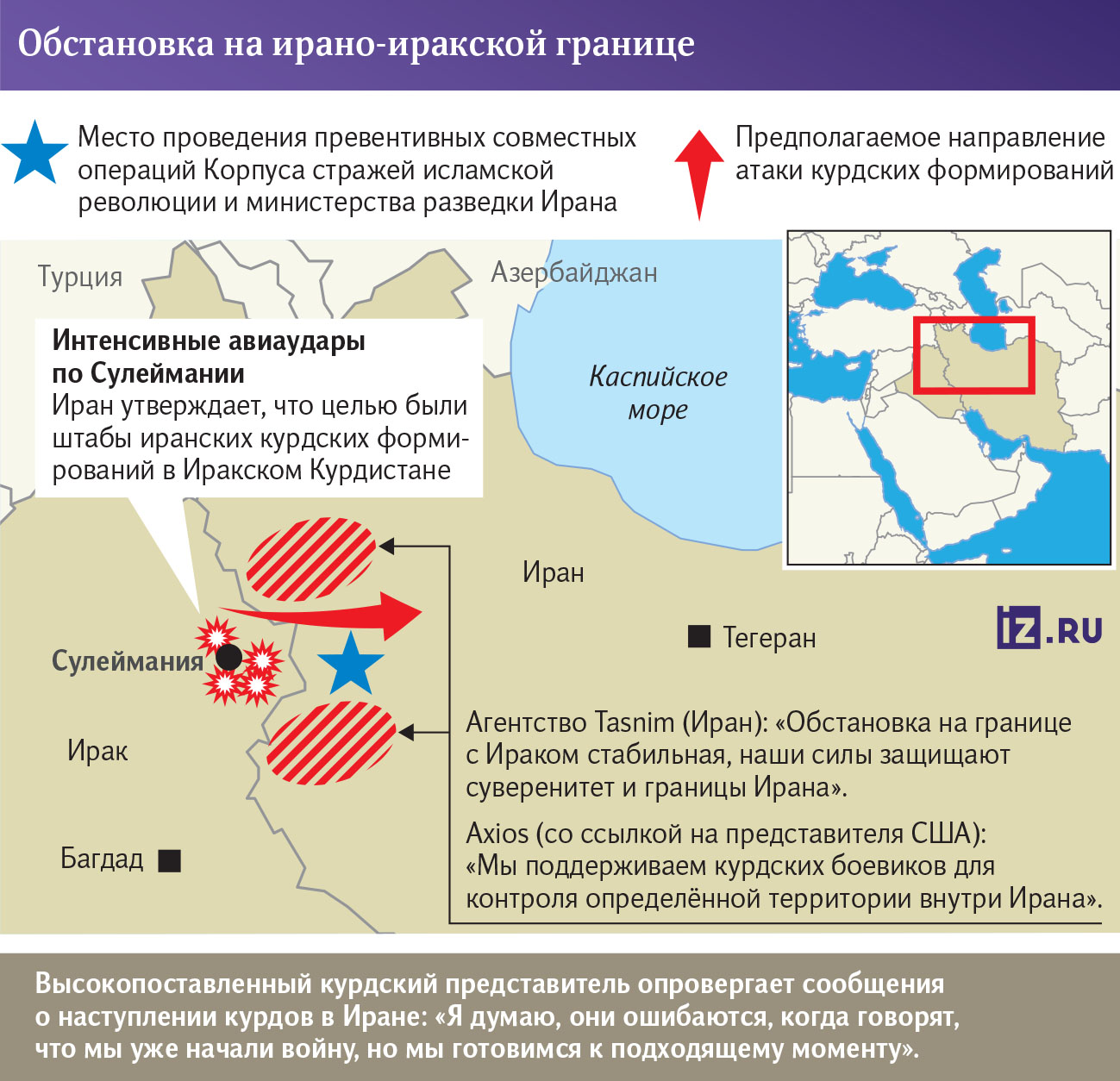
At the same time, the current crisis is capable of intensifying the long-standing confessional confrontation between the Sunni states of the region and the so-called "Shiite axis", which is associated with Iran. This term usually refers to a network of forces and movements allied to Tehran, from Lebanese Hezbollah to Shiite militias in Iraq and Yemen.

Sunni-Shiite confrontation
Shiites make up approximately 10-15% of the Muslim population of the Middle East, live in most countries of the region, and in some their presence plays an important political role.
In Saudi Arabia, the Shiite community also makes up about 10-15% of the population. She lives compactly in the eastern provinces, where a significant part of the country's oil infrastructure is located. The authorities traditionally view them as a potential factor of instability, fearing influence from Iran.

Such internal factors make the Saudi leadership particularly sensitive to Iran's growing influence in the region. Over the past decades, it has been the rivalry between Tehran and Riyadh that has largely determined the configuration of Middle East politics.
This confrontation is often described as a competition between two confessional centers of power. Saudi Arabia has traditionally been one of the main patrons of the Sunni world, while Iran positions itself as a defender of Shiite communities and allied movements in the region.

According to Musalam Sheaito, head of the Al Mayadeen TV channel office in Russia, Washington often uses Sunni-Shiite contradictions as a tool of pressure on regional rivals. According to the analyst, such tactics have already been used during the conflicts in Syria and Lebanon, where the confessional factor has become one of the elements of the political and military struggle.
The expert community also discusses the role of the United States and its allies in using regional contradictions to put pressure on Iran. Washington has been developing military and political ties with the Arab monarchies for decades, deploying its bases in the region and expanding defense cooperation. This forms a kind of containment belt around the Islamic Republic.

Musalam Sheaito noted that the Gulf states are actually following the US political line in the current crisis, even though they themselves are among the victims of the escalation.
Historically, the differences between Sunnis and Shiites go back to the question of the succession of power after the death of the Prophet Muhammad. While in the Sunni tradition the leader of a community can be elected or appointed, in Shiite Islam the key role is played by the line of spiritual leaders — imams descended from Ali, the son-in-law of the prophet. In practice, these theological differences have long become a tool of geopolitics. Rival states often mobilize the religious factor to strengthen their own positions and expand their influence in neighboring countries. The wars of recent decades have shown that the confessional factor can exacerbate political and military crises. The current escalation around Iran and Israel also risks re-actualizing these contradictions.
Special attention was also drawn to the strike on February 28, which led to the death of Iran's supreme leader Ali Khamenei. The event took place during the Muslim holy month of Ramadan, which gave the event an additional symbolic meaning. Such a coincidence could strengthen the religious mobilization of Iran's supporters and give the conflict a more pronounced confessional connotation.
Musalam Sheaito believes that the attack on the supreme leader of Iran actually turned out to be a mistake. In his opinion, Americans underestimated the psychology of Shiites, for whom death is not perceived as the end, but as a continuation of the path and the opportunity to become a martyr. The death of leaders during the sacred months strengthens, rather than weakens, the Shiite community, such actions enhance Iran's consolidation and ideological resilience rather than undermine it, the expert added.

Iran is going through a transitional period after the death of the country's supreme leader. Before his death, religious restrictions on Shiite teachings effectively prohibited the development and use of weapons of mass destruction, including nuclear weapons, but an increased external threat could change the republic's policy. Iran has a fatwa prohibiting the creation of weapons of mass destruction, Musalam Sheaito recalled.
— But now there is a period when there is no leader, which means that power is in the hands of non-religious people, an irreligious government. Yes, maybe they will resort to this method (accelerating the nuclear program. — Ed.) and protect themselves. Otherwise, as everyone says, if you don't have a strong weapon, you can't defend yourself," he added.
At the same time, the expert admitted that the United States, if it does not achieve its goals, may resort to extreme measures, including nuclear weapons.
Переведено сервисом «Яндекс Переводчик»
