- Статьи
- Society
- Once upon a Time in Bollywood: one in eight businesses is ready to hire workers from India and Africa

Once upon a Time in Bollywood: one in eight businesses is ready to hire workers from India and Africa

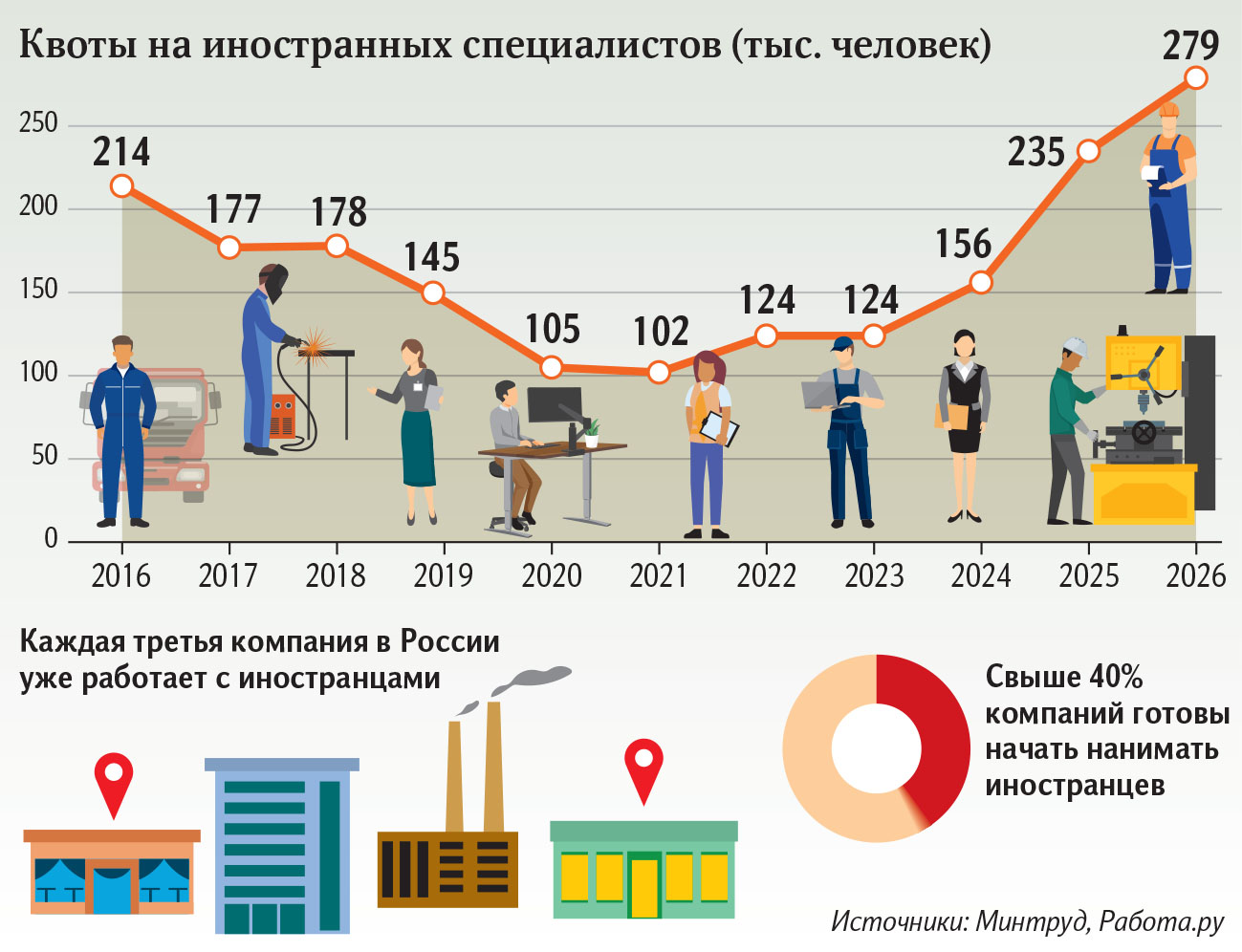
Every third company in Russia is already attracting foreigners, and more than 40% are ready to follow their example. At the same time, 13% of employers consider candidates from Africa and India, according to the study "Jobs.<url>" and "SberPodbora" (Izvestia has it). Businesses are running out of people, and opportunities to participate in the "salary race" are dwindling. Against this background, Russia is becoming an increasingly attractive destination for migrants: in 2026, the quota for workers from visa-eligible countries has been increased to 279,000, 19% more than a year earlier. How the influx of foreign personnel is changing the labor market and which specialties are in demand the fastest — in the material of Izvestia.
Which countries do businesses hire migrants from?
Today, 37% of Russian companies employ foreign employees. More than half of them are big businesses. Another 43% of employers are ready to consider this option, and only a fifth do not plan to hire people from abroad. This is stated in a study of large recruitment services: over 300 business representatives from all regions of the country participated in the survey.
The interest in foreign personnel, especially for mass positions, has noticeably increased, said the Deputy General Director of "Work.<url>" by Alexander Veterkov. Previously, only 5% of companies declared hiring foreigners, while 23% expressed their willingness to do so.
The geography of recruitment is also changing, he added. Employers have been actively hiring employees from CIS countries for a long time. However, due to the growing shortage of staff, the business is gradually expanding its search. Against the background of a record shortage of employees, companies began to attract people from Africa, Latin America and South Asia more often — this trend was previously highlighted by the Central Bank in its February report on the regional economy.

According to a study by the services, the EU countries (54%), the CIS countries (38%), as well as the EAEU and Asia — China, North Korea, Thailand and Cambodia (21% each) are leading among the desired sources of labor. Every eighth employer is ready to consider candidates from Africa, including from the Central African Republic, Nigeria and Zimbabwe, as well as from India (13% each). The respondents could choose several answers.
In 2025, the most noticeable growth was provided by the countries of Asia and Africa, shared Alexander Veterkov. The undisputed leaders are China, India, Bangladesh and Turkmenistan. He also named Vietnam, Indonesia, Sri Lanka, Pakistan and Myanmar among the fast-growing destinations.

Russia is gradually occupying a niche that is being vacated in more expensive or closed labor markets. According to the expert, foreigners are offered official contracts for up to three years, housing and health insurance, which citizens of India and Sri Lanka especially pay attention to. Against this background, many choose Russia instead of the UAE and the Persian Gulf countries, which are popular destinations for migrants.
There, the competition is higher, the requirements are tougher, and the kafala system (which operates in a number of countries in the region: without the consent of the authorities, a migrant cannot change jobs or leave the country) actually binds the employee to the employer, Alexander Veterkov said. With a comparable or higher income, the entry threshold to the Russian Federation is lower.

Russian President Vladimir Putin and Indian Prime Minister Narendra Modi at the plenary session of the Russian-Indian Importers Forum in New Delhi, December 5, 2025
The development of cooperation is also being consolidated at the interstate level. Following Vladimir Putin's December visit to New Delhi, a package of documents was signed, including an agreement on temporary employment of citizens of the two countries. It makes it easier to hire Indians in Russia and Russians in India. At the same time, visitors receive the rights provided for foreign citizens and are required to comply with Russian legislation.
The mechanism for attracting workers from "visa-free" states operates through a quota system. In July 2025, the Ministry of Labor announced that the total limit for this year is 235,000 people, of which 72,000 are for Indian citizens. The volume is formed according to the requests of the regions with a confirmed shortage of personnel, then the proposals are reviewed by an interdepartmental commission and approved by the government.
For 2026, the quota has been increased by 19%, to 279 thousand people. This is the highest figure for at least the last decade, Izvestia calculated. However, there is no official breakdown by country. The editorial board sent a request to the Ministry of Labor.
Why companies are willing to recruit foreigners
Business is turning towards migrant workers for several reasons, noted Alexander Veterkov. First of all, due to the acute shortage of staff. In logistics, construction, and trade, the deficit reaches 40-50%, and companies cannot fulfill orders without an influx of people from abroad.

The second factor is predictability, the expert continued. Employees from visa-eligible countries such as India and Vietnam arrive by quota and are assigned to a specific employer for the duration of the permit. Unlike CIS workers who work under a patent and can quickly change jobs, they are less susceptible to turnover, which is especially important for long-cycle industries.
The third reason is economics. Despite the cost of registration and relocation, the final costs are reduced by reducing downtime and staff stability.

An additional incentive was the reduction in opportunities to raise salaries against the background of slowing demand, expensive loans, the tax burden and the cancellation of benefits on insurance premiums for some small businesses, said Olga Belenkaya, head of the Macroeconomic Analysis Department at Finam.
According to Rosstat, by the end of 2025, the need for personnel reached 2.7 million people, Nina Yakovenko, associate professor of the Department of Business and Labor Law at the O.E. Kutafin University (MGUA), recalled. The most acute shortages are in construction, industry, mining, agriculture, logistics, shipping, and the hospitality industry.

The expert explained China's leadership in the influx of migrant workers by the participation of its citizens in projects of Chinese corporations — in the construction of bridges, roads and factories.
According to Nina Yakovenko, in 2024-2025, residents of Central Asia and a number of African countries were most actively attracted to working and construction positions. At the same time, citizens of China, Turkey, the United States and EU countries are more common among highly qualified specialists.
How to employ a migrant in Russia
The order of registration depends on the status of the visitor, she continued. Citizens of the EAEU countries can work under an employment contract without a patent. People from other visa-free countries apply for it on their own. For visa employees, the employer must obtain permission to attract and use foreigners.
Hiring from abroad is much more difficult than from the CIS countries, Alexander Veterkov noted. Employers face strict quotas and industry restrictions, multi-stage registration, language and cultural barriers, which increase the risk of turnover. Hidden expenses include assistance with housing, documents, catering, and transportation. An additional problem is the shortage of qualified specialists and the bureaucracy in attracting them.

According to him, the deadlines for closing vacancies are growing, and the number of recruitment stages is increasing. Companies are often forced to involve specialized migration support specialists or involve contractors at certain stages of registration.
At the same time, control over compliance with migration and labor laws is being tightened, and violations face heavy fines, Nina Yakovenko from the Moscow State Law Enforcement Agency reminded. Therefore, the idea that foreign labor can significantly save on the wage fund is gradually losing relevance.

The pros and cons of the influx of foreign workers
Foreign workers mostly close segments with acute staff shortages, which helps to partially balance the labor market and reduce economic stress, said Farida Mirzabalayeva, Associate Professor of the Basic Department of the Chamber of Commerce and Industry "Human Resource Management" at Plekhanov Russian University of Economics. According to her, this allows us to maintain production activity.
At the same time, staff shortage remains one of the pro-inflationary factors, Alexander Veterkov added. The influx of migrants cools the "wage race" in low-skilled segments and helps businesses contain rising costs. Foreigners occupy positions that Russians are reluctant to take - construction, housing and communal services, ancillary work. This indirectly reduces the bias when people with higher education en masse become couriers due to high incomes.

However, the growing interest in foreign personnel is more often a forced measure than a strategic choice, says Alexander Shkarupa, brand director and founder of the Dynamics agency. In his opinion, it is necessary to change the approach to education and increase labor productivity within the country. Educational institutions should train qualified specialists for industry and the service sector, rather than formally issue diplomas.
In parallel, businesses should invest more actively in automation, digital solutions, and process optimization. According to the expert, these tools can become sustainable growth drivers without dependence on the influx of low-skilled labor.
Переведено сервисом «Яндекс Переводчик»
