
Atmosphere of influence: Russia will test a replacement for the Starlink system

In March, Russian developers will begin test flights of the Argus stratospheric drone, which is potentially capable of providing Russian troops and other users with high-speed Internet, similar to the Starlink system, Izvestia found out. In addition, Argus will be able to jam enemy communications and monitor the surface in real time. It will operate at altitudes from 15 to 24 km, inaccessible to light air defense systems. The tests will start with a smaller model, and if successful, they will assemble a full-fledged version with a wingspan of 40 m. The Russian Defense Ministry said on February 17 that the recent shutdown of the Starlink terminals had no effect on the command and control system of troops in the free zone, but experts see the need to create additional alternative communication channels for the needs of the army. Whether Argus is suitable for these purposes is described in the Izvestia article.
The economy of the stratosphere
Argus's functionality is similar to artificial Earth satellites, and its main feature is its altitude. The device will operate at a distance of 15 to 24 km from the earth. At the same time, man-portable air defense systems (MANPADS), such as Igla and Verba, reach targets at an altitude of up to 15 km. Thus, in order to shoot down the Argus, the enemy will have to use heavy missiles, such as the S-300 or Patriot.
— The price of such a missile is many times higher than the cost of the drone itself. Even if the enemy decides to shoot down the Argus, he will spend millions of dollars destroying the device at a cost of pennies. This is an economic victory even before the start of the battle," Nicholas Oxman, head of the stratospheric UAV project, told Izvestia.

According to him, the device should be in flight for almost unlimited time and use solar energy for this. Flight control is performed in automatic or manual mode. Unlike satellites that continuously move in orbit, Argus will be able to fly to the desired zone and hover over it.
— Argus can act as a communications operator, as it is able to transmit high-resolution video, provide front-line communications and control other drones. This is important, given the fact that Russia does not have a very large group of satellites capable of transmitting such volumes of data in real time," the developer noted.

The device can also be used as a universal "jammer". Modern Western weapons largely depend on satellite navigation and communications. The antennas of these systems are pointing upwards, and to hide them from ground-based electronic warfare (EW), it is enough to put the terminal in a trench or place it in the folds of the terrain. Argus, being in the stratosphere, sees the target from above, making the enemy's defense useless.

Due to the ability to return to earth, the requirements for the electronics of a stratospheric drone are lower than for satellites flying into space "one way", which makes the device cheaper.
In addition, Argus will be able to find applications in the civilian sphere, for example, to monitor the ice situation on the Northern Sea Route, where conventional satellites often do not provide an operational picture, and to provide information for agricultural needs, said Nicholas Oxman.
Physics versus Ambition
Today, the issue of operational expansion of the orbital group to provide broadband Internet access is extremely acute. Domestic developments in this area are still lagging behind their Western counterparts in terms of deployment rates, Pavel Sergeev, a veteran of communications of the Armed Forces of the Russian Federation, told Izvestia.
— Against the background of the fact that the Americans have blocked the Starlink terminals in the SVO zone, the creation of additional alternative communication channels for the needs of the Russian Armed Forces and especially for units in the special operation zone is becoming a matter of national security. It is impossible to quickly fill the shortage of satellites in low orbit, therefore, attention to stratospheric unmanned vehicles is justified and timely," he said.

In early February, SpaceX limited the use of Starlink satellite communications in its area. All terminals that have not been verified by the Ukrainian authorities and are not included in the relevant lists have stopped working.
On February 17, Russian Deputy Defense Minister Alexei Krivoruchko stated that "the shutdown of the Starlink terminals did not affect the command and control system of troops, units and units in the free zone," and "the communications and control systems in service ensure a stable exchange of information through closed channels."
Valery Tishkov, head of the Main Communications Directorate of the Russian Armed Forces, said that the Russian army has "enemy communications equipment (Starlink. — Ed.) were used only by individual units and primarily to mislead the enemy."
According to Pavel Sergeev, the presented project of a high-altitude guided vehicle has serious potential. Although the claimed payload of 40 kg with a total weight of 315 kg is a debatable indicator. On the one hand, Russian communication equipment is often heavier than its Western counterparts, so the device may not have enough "payload capacity". On the other hand, it is extremely difficult to increase it, since every extra kilogram requires additional battery power, which is very heavy in itself.
— Difficult hydrometeorological conditions in the stratosphere remain a key challenge for such systems. The speed of movement of air masses at these altitudes is significantly higher than in the lower atmosphere, which creates enormous wind loads on the structure with a large wingspan. The developers will have to prove the stability of the device in these conditions," Pavel Sergeev emphasized.

The developers are currently completing the assembly of a smaller version of the UAV with a 7 m wingspan in order to begin flight tests in March. They will test the aerodynamic characteristics and operation of control systems in real conditions. After confirming all calculations, the company will begin construction of a full-scale version with a wingspan of 40 m.
The idea of using solar-powered stratospheric aircraft as pseudo-satellites is not new. Major players such as Boeing, Airbus, NASA and ESA have invested heavily in this area, but it has not yet reached commercial operation. The main problem is fundamental physics, and not just a lack of funding, says Dmitry Kuzyakin, chief designer of the Center for Integrated Unmanned Solutions (CCDB).

— Unlike a spacecraft that is in orbit "for free" in terms of energy, a stratospheric aircraft needs a huge amount of energy to maintain flight. During the day, it works as a storage device, and at night it has to expend energy not only on the payload (radio equipment), but also on the operation of the engines in order to simply stay in the air," he explained to Izvestia.
According to the expert, at the moment there are three stop factors affecting the introduction of stratospheric aircraft. The first is the energy balance. The current efficiency of solar panels and the energy density of batteries do not allow the device to stay in the air continuously for a long time. The "night mode" of planning requires enormous reserves of energy for subsequent lifting.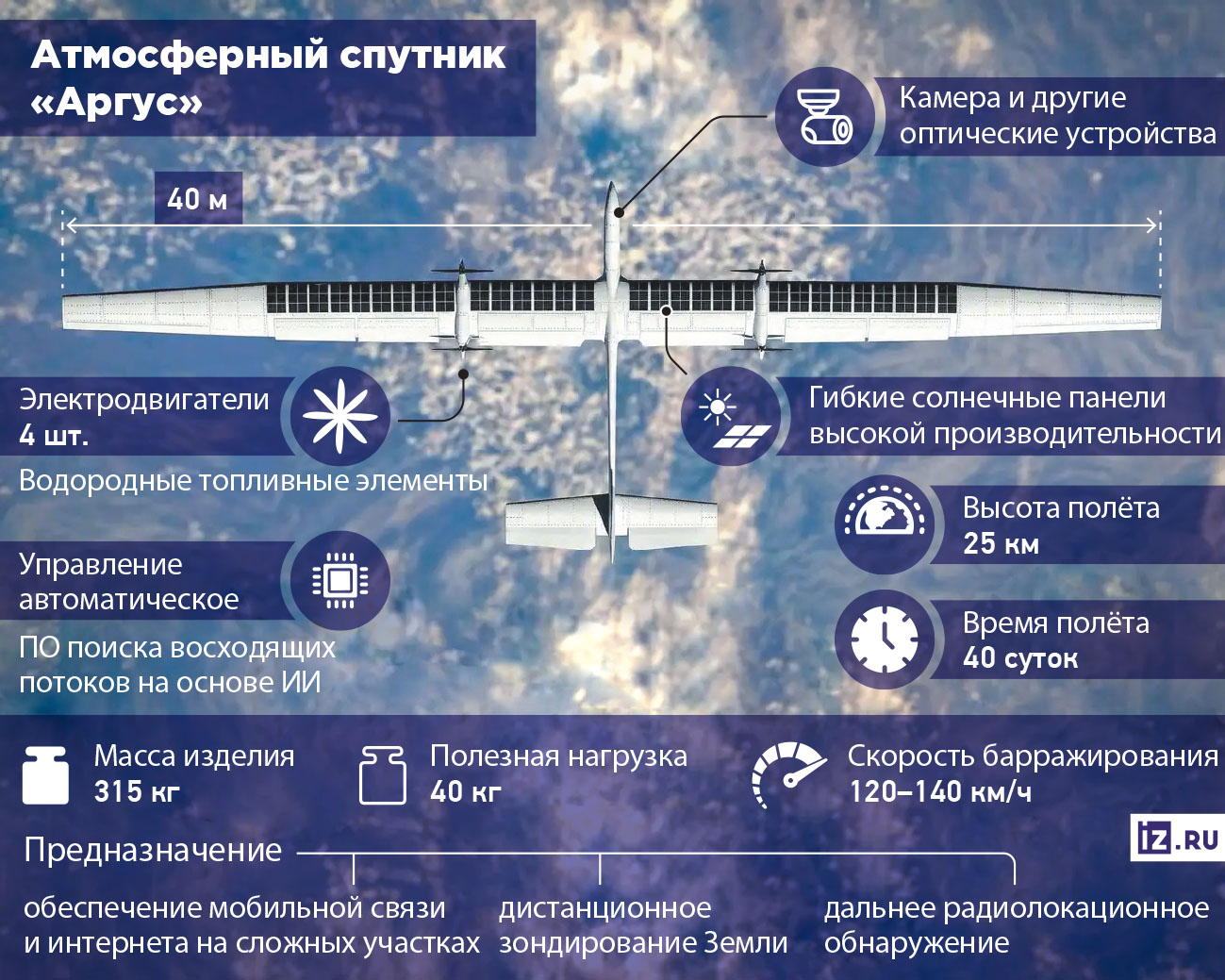
— The second factor is atmospheric conditions. The "western shift" in the stratosphere is the constant powerful winds. It is energetically impossible to hold the plane in place, resisting this element. The third factor is materials science. To fly at the stated altitude, the device must be ultralight, but at the same time incredibly durable to withstand turbulence," Dmitry Kuzyakin added.
Google's attempts with the Loon guided balloon project proved that it is technically possible to solve the problem of communication from altitude, but it turned out to be more expensive than a low-orbit satellite constellation such as Starlink. Moreover, balloons are more efficient than airplanes, since they do not waste energy on maintaining lift, the designer noted.
Dmitry Kuzyakin believes that if Russian developers have really succeeded in creating a device capable of staying at a point above a given area for a long time, this will mean a breakthrough in the field of materials science and battery capacity. However, to verify this, it is necessary to see the confirmed results of long-term autonomous flights.
Переведено сервисом «Яндекс Переводчик»
