The secret of the material: the "hidden" state of the magnet will increase the speed of hard drives
- Статьи
- Science and technology
- The secret of the material: the "hidden" state of the magnet will increase the speed of hard drives


Scientists have found a way to control the magnetic properties of materials using a laser at room temperature. A short pulse puts matter in a special "hidden" state, allowing you to instantly switch the directions of magnetic moments. As experts told Izvestia, this paves the way for the creation of ultrafast next-generation data storage and processing systems. For example, ultra-high-speed hard drives for computers.
How magnetic storage media work
Scientists have moved closer to creating data storage devices that will work on new principles. Specialists from the A.F. Ioffe Institute of Physics and Technology of the Russian Academy of Sciences and colleagues proposed changing the magnetic state of a special substance, an antiferromagnet, at room temperature by exposing it to a laser. Previously, scientists mainly tried to use this method of controlling an antiferromagnet only at very low temperatures — from -196 to -269 degrees, which is not suitable for real devices.
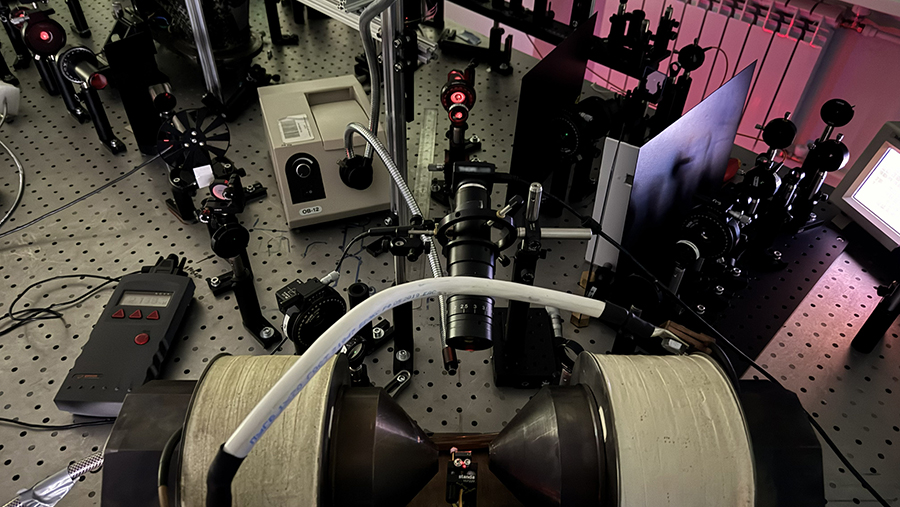
As the scientists explained, in order to use magnetic material as a storage medium, for example, to write "0" or "1" in a computer's hard drive, you need to be able to switch the directions of magnetic moments in it — microscopic "magnetic arrows". At the same time, it is important that the magnetic moments are strictly ordered (everyone is looking in a certain direction), because only in this case does the material create a clear and stable magnetic signal that ensures the recording and extraction of information from the medium.
Existing magnetic memory technologies use so-called ferromagnets, which include, for example, iron, cobalt and nickel. The magnetic moments of the atoms in them are spontaneously aligned in one direction strictly parallel to each other. An external magnetic field can switch them all (reverse their direction, for example, for recording and transmitting data), but it cannot be done quickly, which limits the further development of memory devices based on such materials. Antiferromagnets, another class of materials in which the magnetic moments of neighboring atoms are oriented in opposite directions, can serve as a faster alternative. However, there is still a search for a fast and effective way to switch the magnetic states of antiferromagnets at room temperature.
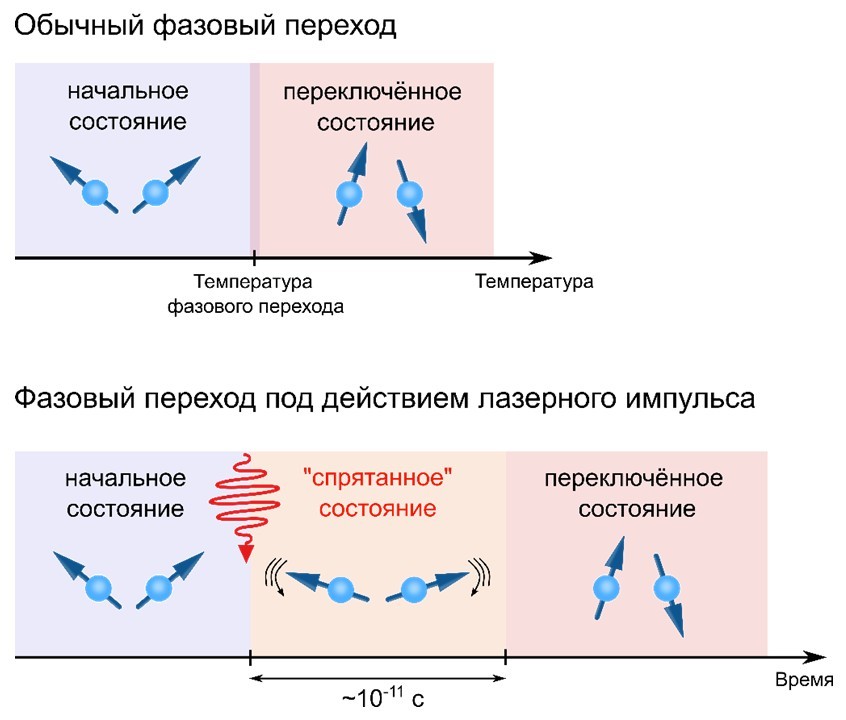
The authors conducted experiments with iron borate, a material based on iron, boron and oxygen. This antiferromagnet has two groups of magnetic moments, which are directed opposite to each other and slightly oblique (they do not lie strictly parallel). Interestingly, when heated to +140 degrees, the magnetic moments in this material turn sharply by 90 degrees (a so-called magnetic phase transition occurs). This can be compared to how ice at 0 °C turns into water, only much faster.
Physicists exposed the material to short laser pulses and determined that under such conditions the direction of the magnetic moments changes dramatically. At the same time, the authors discovered for the first time that such a process goes through an intermediate "hidden" state, which cannot be observed under normal conditions.
"For the first time, we were able to quickly switch the magnetic state of an antiferromagnet with a laser at a temperature slightly above room temperature," said Anna Kuzikova, a project participant and a junior researcher at the Laboratory of Ferroic Physics at the Ioffe Institute of Physics and Technology of the Russian Academy of Sciences.

Ultra-fast hard drives
The "hidden" state exists for only millionths of a microsecond, after which, due to laser heating, the magnetic moments of the atoms finally turn 90 degrees, that is, the magnetic state of the material switches. Despite such a short time of existence, the "hidden" state turns out to be crucial for how quickly the switch will occur and whether it will be complete.
— The results show that short laser pulses are able to change the magnetic state faster and more gracefully than a magnetic field or electric current. Their use opens the way to the creation of energy—efficient and high-speed memory and logic components," said Anna Kuzikova.
This technique can be used to create magnetic memory elements and logic circuits of a new type, as well as spintronic devices in which information is encoded by the magnetic state of electrons, modified by an optical pulse, Andrey Mironovich, associate professor of the Department of Materials Technology of Electronics at NUST MISIS, told Izvestia.
— We are talking about ultrafast magnetic recording devices, including promising versions of hard drives and MRAM (random access devices based on spin gates). State switching in them can occur in an ultra—short time without loss of data stability," he said.
The new method provides a very high switching speed and reduces energy consumption due to laser control. In addition, such devices will potentially heat up less during operation, the scientist noted.
— Experts have shown a new physical effect, due to which a change in the direction of magnetization occurs. In general, the study of the process of remagnetization of materials is relevant, as it is aimed at developing devices for recording and storing information with higher performance. The method of optical remagnetization using a laser presented in the article makes it possible to achieve this effect," Alexey Ustinov, Professor of the Department of Physical Electronics and Technology (FET) at St. Petersburg State Technical University LETI, commented on the work.
The discovered mechanism is applicable in logic technologies and neuromorphic computing. The main advantage of this method is the possibility of control through a "hidden phase," said Alexander Chernov, Chief Researcher and head of the Laboratory of Physics of Magnetic Heterostructures and Spintronics for Energy—saving Information Technologies, professor at the Department of the Russian Quantum Center. The study shows that a laser pulse creates a short-term "hidden" state of matter that is inaccessible under normal equilibrium conditions.
— By adjusting the laser power (fluence), researchers can dynamically control the coexistence of different magnetic phases. This ability to stabilize and adjust the coexistence of phases is a functional requirement for neuromorphic computing, providing a level of control unattainable by standard thermal methods," the expert said.
Scientists from the Scientific and Practical Center of the National Academy of Sciences of Belarus for Materials Science (Minsk) and Saratov State University named after N.V. Chernyshevsky (Saratov) took part in the work.
The results of the study, supported by a grant from the Russian Science Foundation, are published in the journal Physical Review Letters.
Переведено сервисом «Яндекс Переводчик»
