- Статьи
- Society
- Hello, I'm his aunt: scammers are demanding $20 million from Russia for the death of an APU militant

Hello, I'm his aunt: scammers are demanding $20 million from Russia for the death of an APU militant

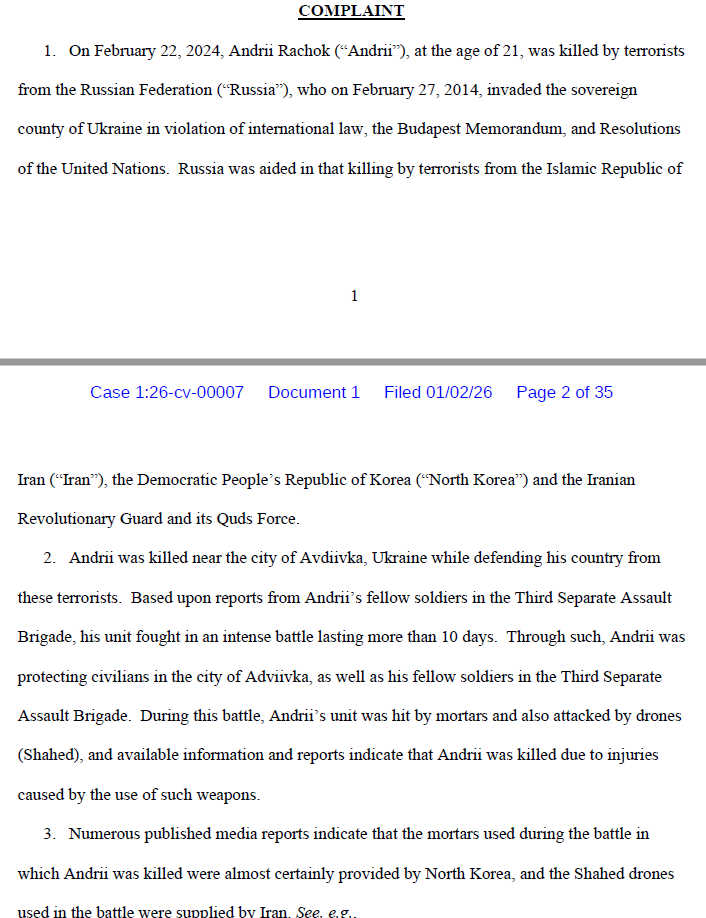
For the first time, a lawsuit has been filed in the United States by ordinary Americans who are trying to recover $20 million in compensation from Russia for the death of a Ukrainian militant, posing as his close relatives, Izvestia has learned. The plaintiff is Tatiana Kimberlin, who calls herself the aunt and "functional equivalent of the parents" of the soldier who died near Avdiivka. She expects to receive funds from frozen Russian assets. Her husband is a political activist, previously convicted in the United States for terrorism, drug trafficking and forgery of documents. He spent at least 17 years in prison. Tanya Chatken, who in 2019 sentenced Russian Maria Butina to one and a half years in prison, was appointed the judge in the case. About how the family of an American repeat offender declared themselves patriots of Ukraine, how they profit from this, and whether there are risks to Russian assets as a result of their lawsuit, see the Izvestia article.
"The functional equivalent of parents"
In the statement of claim dated January 2026, which was filed with the court of the District of Columbia in Washington (Izvestia reviewed the document), it is said that on February 22, 2024, a serviceman of the Armed Forces of Ukraine, Andrei Rachok, was killed near Avdiivka. Further, the lawsuit claims that Iran and the DPRK are also involved in this — these countries are listed as co-defendants in the case, along with the military Quds unit of the Iranian Islamic Revolutionary Guard Corps (IRGC).
Legally, the claim is based on the rules on international terrorism in force in the United States. Iran and North Korea are recognized by the United States as state sponsors of terrorism, and Quds is a terrorist organization.
The text of the lawsuit states that Iran and North Korea allegedly helped Russia with drone strikes and mortars, which were used in the fighting near Avdiivka, and "Andrei died from injuries sustained as a result of the use of such weapons."
The plaintiffs in the case are members of the Kimberlin family from Maryland, all of whom are U.S. citizens. Tatiana Kimberlin calls herself Andrey Rachok's "aunt", her daughters Kelsey and Karina are his "sisters".
"As a child, [Kelsey] spent every summer with him in Ukraine, where she and Andrey were inseparable. When she came to Ukraine in the summer months, she lived in the same house with Andrey. Kelsey's mother, a naturalized U.S. citizen who lives with her in Maryland, was born in the same Ukrainian village as Andrey, and has always treated Andrey like a son. Kelsey considered Andrey her brother, and Andrey Kelsey her sister."
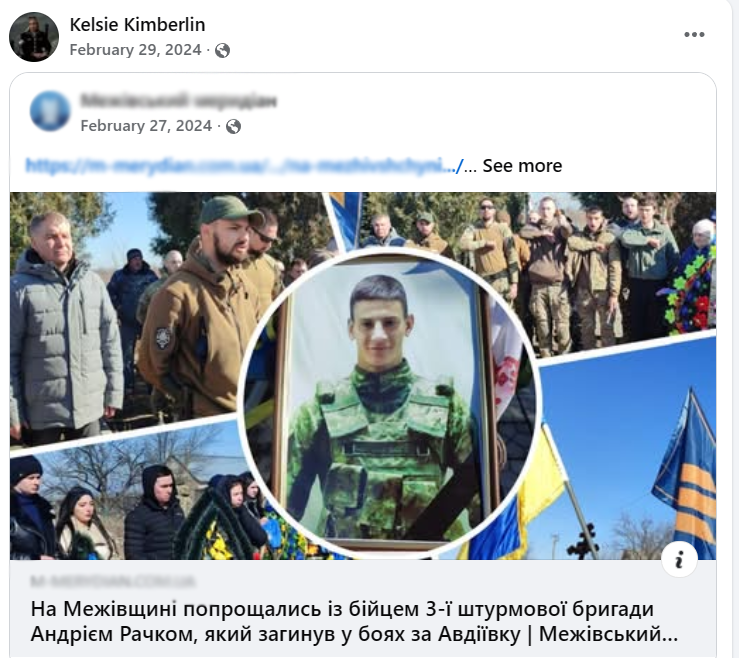
Americans Tatiana and Brett claim that they allegedly "adopted" the Ukrainian after the divorce of his parents and the death of his mother as a result of a long illness. At the same time, they admit that there was no legal "adoption", but they allegedly became the "functional equivalent of parents" for the deceased. The Kimberlin family, as follows from the lawsuit, presented themselves as benefactors for the deceased — they bought him all sorts of things sometime in the past and even paid something "for tuition."
The lawsuit also claims "incessant and painful nightmares," "devastation" and "depression," bouts of "anxiety," "sadness," and "anger," and panic attacks that literally haunt Kimberlin's family members after the death of the Ukrainian Armed Forces militant.
Only money can alleviate all this mental suffering, it follows from the lawsuit. Namely, $20 million in compensation from the Russian Federation, Iran and the DPRK. The plaintiffs expect that this money will be paid to them, including from Russian assets frozen in the United States.
"There is no place to put brands"
Brett Kimberlin is a well—known radical political activist in the United States with a scandalous reputation, as well as a litigator who probably knows a lot about PR.
He is now 71 years old. Immediately after school, he was convicted of lying to the jury that he allegedly did not sell drugs. After his release, he continued to sell drugs. At the age of 24 (in 1978), he detonated several improvised explosive devices to distract public attention from the investigation of a murder committed by his drug trafficking partner. One of the bombs maimed a Vietnam War veteran, who later committed suicide.
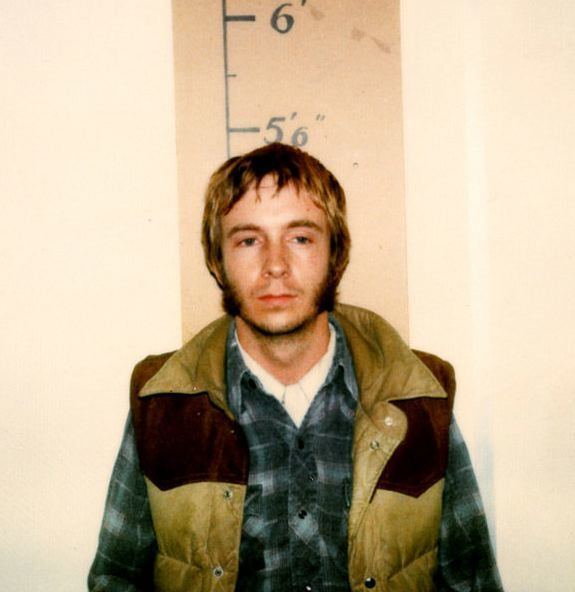
For bombings, forgery of documents (Kimberlin posed as a Pentagon employee) and drug trafficking, he was sentenced to 51 years, but he served only 13, being released early. In 1997, Kimberlin was jailed again for non-payment of compensation to victims and forgery of mortgage documents, this time until 2001.
While still in prison, in 1988, he again attracted media attention: he made an unverifiable statement about compromising evidence against US Vice President Dan Quayle, saying that he allegedly sold drugs to him during his student years.
Kimberlin is the son of a lawyer. While in prison in a terrorism case, by 1992 he had filed over a hundred lawsuits, and in the 2010s he was actively suing bloggers who were digging into his criminal past. With the help of his lawyers, Kimberlin fought for the right of sex minorities to same-sex marriage (the LGBT movement is recognized as extremist in the Russian Federation, banned) and collected dirt on Republicans.
In 2017, it became known that Kimberlin bought fake compromising material on Donald Trump for $9 thousand dollars and tried to attach it to the American media. However, the fakes were too low-grade, and the deception was quickly revealed.
There were reports in the American media that Brett Kimberlin helped the US Democratic Party promote a fake about alleged Russian interference in the US election on Trump's side.
Ukraine — the new business of a veteran of political activism
On his website, Brett states that he has been working to support Ukraine for 30 years: "in the early 1990s, he did business with Ukrainian businessman Valentin Kariman, who was an adviser to President Kuchma," managed Lada International, developed trade between the United States and Ukraine, met Kuchma in Washington, gave him a handmade billiard cue..
However, as Izvestia found out, the Kimberlin website is only a month old — the domain address brettkimberlin.org It was registered almost simultaneously with the filing of the lawsuit against Russia, in early January 2026. This suggests that the website was created specifically "to reinforce" Kimberlin's credibility in the eyes of the judge.
The aforementioned Valentin Kariman was a friend of Viktor Yanukovych and was involved in the automotive business — he traded in Russian Lada cars, he was called the director of Lada-Mac, that is, Kimberlin probably did the same at Lada International.
Brett Kimberlin now runs a non—profit foundation named after his daughter Kelsey, who, as an "American-Ukrainian singer," produces "dramatic clips" in support of the Ukrainian Armed Forces. The Kelsie Kimberlin Foundation was established in August 2023; it does not publish reports, submitting statements to the American regulator indicating that its annual turnover does not exceed $50,000. Earlier, the American media had questions about the cleanliness of the two previous Kimberlin non-profit organizations.
On his website, Brett mentioned that he married a Ukrainian woman in 1996, which is probably the beginning of his support for Ukraine, as he was in prison in 1997-2001.
Risks for Russia
Practice shows that without a political background, such cases simply do not reach court, Arkady Bukh, a New York lawyer who has been practicing since the 1990s, told Izvestia. According to him, such processes last for years and do not always pursue the goal of "getting money," but can be an instrument of foreign policy pressure — just recall the cases against Saudi Arabia in 2016-2017.
At that time, a law called "Justice against Terrorist Sponsors" (JASTA) significantly expanded the jurisdiction of US courts to hold other states accountable. Armed with this act, relatives of the victims and victims of the September 11, 2001 terrorist attack filed lawsuits against Saudi Arabia.
By 2017, the United States had already forced Saudi Arabia to make deals, in particular, to purchase $110 billion worth of American weapons. During the same period, the United States actively encouraged the Saudis to act against Iran. Perhaps that is why there are still no court decisions on the claims of the victims.
But a similar case involving Iran, which does not cooperate with the United States, was completed quickly, back in 2016. The court decided to recover $7.5 billion from Iran in favor of the relatives of those killed at the World Trade Center: $4-12 million each, depending on the degree of kinship. However, there were problems with recovery: Iran began to sue — by 2023, the International Court of Justice had declared illegal the freezing of part of Iran's assets by the United States and demanded compensation to Tehran.
Of the similar difficulties with the direct distribution of frozen money, the main payment tool at the moment is the "Fund for Victims of State Terrorism" (USVSST) under the US Department of Justice. Created in 2015, it has distributed about $10 billion over 10 years. There are no fewer people willing to receive money over time: for example, courts in the United States are still dealing with compensation cases for military families who died in the bombing of the Marine barracks in Beirut (Lebanon) in 1983.
— Getting "jurisdiction" in an American court over a sovereign state and overcoming its immunity is, to put it mildly, very difficult. In relation to Russia, these are only a few cases. Even if this is successful, the question arises of the execution of the decision on which assets to recover. In this case, it is important that Russia is not included in the list of countries that sponsor terrorism. Therefore, Iran and North Korea, which were recognized as sponsors of terrorism in 1984 and 2017, were involved in the construction of the case," Arkady Bukh explained.
As for the choice of a judge in this case, Buch believes that the appointment of Tanya Chatken (who led the Maria Butina case on the "illegal activities of a foreign agent") is more a coincidence than conspiracy theory.
— The appointment of judges in federal courts is automatic according to the distribution system — there are not many judges in the District of Columbia, so the probability of repeated collisions with high-profile cases is objectively higher. The District of Columbia is a traditional choice for lawsuits against other states, and a significant part of such international practice is concentrated here," the lawyer noted.
There are also obvious inconsistencies in the case, Izvestia found. The crustacean did not die from the mythical Iranian "shahed" or its Russian counterpart, and not from an alleged Korean mortar. Ukrainian media reports say that the Crustacean died from the detonation of an FPV drone.
In one of the messages published in connection with the death of a Ukrainian, Rachka's girlfriend is quoted as saying: "When his battalion was sent to Avdiivka, he did not even tell what horror was happening, he just said that it was fun there and he liked this movement." Meanwhile, American Crustacean sister Kelsey Kimberlin advertises Ukrainian wine and raises money for FPV drones for the Ukrainian Armed Forces.
On LinkedIn (the service is blocked by Roskomnadzor), her father's foundation is listed as her place of work, and last year they came up with a "new mission" for the deceased Ukrainian "relative" — under his "banner" Kimberlin lobbied for an increase in the supply of weapons and money to Ukraine.
By the way, in the obituaries of Andrei Rachk published online, there is not a word about the Kimberlins, Izvestia was convinced. It is reported that his mother died, and the next of kin was his grandmother.
Переведено сервисом «Яндекс Переводчик»
