
Land stripping: how and why Romania is preparing to absorb Moldova

Bucharest is working on linking Moldovan and Romanian energy, transport, banking systems and communications, Russian Ambassador to Romania Vladimir Lipaev told Izvestia. According to him, Moldova is undergoing a harsh "Romanization" and an offensive against the Russian language. Experts warn that an attempt to unite in the coming years will unfreeze old conflicts and bring NATO even closer to Russia's borders.
Romania's growing influence in Moldova
At the beginning of the year, the discussion about Moldova's joining Romania intensified. For the first time, President Maia Sandu openly said that she would vote "yes" in a hypothetical referendum on unification with Romania. She explained this by saying that it is becoming increasingly difficult for a small country to resist Russian pressure alone.
Romania reacted cautiously to this idea: President Nicusor Dan noted that the people of the country are ready to unite, but Moldovans themselves must make such a decision. Prime Minister Ilie Bolojan, in turn, called joining Romania "the fastest way for Moldova to join the EU."

Moldovan President Maia Sandu
Bucharest pursues a policy of "Romanianization" of Moldovan society and establishes control over various spheres of the republic's life, Russian Ambassador to Romania Vladimir Lipaev explained to Izvestia.
— Romanian language and Romanian history are taught in schools (instead of Moldovan language and Moldovan history). The canonical expansion of the Romanian Orthodox Church is gaining momentum. Not only ordinary Moldovan citizens, but also leading politicians, including the president, have Romanian passports. Entire spheres of government, including national security, are controlled by former and current Romanian functionaries. The integration of energy and transport infrastructures, the banking system, and communications continues," the diplomat stressed.

According to him, Moldova has traditionally been the focus of Romania's foreign policy as a potential object of territorial expansion. Romanian politicians continue to actively promote the thesis that Romanians live in the Republic of Moldova. At the same time, the Moldovan authorities are attacking the position of the Russian language, the traditional bilingualism in this country. They are trying to tear the Moldovan people away from Russian culture, which has always been their great civilizational advantage.

— The idea is being introduced into the public consciousness in both countries that Romanians and Moldovans are a single but divided people (like the Germans of the times of Germany and the GDR). I don't think it's necessary to explain who, in Bucharest's opinion, separated them. And if so, then their reunification as part of Greater Romania is supposedly a natural and justified process. However, historical realities look different," the Ambassador stressed.
Against this background, Chisinau is consistently severing ties with Russia. In November, the Parliament of the Republic voted to close the Russian House, which had been operating in the country since 2009. In January, the Moldovan Foreign Ministry began the necessary procedures for the country's complete withdrawal from the CIS. As Izvestia reported earlier, the opposition insists on holding a referendum on this issue and is preparing to start collecting signatures.
How Moldovans view the prospects of unification
According to Vladimir Lipaev, the project of unification of the two countries remains on the political agenda. But local experts are confused by the possible cost of the issue: the Romanian budget may not be able to withstand such expenses.
The probability of holding referendums on unification in the coming years is extremely high, and the Moldovan authorities are actively preparing for this event, Nicole Botistianu, an analyst at the Center for Comprehensive European and International Studies at the National Research University Higher School of Economics, told Izvestia.
"For Romania, in the case of unification, the territory of the modern Republic of Moldova will become another poor region that "needs to be fed," and the Romanian educated elites understand this perfectly well," the expert clarified.
The historical factor also plays a role. Moldovans and Romanians parted ways following the results of the Russian-Turkish war of 1806-1812. Bessarabia, which makes up most of modern Moldova, became part of Russia after this conflict. The Romanian principalities remained in vassalage to Turkey. Since then, the process of formation of the two peoples took place independently of each other, they were nothing more than neighbors.

Boteșteanu believes that the loss of sovereignty and a change of status due to joining another state are hardly in the sound interests of Moldovan big business. After all, in this case, the elites will lose their status, becoming part of another country. Moldovan society is even more divided on the issue of joining Romania than Romanian society. According to recent opinion polls, only about a third of Moldovan voters support the prospect of losing their own statehood. In Romania, there are more supporters of unification — about 56%.

It is important to understand that Moldova can join the EU not only through unification with Romania. Today, Bucharest has a powerful competitor in terms of its influence on Chisinau — the European Union, which is inclined to play its own games here. The role of its structures is currently predominant, the Russian Ambassador stressed. Brussels is particularly important in the issue of financing: at the end of 2024, the EU approved an unprecedented "growth plan for Moldova" in the amount of €1.8 billion.
How will the possible unification of Moldova and Romania affect the Russian Federation
If the Moldovan authorities nevertheless decide to join Romania, this will lead to a sharp destabilization of the situation in the region. Radical political actions will activate smoldering conflicts and create new threats to Russia's security.
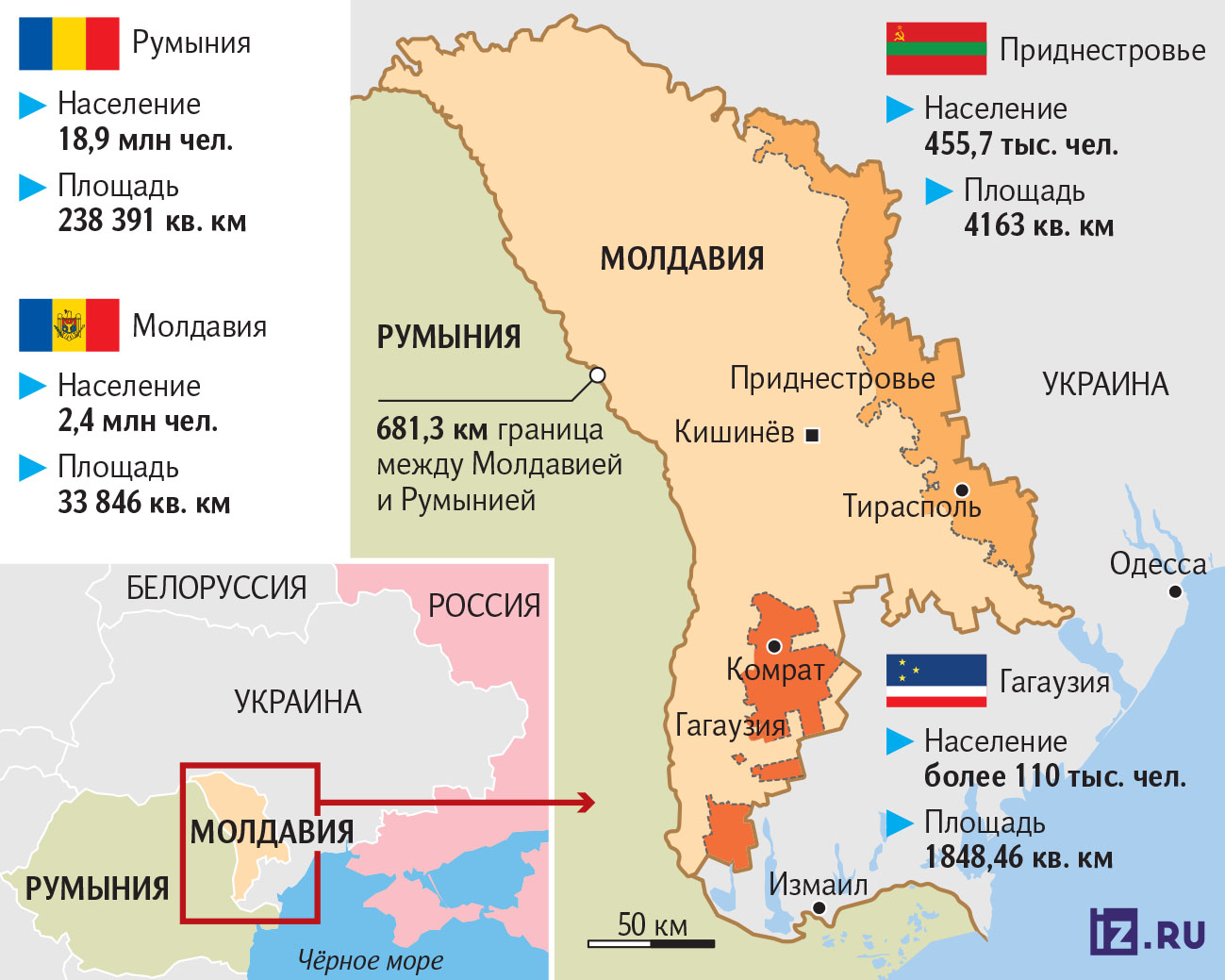
Gagauzia— an autonomous region within Moldova, is categorically opposed to unification with Romania. According to the law on the special legal status of the region of 1994, in the event of a change in the status of Moldova as an independent state, the people of Gagauzia receive the right to external self-determination. In addition, the authorities of Gagauzia are in conflict with Chisinau — in August last year, the head of the region, Evgenia Gutsul, was removed from office and convicted.

The head of the Gagauz Autonomy in Moldova, Evgenia Gutsul
The second point of tension will be Transnistria. According to the SVR, Maya Sandu allowed a military operation in Transnistria back in 2024. The possible unification of Moldova and Romania, especially if it is accompanied by institutional and cultural unification, is highly likely to provoke a new round of tension in Transnistria, Artem Purchun, an employee of the Faculty of World Economy and World Politics at the Center for Comprehensive European and International Studies at the National Research University Higher School of Economics, told Izvestia.
— The region is unlikely to accept the legitimacy of the new government, associated with the Romanian state and Euro-Atlantic structures. This will not only block any attempts at reintegration, but may also lead to a transition of the conflict from a "frozen" state to a phase of active political or even military confrontation.

Against this background, Romania is increasing its military activity on Moldovan territory. With its support, military facilities are expanding, such as the base in Bechoy. The republic remains an important strategic logistics hub for NATO to supply Ukraine. And with the accession of Moldova, the length of the Romanian-Ukrainian border will only increase.
Perchun believes that unification with Romania would mean the final loss of Moldova as a separate subject of foreign policy and, consequently, a reduction in the Russian presence on the western flank of the post-Soviet space. Such a scenario threatens the Russian Federation with the emergence of a new hotspot, where the interests of NATO will clash with the rights of the Russian-speaking population of Transnistria and Gagauzia.
Переведено сервисом «Яндекс Переводчик»
