
Search concerns: Russia lacks helicopters for air rescue services

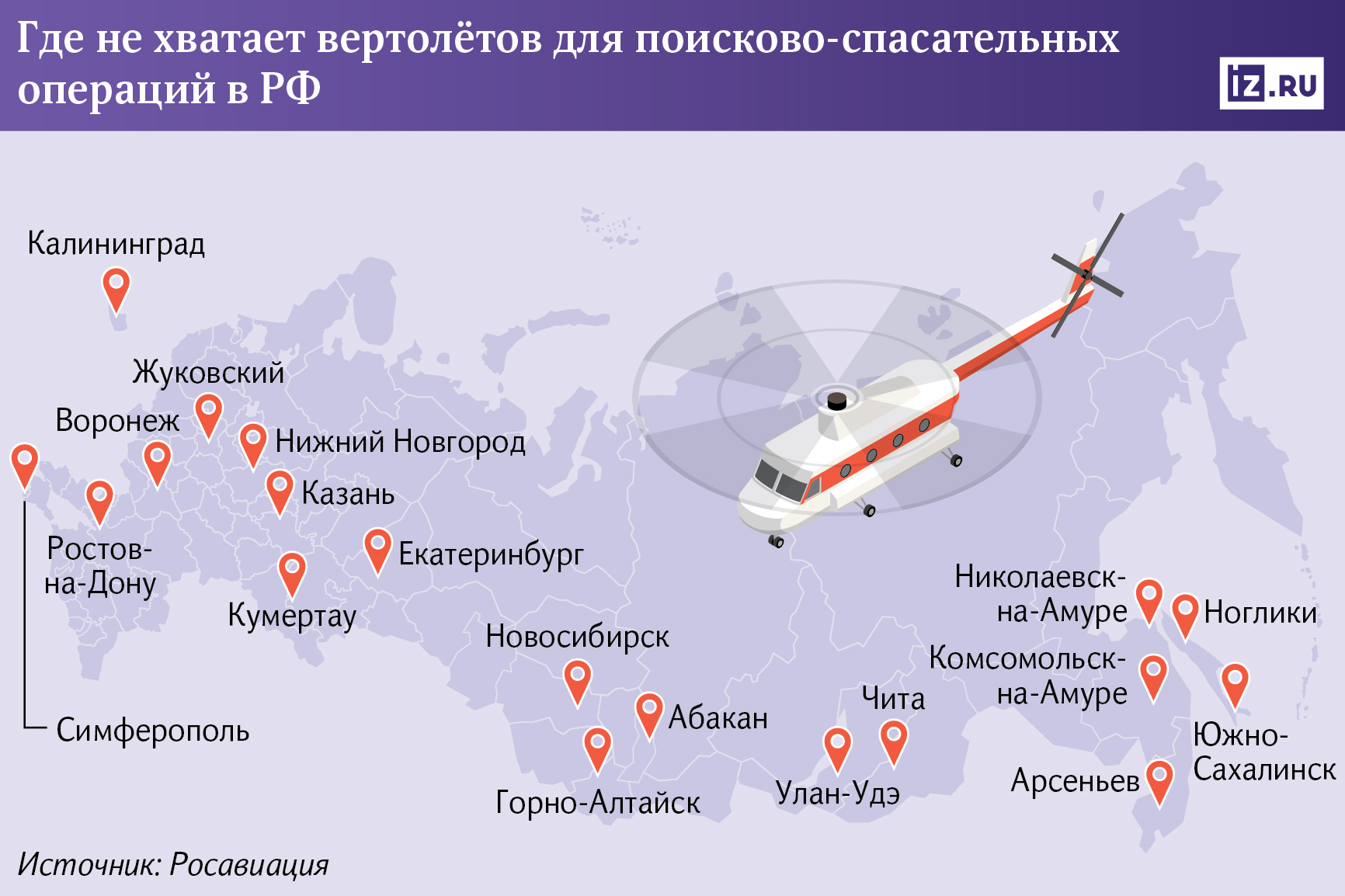
Aviation rescue services in Russian regions may be left without helicopters, as a result of which assistance to disaster victims will be difficult. Currently, almost a third of the 111 approved duty stations for Mi-8 rescue aircraft and An-26 aircraft in the country are not closed — in Voronezh, Kaliningrad, Yekaterinburg, Novosibirsk, Chita, Kazan, Simferopol, Yuzhno-Sakhalinsk, Komsomolsk-on-Amur and other cities. Contracts with airlines and the involvement of their equipment in the work have become a common practice of rescue services. But private carriers refuse to provide these services because of the tariffs at which the State Corporation for Air Traffic Management offers them to work. Now they are 75% lower than the cost of flights, the carriers claim. As a result, bidding on contracts has been disrupted more than once, and in some cities, search and rescue contracts could not be concluded at all due to the lack of contractors. The Federal Air Transport Agency, on the contrary, claims that tariffs have been indexed and can be changed again if necessary, but carriers do not want to explain what they need money for. At the same time, such services annually conduct dozens of rescue operations throughout the country. Izvestia investigated what is happening in this area.
Why helicopter pilots don't want to work as rescuers
Air rescue services may face a shortage of helicopters, which will eventually have a negative impact on disaster victims. As Izvestia found out, there is already a shortage of rescue Mi-8 and An-26 aircraft in 31 of the 111 duty stations for such equipment approved by the Federal Air Transport Agency. In particular, in Voronezh, Kaliningrad, Yekaterinburg, Novosibirsk, Chita, Kazan, Simferopol, Yuzhno-Sakhalinsk, Komsomolsk-on-Amur, Nikolaevsk-on-Amur, Rostov-on-Don, Nizhny Novgorod, Zhukovsky, Gorno-Altaysk, Abakan and a number of other cities.

The Federal Air Transport Agency has a unified aerospace search system (FBU "EU AKPS Service"), which rescues victims of aviation accidents, as well as all those in distress at sea. Rescue teams are on duty at the base, flying to the emergency site in helicopters that they rent from airlines.

However, helicopter airlines have recently been unwilling to continue search and rescue and aerospace search operations without raising government tariffs, the carriers told Izvestia. At least in 13 regions of Russia, long-term contracts totaling 3 billion rubles were ignored during 2025, according to the results of the State ATM Corporation's purchases over the past year. Izvestia has reviewed this data.
Rescue teams are based at airfields designated by the Federal Air Transport Agency, are on duty around the clock and are required to fly to the scene of an aviation emergency within half an hour, Roman Gusarov, editor-in-chief of the <url> portal, an expert, told Izvestia. They are trained to operate in extreme conditions, and can land from helicopters on hard-to-reach terrain. The same services work in the interests of Roscosmos, looking for descent vehicles, are the first to arrive at the cosmonauts' landing site or rescue them in case of an emergency landing, the expert added.

Too low tariffs push the economy of the PSO below profitability, which is why airlines cannot maintain the technical condition of helicopters and their airworthiness, which affects flight safety, according to Izvestia's sources in the airlines.
— On average, a month on duty at the PSO costs the airline about 6.3 million rubles. These costs include not only salaries, fuel, and airport fees, but also helicopter airworthiness maintenance, depreciation of equipment, and more," Vadim Baldin, director of Gelix Airlines, told Izvestia. — The cost of maintaining the airworthiness of aircraft has increased by more than 800 thousand rubles per month, airport services have increased in price by 30%, the wage fund by 15%, and travel expenses related to crew accommodation at the duty station have doubled.
As a result, in 2025, auctions for state contracts for PSO using Mi-8 helicopters did not find participants in Chita, Yekaterinburg, Blagoveshchensk, Irkutsk, Gorno-Altaysk, Samara, Chelyabinsk, Perm, Kyzyl, Novosibirsk, Bratsk, Smolensk and others. In Abakan, auctions were disrupted three times (in February, July and December 2025). The ATM Group raised the price from 114 to 119 million rubles, but the contract did not find any interested parties and was left until better times.

In Yekaterinburg, auctions for contracts in the amount of 131-137 million also failed three times, they were postponed to this year. A similar situation has developed in Gorno-Altaysk, where auctions have not found participants, and the contract for 111 million rubles has been postponed to 2026.
During the bidding process, the ATM Group raises the price slightly, but the proposed tariffs do not take into account the increase in costs in 2025. As a result, in long-term two-year contracts, the cost of a month's duty fluctuates around 5 million rubles, including VAT. This is lower than profitability, which creates a significant gap in the airline's budget, which there is nothing to close, notes Vadim Baldin.
According to Gelix Airlines, in order to make the work profitable, it is necessary to raise fares not by 13-20%, but by at least 75%.
"It is difficult to fit into the current procurement budgets of the ATM Group, even for Mi-8T helicopters, which have lower airworthiness costs, lower depreciation and no lease payments," Dmitry Zhelyazkov, Deputy General Director of Converse Avia Airlines, told Izvestia. — Such helicopters are usually 30-40 years old. If you work with more modern and powerful Mi-8MTV/AMT leased or acquired, the cost of services will increase 1.5–2 times.
Therefore, few people today want to sign long-term contracts for PSO services. Tariffs for ongoing purchases are below the profitability thresholds according to the airlines' internal calculations and are unprofitable, the market participant noted.

In order to at least partially close the gaps in the locations of the PSO, it is possible to conclude short-term contracts in order to have time to leave due to losses, a source at one airline said.
If the situation does not change and the tariffs do not approach economically reasonable ones, the number of gaps in search and rescue support for the territories of the Russian Federation may increase by 1.5-2 times in 2026, believes a source of Izvestia in one of the airlines.
According to the Helicopter Industry Association (AVI), the issue of low ATM tariffs and related problems has been repeatedly discussed in the Federal Air Transport Agency.
The press service of the federal agency told Izvestia that the State Corporation's ATM proposals for 2026 were indexed from 13 to 28%, depending on the location.
"We are ready to review these proposals, but operators need to provide cost estimates — not all applicants are willing to do this," the department noted. — Consultations are continuing, and there are good prospects for concluding an agreement on the deployment of AFVS in Irkutsk. We are waiting for reasoned, digitally backed proposals in Abakan, Gorno-Altaysk and Yekaterinburg.

Izvestia sent requests to the ATM Group of Companies, the Ministry of Transport, the Ministry of Emergency Situations, Roscosmos, and airlines.
Is it possible to replace rescuers on helicopters
The main "workhorse" of the EU AKPS Service remains the Mi-8 helicopters of private airlines operating under contracts with the ATM Group.
— Helicopters are on duty within a radius of 320 km from their base and close not only land, but also sea routes, for example, in Vladivostok, Kaliningrad, etc., — Dmitry Zhelyazkov noted. — If ships are in distress, then helicopters and planes of the air search and rescue service fly to them.

So, in May 2025, two fishermen were in distress in the Barents Sea off the Rybachy Peninsula and were evacuated by rescuers of the Federal Air Transport Agency using Mi-8T to Murmansk. And in April 2024, a sick crew member was evacuated from a Panamanian cargo ship in the waters of the Sea of Japan.
The AKPS forces also searched for the lost An-24 aircraft of Angara Airlines near Tynda. They also flew to the crash site of the helicopter of the carrier "Take-off" in the Khabarovsk Territory in July 2025. These specialists fly out to all aviation accidents, including those involving small aircraft.
In 2024, the Federal Air Transport Agency conducted 41 rescue operations on land and at sea. 187 people were rescued. And if the services are left without helicopters, their capabilities will be significantly limited, experts say.

If there are gaps in duty stations, there is nothing to fill them with, since the Ministry of Defense or the Ministry of Emergency Situations do not always have available helicopters, Dmitry Zhelyazkov said.
— The situation in which the state authorities find themselves is complicated. When calculating the cost of ordered services, indexes published by the Ministry of Economic Development are used," Oleg Panteleev, Executive director of the Aviport agency, told Izvestia. — In turn, airlines are faced with the fact that the cost of services is growing to a greater extent than the deflator indices compensate. As a result, at first this gap "ate up" profits and now carriers are not ready to assume obligations under contracts due to losses.
To reduce costs, airlines have to use An-2 aircraft instead of Mi-8 helicopters, Oleg Kochkin, General Director of Vyatkaavia, told Izvestia. They fit into the proposed fares, as the cost of a flight hour is three to four times lower. The ATM Group is forced to do this, he added.
But if the helicopter, after detecting the victims, can land a group of rescuers on an empty site or parachute from a winch, then they have to jump from the An-2 to the scene with a parachute, he noted.
However, according to Dmitry Zhelyazkov, helicopters cannot always be replaced in search and rescue work.
"Finding the location of aircraft or ships in distress is only half the battle," he says. — It is extremely important to carry out a safe landing of rescuers with special equipment and quickly evacuate people from the emergency site, and it is impossible to do without helicopters here.
Therefore, in order to prevent the reduction of the work of search and rescue services, government support and subsidies to the customers of the PSO are needed, the expert concluded.
Переведено сервисом «Яндекс Переводчик»
