- Статьи
- Society
- To whom the "Inspector General" is going: books stolen in Europe could be sold at the Litfond auction

To whom the "Inspector General" is going: books stolen in Europe could be sold at the Litfond auction

The traces of the sensational case of the theft of rare books of Russian classics from European libraries, the damage estimated at more than $ 3 million, lead to Russia, Izvestia has established. The well-known auction house Litfond may be involved in the sale of some of the stolen rarities. He tried to hide the traces of these transactions: information about suspicious lots — books by Pushkin and Gogol with the seals of the Warsaw University Library — was removed from his website, but preserved in the web archive. The opposite is also the case: Western auction houses Sotheby's, Dreweatts, Gorringe's sell valuable publications that disappeared earlier in Russia and were put on the wanted list by Interpol. For example, Izvestia has discovered the sale of several handwritten Bible sheets dating back to the 11th century and stolen from the Russian National Library. The details of the criminal schemes are in our investigation.
Missing Litfond lots
The well-known Russian auction house Litfond could have been involved in the sale of at least two rare publications stolen earlier from the Warsaw University library, Izvestia has established. This conclusion can be drawn when comparing information about stolen books (in particular, studying their library stamps) with those publications that were sold at Litfond auctions in 2022-2023. We are talking about a collection of poems by Alexander Pushkin in 1829 and the first edition of Gogol's The Inspector General in 1836.
Both publications are related to the high—profile "Pushkin case" - an international investigation into the large-scale theft of Russian classics from European libraries in 2022-2024.
On December 22, 2022, Litfond put up for auction a collection of poems by Alexander Pushkin, published in 1829. Izvestia correspondents found the seal of the Warsaw University Library on the title page of the publication. The starting price of the lot was 6 million rubles, as a result, it was sold twice as much to an unknown buyer, after which traces of the publication are lost. Litfond could have taken steps to clear the data about this lot, since at the moment there is nothing to indicate that it existed at all: information about it has been deleted from the auction house's website and is available only in the web archive.

Description of the collection of Pushkin's poems with the seal of the University of Warsaw removed from the Literary Fund's website
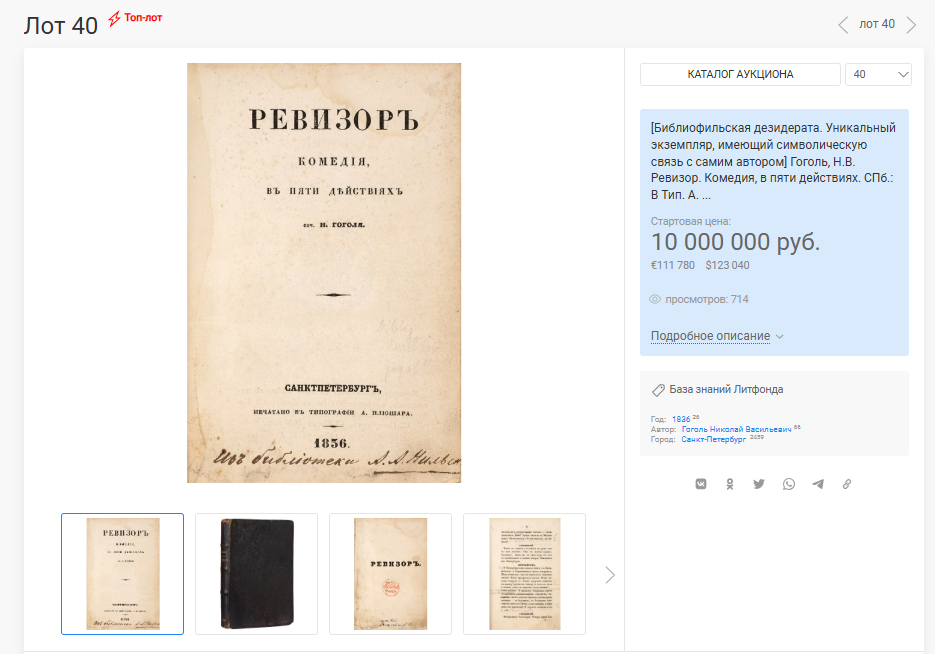
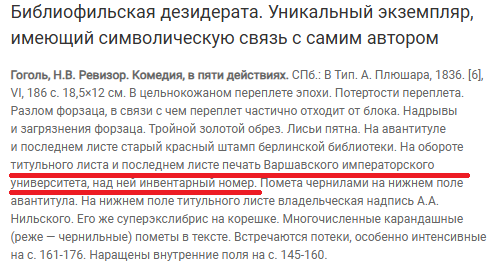
In the spring of 2023, the Literary Fund announced in the media the sale of a rare first edition of Nikolai Gogol's The Inspector General. The auction took place on April 20 of the same year, the starting price of the lot was 10 million rubles. At the same time, lot No. 40 is currently missing from the auction archives on the Litfond website (in order are No. 39, then No. 41). We were able to find his description only with the help of a web archive. The seal of the Warsaw University Library on the presented images is difficult to see, but it is explicitly stated in the description of the lot: "On the back of the title page and the last sheet is the seal of the Warsaw Imperial University, above it is the inventory number."
Izvestia sent a request to the Litfond addressed to its head Sergey Burmistrov with a request to comment on the circumstances of the appearance of the lots at auction. There was no response at the time of publication. Earlier, Sergei Burmistrov, in a comment to the British newspaper The Guardian, assured that Litfond does not put up for auction books with the seals of existing libraries.
However, not all libraries "re-stamp" their funds when changing the names of institutions. For example, the library of Vilnius University is currently searching for books missing in the framework of the Pushkin case based on old pre-revolutionary stamps.
What is the "Pushkin case"?
In 2022-2024, a wave of large-scale thefts in libraries swept across Europe. More than 170 lifetime editions of Pushkin, Gogol, Shevchenko, Krylov, Lermontov and other writers became the prey of criminal bibliophiles. The greatest damage was caused to the libraries of Warsaw and Vilnius Universities, and the loss was also recorded in Latvia, Estonia, Germany, Switzerland, and France. The total value of the stolen books is estimated to exceed $3 million.
Infiltrating libraries under the guise of readers, the attackers replaced the books they received with copies of them, after which they carried out the rarities under their clothes. According to the staff of the affected libraries, the forgeries were of such high quality that they could only be distinguished from the original under a microscope. Some of the stolen rarities were seized in April 2024 during searches in Georgia at addresses associated with members of the criminal group.
In 2023-2024, several Georgian citizens were detained on theft charges. One of the main defendants in the case, Mikhail Zamtaradze, who is currently serving a prison sentence in Lithuania, testified that a certain Russian citizen, Maxim Citrin, coordinated the work of the criminal group. Allegedly, it was he who indicated which books he was interested in, and sent high-quality fakes, which the criminals substituted for real books. The Guardian suggested that Maxim Tsipris, the executive director of the Moscow online store Staraya Kniga, could be the real customer.

In a telephone conversation with a correspondent of Izvestia, Maxim Tsipris denied his involvement in the theft of rarities.
"I have nothing to do with this, I can't help you," he said.
According to Tsypris, the law enforcement agencies of European countries have not contacted him.
The Polish Prosecutor's Office pointed to Litfond as a likely sales site for a number of valuable publications in early November 2025. The case file against Mikhail Zamtaradze contains information that there are search queries about Litfond in the browser history on his iPhone. However, the Polish prosecutor's office did not provide any information indicating the exact lots of the Russian auction house.
Facsimile instead of the original
Meanwhile, according to Izvestia's sources, Maxim Tsipris visited Tbilisi twice in the summer of 2023 — the antique dealer flew to Georgia on June 8 and July 28, the trips lasted no more than two days. In addition, it is worth noting that Staraya Kniga is not only an online store, but also a modern printing house. In a telephone conversation with a correspondent of Izvestia, who introduced himself as a potential client, a company representative confirmed that they could produce high-quality facsimiles of the rarities. According to legend, we wanted to order an exact copy of Mikhail Lomonosov's book A Short Guide to Eloquence, published in 1791, as a gift to the head.
"We'll do it in two weeks, the price is 30-35 thousand rubles,— the Staraya Kniga informed us.
Meanwhile, Peter Druzhinin, an expert on antique books and a leading researcher at the Institute of the Russian Language of the Russian Academy of Sciences, is skeptical about the statements of European libraries about the highest quality of fakes used in the thefts of Pushkin and Gogol.
—I consider the words that these copies can only be distinguished with the help of a microscope to be slyness, an excuse for the inattention of library staff," Pyotr Druzhinin told Izvestia. — They were probably ordinary photocopies on old paper. Or even only the title page with the title of the book is a copy, and the book block is an old one from another and inexpensive book. Indeed, in Western and Russian libraries, when returning books, the librarian now looks inside the book, then only at the title page, and formally, the issuance and acceptance are performed by reading the barcode on the binding. And we don't forget that for Western librarians, Russian is not exactly the first language in their arsenal.
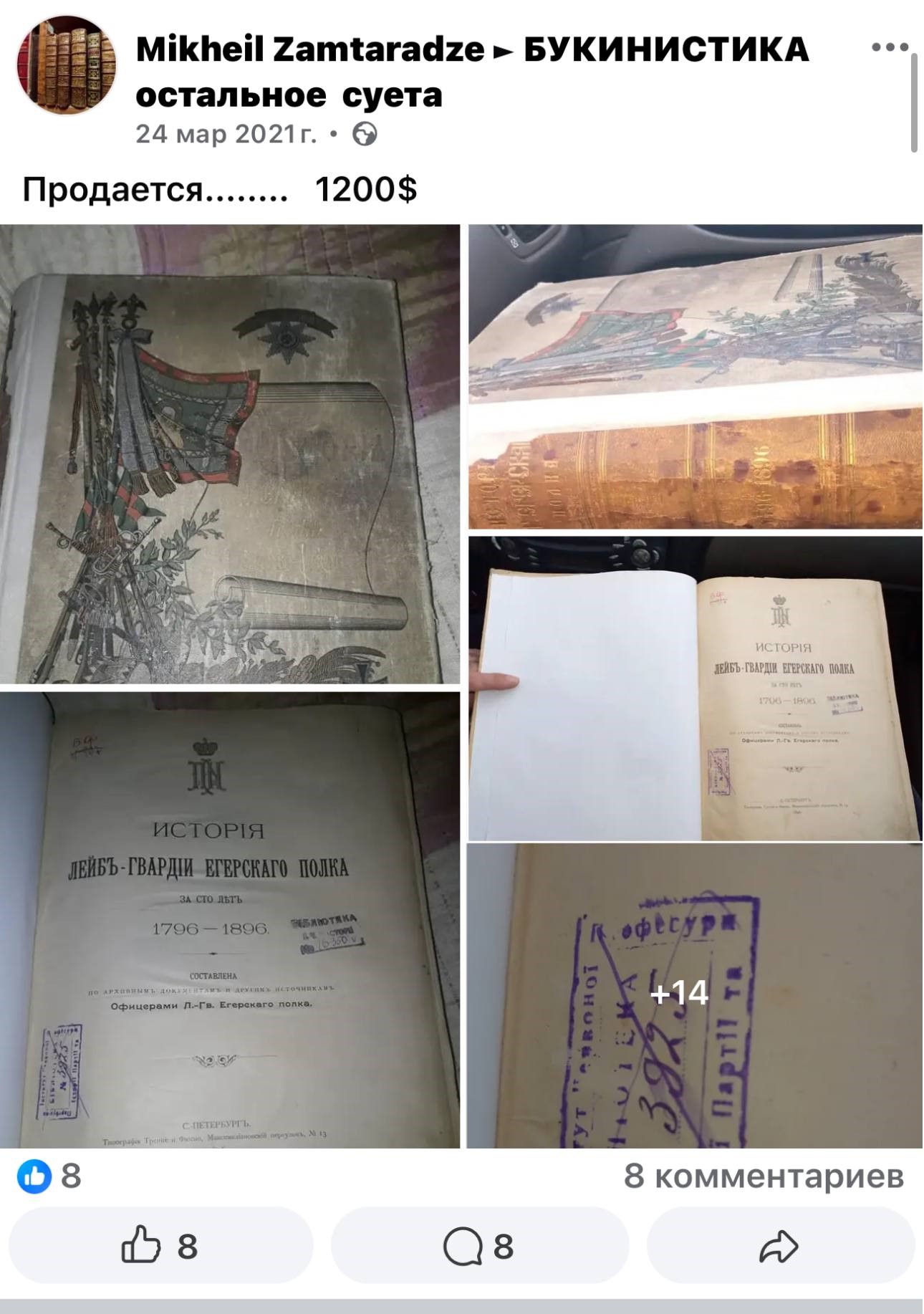
The library thieves from the Pushkin Case were by no means new to the second-hand book business. Judging by Mikhail Zamtaradze's Facebook profile (owned by Meta Corporation, whose activities are recognized as extremist and prohibited in the Russian Federation), the defendant had previously actively traded antique books, including those with library stamps, on social networks and acted as the administrator of a profile group. Another arrested participant in the thefts, Beka Tserikidze— was previously convicted of stealing books from a Tbilisi museum.
Other claims against Litfond
This is not the first time that the Literary Fund has been involved in scandals involving the auction of stolen art objects. So, in November 2020, rarities stolen from the military historical gallery "Military Thought" turned out to be among the lots. However, the fact that the items were stolen might not have been known in the "Literary Fund". The gallery management discovered the loss only after the stolen item appeared at auction. As Vladislav Sereda, director of Military Thought, told Izvestia, one of the gallery's employees stole the items, after which he took them to auction, and when registering the lot, he indicated his passport data.
— In general, our auctions do not check things for their possible criminal origin. The exception is if information on a particular subject passes through law enforcement agencies. Stolen items can be auctioned in two ways. The first is when a person deliberately brings a stolen item to the auction, as was the case in our case. The second is when the seller is a bona fide citizen who does not suspect that the item is wanted," Vladislav Sereda said.
The practice of auction houses and antique shops deliberately accepting stolen goods for sale is quite common, while the risk for antique dealers to be prosecuted is minimal, Svetlana Volkova, a lawyer for legal issues of antiques, art and collectibles, told Izvestia.
— There is an article 175 in the Criminal Code, "Acquisition or sale of property knowingly obtained by criminal means." But cases where the heads of antique shops or auctions are brought to justice are extremely rare. They simply say that they did not know that the item was stolen, and they are being tried as witnesses in criminal cases. At the same time, it often turns out that they do not have any documents for these subjects, they do not go through accounting. In my practice, there was a case when the owner of an antique store was a witness, and a year later he put up for sale items stolen in the framework of the same criminal case," the lawyer said.
Stolen in Russia, sold at Sotheby's
Lots with criminal provenance are going under the hammer in large numbers not only in Russia. Moreover, Western auction houses sell items that have long been on the wanted list and can be easily identified through open Interpol databases.
Interpol's Stolen Works of Art Database includes over 55,000 items. Dozens of historical documents and rare books are among those wanted by Russia. These include, for example, the decrees of the Russian emperors, which found their way onto the black book market as a result of large-scale thefts from the Russian State Historical Archive in the mid-1990s. At that time, the museum was missing more than 4,000 documents, many of which are still openly roaming the auction sites.
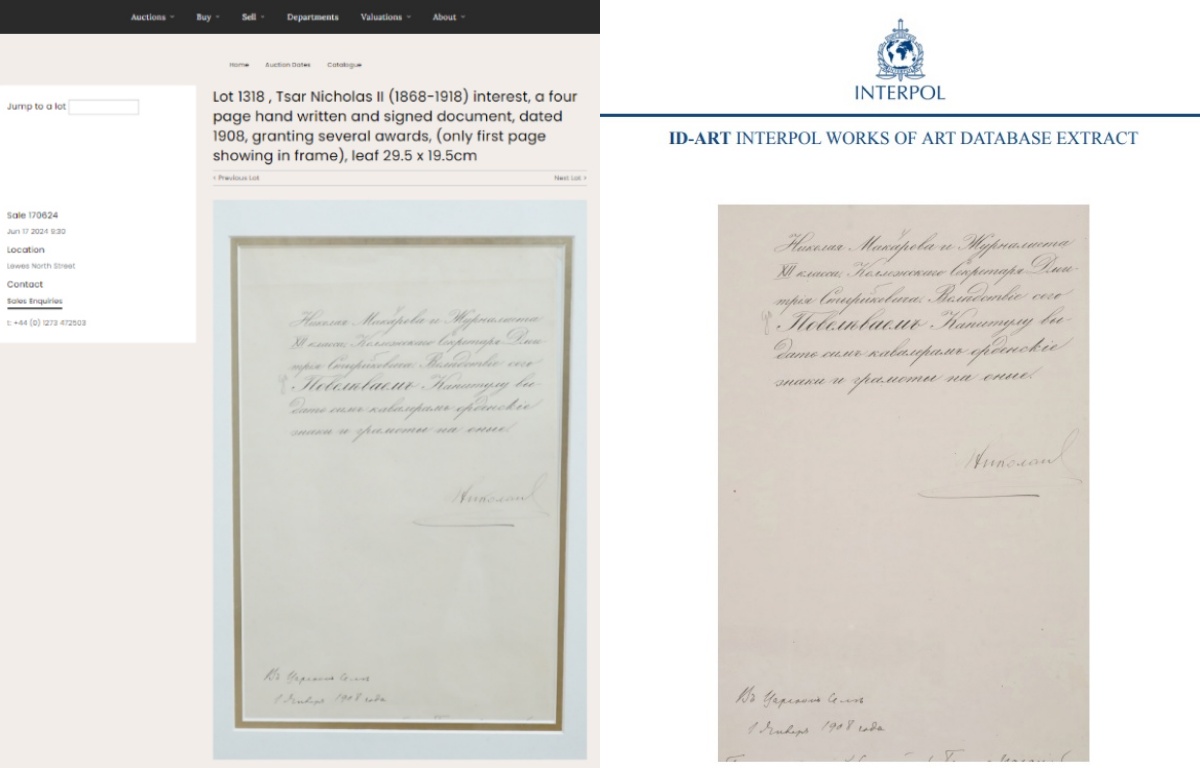
According to Izvestia, Interpol is looking for several decrees of Nicholas II on awards (decrees to the chapter of the Russian imperial and royal orders) dated to the beginning of the 20th century. Izvestia correspondents found one of them in the bidding history of the British auction house Gorringe's. The document was sold at auction in June 2024 for 550 pounds.
The auction house ignored Izvestia's request for the origin of the lot. The publication informed Interpol about the discovery. According to art critic and blogger Sofya Bagdasarova, stolen historical documents regularly appear at open auctions.
— As a rule, these are small European and American auctions. The last case I know of occurred in December 2024. Documents from the time of Peter I and Catherine II have surfaced at the Spanish auction International Autograph Auctions Europe S.L. in Estepona. Unfortunately, due to the current political situation and the attitude towards Russia, the standard ways of suspending such transactions have become much more complicated," she notes.
Izvestia was able to find real second-hand book treasures among the items stolen in Russia, and the most famous sites sell them. Interpol is looking for several sheets of a handwritten Bible in Hebrew, dated to the 11th century. Izvestia discovered that one of them was put up for auction by Sotheby's auction house in 2012. The estimate, that is, the preliminary estimate of the lot, was 25-35 thousand pounds. The auction house does not specify how much the fragment of the ancient manuscript eventually went under the hammer.

As for the history of the relic's ownership, Sotheby's is laconic here.: As stated in the description of the lot, the manuscript was part of the famous collection of Schoyen manuscripts and was purchased in 1992 from the Quaritch second-hand bookstore in London.
As Izvestia established during the investigation, fragments of the manuscript could previously have been part of the collection of Avraham Firkovich, a collector of Jewish relics. In the 19th century, the collection was transferred to the Imperial Public Library, and its funds were inherited by the Russian National Library (RNB). The publication contacted the RNB, which confirmed these concerns.
— We are talking about a pair of sheets from a Hebrew manuscript of the XI century, stored under the code Hebrew IIB1283. They were indeed stolen, presumably by the former curator of Oriental manuscripts, Viktor Lebedev, in the 1990s or earlier. A criminal case has been opened into the thefts, the RNB press service told Izvestia.

Viktor Lebedev, in particular, was an accomplice in a criminal case on the theft of 89 ancient manuscripts of the XIII–XVIII centuries from the National Security Fund in 1994 for a total of $150 million. By the time of the theft, Lebedev had already resigned from the library and was living in Israel, but he provided invaluable assistance to the robbers by providing them with a layout of the premises and a list of the most valuable "literature." The manuscript that surfaced at Sotheby's was apparently stolen a few years earlier. In 1991, 25 valuable manuscripts were discovered missing in the library during an inventory. A criminal case was opened into the disappearance, but by that time Lebedev had obtained Israeli citizenship and left Russia.
As the RNB explained to Izvestia, library staff tracked the fate of the stolen relics: other missing fragments of the manuscript surfaced on the site of the British auction house Dreweatts in 2017 and 2020. It was not difficult to find the lots — they went for £30 and £42 thousand, respectively.
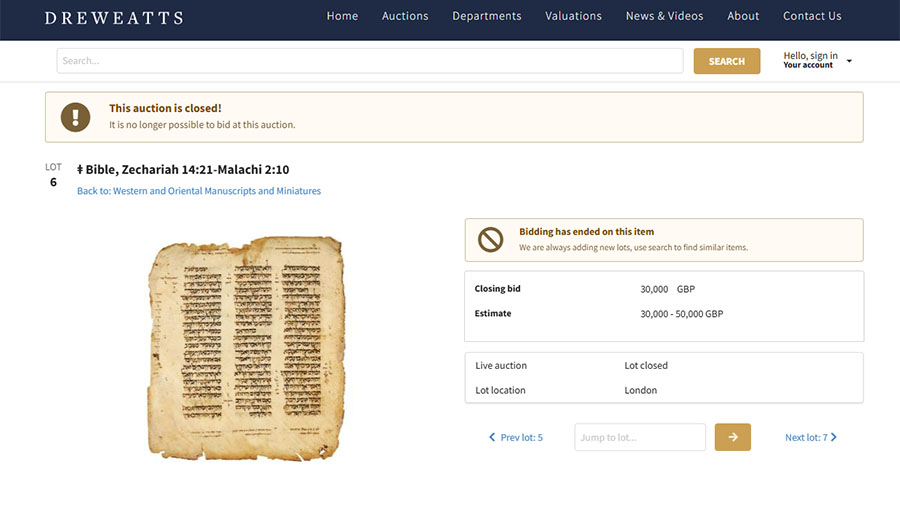
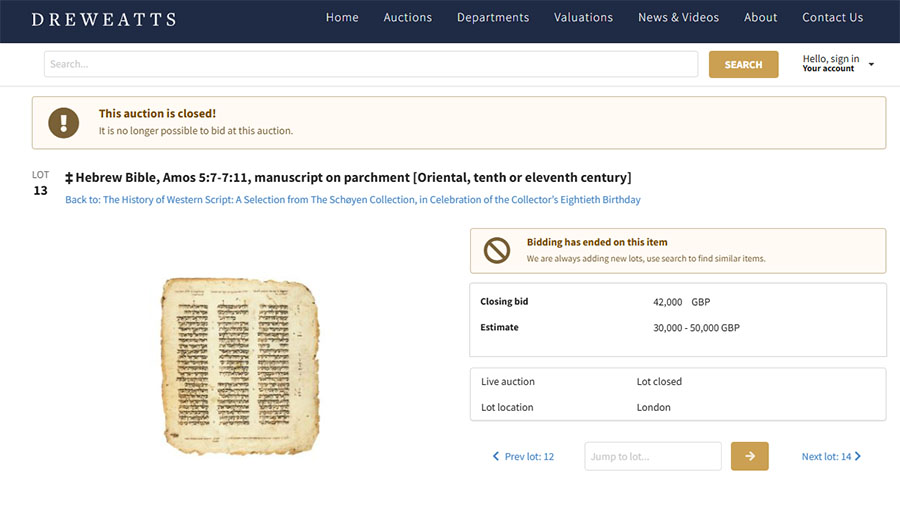
Thus, Izvestia correspondents easily identified the true owners of the rarities, whereas for some reason professional experts from Sotheby's and Dreweatts could not do this before the auction.
Meanwhile, the value of the books stolen in Russia may be in the millions of dollars. Among the cultural treasures sought by Russia, we found the book by Nicolaus Copernicus "On the Rotation of the Celestial Spheres", published in Nuremberg in 1543. The main feature is the "modern oval stamps of the Library of the Russian Academy of Sciences." The theft of the book was not reported by the media, however, in 2008, the Copernicus book of the same year was sold at Christie's auction for $2.2 million.
Obviously, against the background of the cooling of diplomatic relations between Russia and the West, the criminal traffic of library and archival curiosities from Russia to the West and back will only increase. With a request to tell us whether at least some kind of interstate cooperation is currently underway in the field of the return of lost valuables, Izvestia appealed to the Ministry of Culture of Russia. As the ministry informed us, the ministry "is not directly involved in these events."
Переведено сервисом «Яндекс Переводчик»
