
They are fighting about salaries: 76% of companies plan to index salaries in 2026.

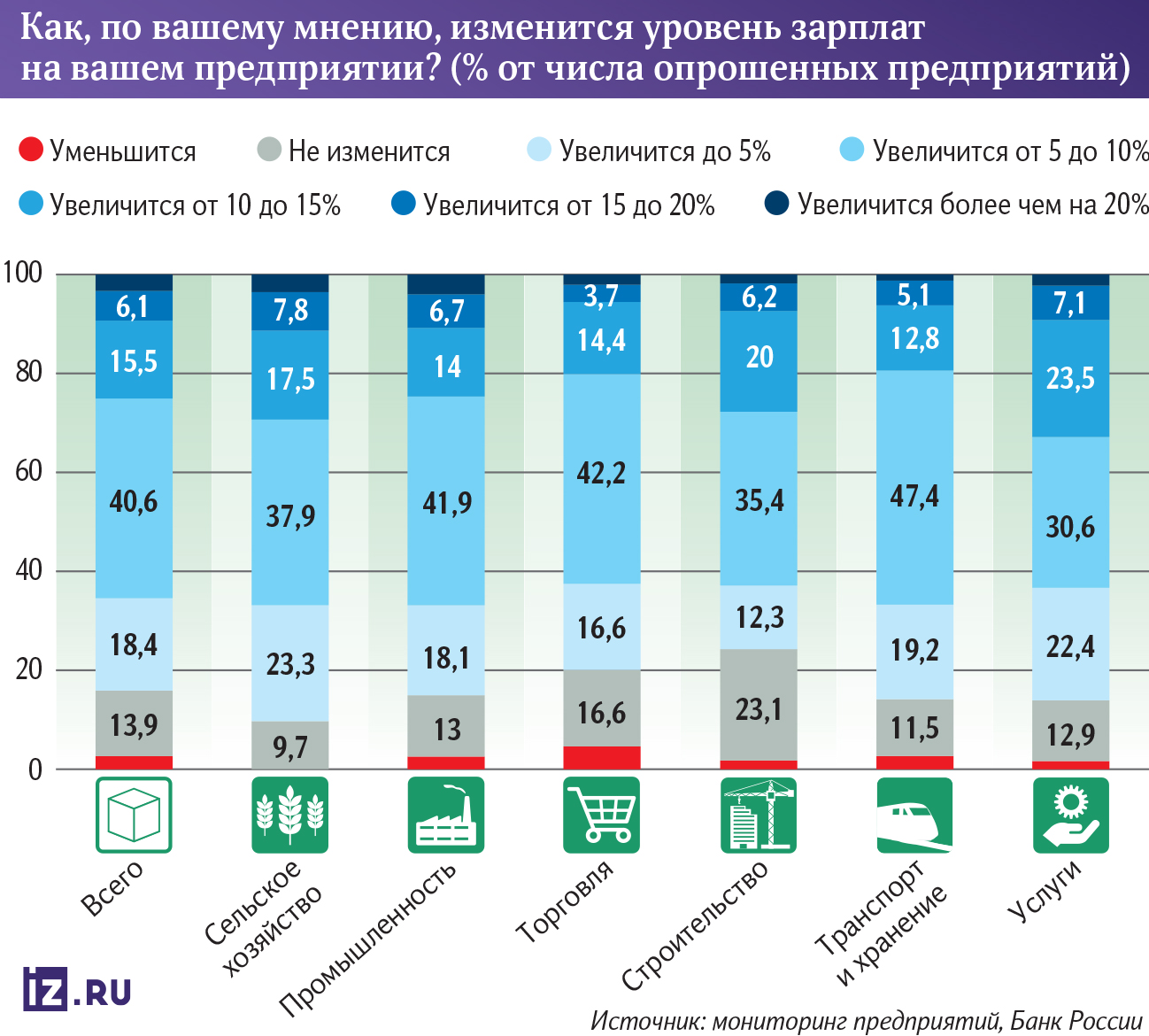
Next year, three quarters of organizations plan to index the salaries of their employees, follows from the latest survey of the Bank of Russia, which was reviewed by Izvestia. Basically, enterprises want to do this within the official inflation rate of 5-10%. Moderate indexation in 2026 will lead to a slowdown in the growth of real incomes of the population. Which enterprises are required to raise salaries and what to do if this does not happen — in the Izvestia article.
How many companies plan to raise salaries
About 76% of enterprises plan to index employee salaries in 2026. This follows from a survey by the Bank of Russia published in a report on the regional economy (Izvestia analyzed it). In general, companies want to increase salaries by the official inflation rate of 5-10%. According to the Ministry of Economic Development, as of December 15, it was slightly more than 6%.
For comparison, in 2024, these companies accounted for about 75%. But at that time, some organizations stated that they were focusing on indexing the minimum wage at 16.6%. At the same time, according to the Central Bank, about 93% of the surveyed enterprises indexed wages last year, while about 83% did so in 2025. Izvestia sent a request to the Bank of Russia and the Ministry of Labor.

Business is currently influenced by several factors. In particular, the high key increases the cost of loans, reduces demand for durable goods and services, and increases the requirements for project payback, said Vladimir Chernov, analyst at Freedom Finance Global. In addition, he continued, the tax burden is becoming more noticeable — many organizations call it one of the main factors of pressure on salaries.
— Lower demand, especially in cyclical industries, makes salary indexation risky due to the fact that margins do not always compensate for costs. In response to these challenges, more and more companies are switching to a mixed remuneration model: the base salary increases moderately, while the rest of the payments may be variable. These are one—time bonuses, payments for achievements, plus an extended social package, flexible schedule, training and internal transfers," the expert explained.
How is salary indexation regulated in Russia
According to labor legislation, companies must regularly index employee salaries, as consumer prices increase, said Sofya Lukinova, head of the legal department at VMT Consult. However, the rules and regulation of this area are different for public and private sector companies, explained Irina Barysheva, manager of the Kept Group for Human Resources Management and Taxation of individuals.

For example, for employees of state and municipal institutions, wage indexation is considered mandatory and must take place every year. This is spelled out in the law, the lawyer emphasized. Moreover, this should happen regardless of the financial condition of a particular institution.

That is, freedom of action is not provided in this case, Irina Barysheva added. At the same time, the situation is different in the private sector. The Labor Code does not establish a specific mechanism for raising salaries for employers, Sofya Lukinova noted. She added: the law only obliges to provide for the indexation procedure in local regulations — the collective agreement, the regulations on remuneration.

If such provisions exist, the employer is obliged to comply with them, that is, unlike a government agency, the company can set, for example, the frequency of salary increases every two years, explained Maria Spiridonova, a member of the Russian Bar Association. If the indexation procedure is not established at all, this is a reason for the employee to contact Rostrud, Irina Barysheva added.
However, if the salary increases in other ways — for example, through promotions or bonuses — then the law is not violated, said Sofya Lukinova. At the same time, an increase every 10 years will not replace indexing, it should happen periodically.
Where can an employee apply to protect their rights
Company employees have several ways to protect their rights. According to Maria Koleda, head of the information department of the independent trade union Novy Trud, it is recommended to send an appeal to the company's management first. If there is no reaction after that, then you can file a complaint with the State Labor Inspectorate (GIT). At the same time, the most effective way in such a situation is to file a claim for the recovery of unpaid amounts in court.
— Besides, collective actions are an effective tool. Employees can initiate a discussion of the issue at a meeting of the labor collective or contact the trade union for negotiations with the management. The coordinated position of a group of workers often has an impact on the employer," she said.

At the beginning of December 2025, the number of electronic applications to Rostrud exceeded 70 thousand, and this is almost one and a half times more than a year earlier (at that time it was slightly less than 50 thousand), Izvestia wrote earlier. The flow of complaints related to wages has also increased significantly, to 26,000: there have been 1.6 times more complaints.

Courts often side with a person whose rights have been violated. However, in order to successfully resolve a dispute, it is important to document all violations — to keep payslips, an employment contract, local acts and correspondence, Maria Koleda added.
For example, a woman who worked for a company for 10 years as the chief specialist of the accounting and reporting department filed a similar claim with the court. During this time, her employer raised her salary five times, but no indexation was carried out in the remaining periods. She demanded to index the salary and pay the debt over 1.5 billion rubles. At the end of November, it became known that the court sided with the employee in the proceedings.

In addition, in mid-November it was reported that the court ordered the South Ural State Humanitarian Pedagogical University to index the salary of an employee. The university did not raise the salary, despite the installation to do so from October 1, 2024. The prosecutor of the Central District appealed to the court, after which the claim was satisfied. In addition, 5,000 rubles of compensation for moral damage were collected in favor of the employee. The university told Izvestia that the court's decision had not entered into force on time, and it would be appealed.

Who will feel the increase in salaries by 5-7%
Indexing within the limits of inflation for many companies today is a conscious choice and an attempt to maintain a balance, says Anastasia Gorelkina, Deputy Chairman of the Board of Directors of HC SDS JSC, member of the Board of Directors of KAO Azot.
— In this case, we are not talking about generous gestures, but about a sense of justice, so that employees do not feel the depreciation of their work. That is, when an employer regularly reviews the level of pay, people gain confidence in the future, and in the long run it works much more effectively than any one—time increases," the expert explained.

Igor Rastorguev, a leading analyst at AMarkets, believes that for employees with incomes close to the minimum wage (starting in January it will amount to 27,093 rubles), a 5-7% salary increase will be a tangible support. At the same time, for workers with above-average incomes, such an indexation only partially compensates for the inflation that has accumulated over the past two years. The key problem is not so much the size of the one—time increase, but rather the gap between nominal and real income growth: according to the Bank of Russia's forecast, real wages will increase by only 2.7% in 2026, while in 2025 this figure will be 4.1%.
Переведено сервисом «Яндекс Переводчик»
