- Статьи
- Economy
- Exit condition: the number of bankruptcies of IT companies in the Russian Federation increased by a quarter

Exit condition: the number of bankruptcies of IT companies in the Russian Federation increased by a quarter

Russia has recorded an increase in bankruptcies of IT companies - by more than a quarter compared to 2024. In January – November 2025, 630 such organizations began such a procedure, the Rusprofile service calculated at the request of Izvestia. At the same time, the number of liquidated market players increased by 11%. Of the firms registered in 2022, just over half are still working. Businesses are reducing IT costs and trying to develop such products on their own. At the same time, the market is being cleared of structures that tried to take advantage of benefits for this sector, but in practice had little to do with it, experts noted. The Ministry of Finance, however, did not confirm the Rusprofile data: the agency maintains its own register of accredited IT companies, and, according to its information, their number is growing annually.
Why are Russian IT companies going bankrupt?
In 2025, the IT business in Russia began to go bankrupt more often than a year earlier. This follows from the Rusprofile counterparty verification service report, prepared at the request of Izvestia. According to his data, in January –November, 630 IT companies began bankruptcy proceedings, which is 28% more than in the same period of 2024, when insolvency was initiated against 491 organizations.
When calculating Rusprofile analysts, they took into account companies and individual entrepreneurs whose registration codes were OKVED 26 ("Manufacture of computers, electronic and optical products") and all its subcategories, 62 ("Development of computer software, consulting services in this field and other related services" with all subcategories) and 63 ("Information technology activities" with all subcategories).
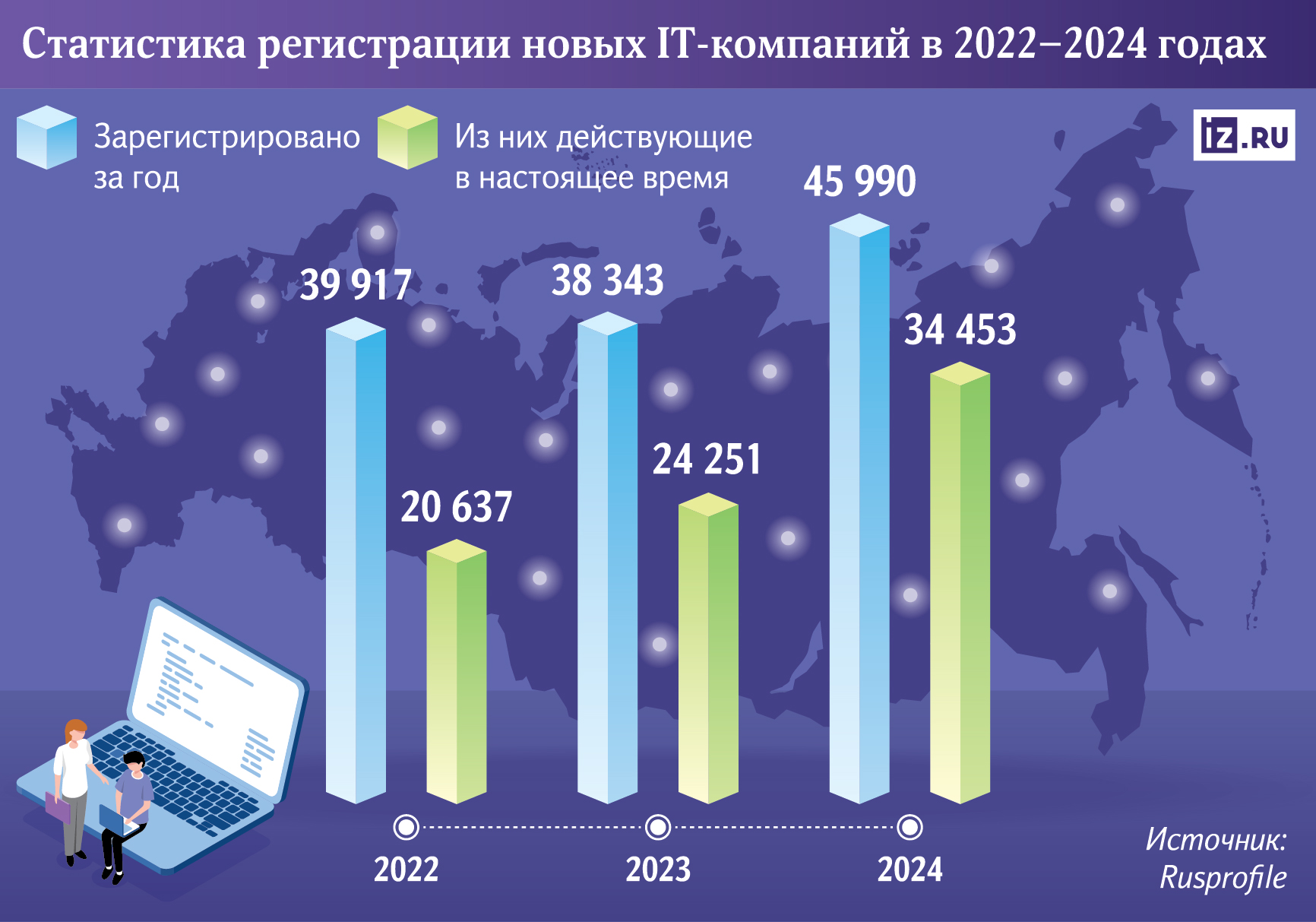
In 2022, against the background of the withdrawal of vendors from unfriendly countries from Russia and a sharp increase in demand for import substitution, 37.9 thousand IT companies were registered in the country. By the end of 2025, only about 20.6 thousand of them continued to operate, the report says.

The Ministry of Finance has not confirmed the Rusprofile data. The agency told Izvestia that they were not familiar with the results and methodology of the study. The fact is that the ministry maintains its own register of accredited IT companies, the number of which is increasing annually, and now there are about 20 thousand of them, the department noted.
— The Ministry maintains its own statistics on accredited IT companies for established and liquidated organizations. This year, according to the Unified State Register of Legal Entities, more than 450 organizations were created and accredited, while the number of liquidated was about 150, according to the Ministry of Finance. — Companies make decisions about doing business, including closing or restructuring it, on their own. According to data from recent years, IT has maintained its leadership in growth rates among large industries.

This is facilitated, among other things, by support measures, the department added. For example, tax benefits (zero VAT rate, reduced income tax rate and reduced insurance premium rates), preferential mortgages and deferred military service for IT specialists were listed there.
There are also measures in place to stimulate demand for Russian software, including bans on the purchase and use of foreign software in government organizations and critical information infrastructure facilities, the department said.
— We consider the registration and liquidation of companies according to the relevant main OKVED, based on the data of the Unified State Register of Legal Entities, — Rusprofile clarified. — The Ministry of Finance considers only accredited organizations registered in the register. The accreditation is voluntary, and there are a number of requirements for it.

According to Leonid Konik, a partner at ComNews Research, there are no contradictions in the Rusprofile and the Ministry of Digital Data. The first organization talks about the number of companies that have started bankruptcy or liquidation proceedings, and the agency cites the number of legal entities that have already been liquidated (or, conversely, added to the register), the expert noted.
— Rusprofile is based on big data: legal data from companies that have announced the beginning of liquidation and bankruptcy, selected according to the "IT" OKVED. If they really go bankrupt or are liquidated, the Ministry of Finance will see this in the next periods," Leonid Konik said.
At the same time, the Ministry of Finance and Rusprofile agree that, despite bankruptcies and liquidations, the total number of registered IT companies in Russia continues to grow. According to their data, the indicator increased by 15%: 42 thousand new organizations were registered in January – November 2024, and 48.4 thousand in the same period of 2025. But whether this growth is related to an increase in the number of IT projects and products is not clear, experts believe.
What is the reason for the increase in bankruptcies in the Russian IT market?
Participants began to talk about a certain cooling of the IT market at the end of last year. They attributed this to the fact that banks either stopped lending to such companies, or offered loans at prohibitive rates, citing a lack of available funds, a market source familiar with the situation told Izvestia. As a result, businesses had to stop or slow down the launch of new IT projects, he added.

The increase in the number of bankruptcies is due to the cooling of the overheated economy in 2022-2024, said Vladimir Dorozhkin, director of Absolut Insurance.
— Large customers have frozen some of the new projects, redistribute budgets and bring to mind already purchased solutions instead of launching new ones. And, for the most part, they strive to use their own competence, that is, to develop and maintain their own IT solutions," he noted.
According to him, the Central Bank's high key interest rate has sharply raised the cost of loans, making it more difficult for companies to refinance old debts and launch new projects. In 2022-2024, there was an accelerated transition to Russian IT solutions and a surge in purchases, which created additional demand and overheating of the market, Vladimir Dorozhkin added.

The active modernization of the IT infrastructure, which the business was engaged in in 2022-2024, has been replaced by a general economy mode, said Evgenia Kruglova, partner of the ITECH web integrator. According to her, the high key rate of the Central Bank and unfavorable credit conditions create a difficult economic background, forcing companies to review all expenses, including budgets for information technology.
— Service companies operating under the outstaff model turned out to be the most vulnerable (a practice in which some IT employees temporarily transfer to work for the customer organization. — Izvestia). The decision of a large customer to simultaneously reduce the team of 20-30 people can put the contractor in a critical position. This leads to an increase in the number of bankruptcies," the expert said.

The IT bubble that formed in 2022-2024 has begun to deflate, Leonid Konik added.
— At the peak of the HYPE, there were more than 22 thousand legal entities in the register of accredited IT companies maintained by the Ministry of Finance, but now there are about 20 thousand of them. Even taking into account the fact that some IT holdings consist of dozens of organizations, and the fact that corporations in industry and other industries have created several hundred IT subsidiaries in total, 20,000 real players are unlikely to be recruited, the expert believes.
In his opinion, there are many companies in the register that quickly changed the main OKVED to one related to IT. Or they were hastily registered subsidiaries of the most remote IT businesses, starting with the sale of animal feed and facade repairs, he added.

In 2025, the authorities, in particular the Federal Tax Service, began to show interest in the results of the activities of these enterprises, the expert noted. In addition, starting in 2026, the benefits package for IT companies will significantly "lose weight": de facto, they will have only a zero VAT rate when selling software products. Therefore, the owners of fictitious organizations that did not intend to create and implement domestic software, but took advantage of government support measures, prefer to eliminate them quickly, Leonid Konik claims.
— There is a reboot of old businesses: those who lived on Western vendors are closing old legal entities and opening new ones for import substitution and work with the public sector, — said Roman Koposov, deputy director of ARB Pro. — Statistically, this looks like an increase in openings and closures, although, in fact, it is a re-shaping of the market.

It is likely that some of the small players are splitting up businesses to minimize the fiscal burden in the new conditions, Evgenia Kruglova believes. But there is also a healthy practice of separating product teams into separate legal entities to attract investment and use the remaining government benefits, she added.
Vladimir Dorozhkin believes that the market will grow at an insignificant pace over the next two to three years. Such reasons as continued optimization of customers' budgets, conservative planning against the background of an unstable geopolitical situation, and difficulties associated with the exchange of experience and technology with foreign players will restrain growth, he said.
Growth topics will also be influenced by the processes of "getting used to" Russian technologies, building up competencies in them, and the emergence of rational industry-specific AI solutions, the expert noted. In his opinion, the stabilization process will be completed by 2030: after that, a return to active IT growth is possible.
Переведено сервисом «Яндекс Переводчик»
