Advanced setup: Syria may increase diplomatic mission in Russia


Syria is considering the possibility of increasing the composition of its diplomatic mission in Moscow and the possibility of acquiring a new building for an expanded mission, Izvestia found out. According to the source of the publication, it will depend on the dynamics of the reset of bilateral relations. The dialogue between the two countries continues, including on military issues. In mid—November, a large Russian delegation headed by Deputy Defense Minister Yunus-Bek Yevkurov visited Damascus. The Syrian media also reported on the fact of the participation of the Russian military in joint patrols with local forces of the Ministry of Internal Affairs and the Ministry of Defense in the province of Quneitra.
Damascus seeks pragmatic relations with Moscow
In case of further strengthening of relations between Syria and Russia, it may be necessary to expand the staff of the Syrian diplomatic corps and, accordingly, purchase a new building for the needs of the Syrian diplomatic mission, a source told Izvestia. According to him, the decision on this issue will depend on the dynamics of the political dialogue between the two countries.
Now the Syrian authorities are demonstrating their desire to build an updated political line in relations with Moscow. The Minister of Foreign Affairs of the Transitional Government, Asaad al-Shibani, speaking at the British Royal Institute of International Relations on November 14, said that Damascus is guided by "pragmatic relations" with Russia and does not seek to join any blocs, preferring to develop partnership with all parties. He stressed that his country is not interested in confrontation with Moscow.
The Izvestia source said that the issue of appointing a new ambassador to Moscow remains on the agenda, although there are no concrete decisions yet. The Russian direction in Syria is supervised by the Secretary General of the Presidential Office, Maher al-Sharaa, the brother of President Ahmed al-Sharaa. Maher al-Sharaa graduated from the Medical Academy in Voronezh and is considered a man who understands Russian specifics well.
An important moment in changing the approach was the visit of the interim President of Syria to Russia on October 15. It was the first meeting between the Syrian leader and Vladimir Putin after the change of power in Damascus. The talks lasted about two and a half hours, and Ahmed al-Sharaa announced his intention to "restart" relations with Moscow.
After al-Sharaa came to power, Moscow gradually built contacts with the new leadership. In July, Foreign Minister Asad al-Shibani visited Russia, and following his visit, the parties agreed to review the current legal framework and adapt it to the new political conditions.

In September, Moscow sent a delegation to Damascus led by Deputy Prime Minister Alexander Novak. Consultations between Syrian Sports Minister Muhammad Sameh Hamid and his Russian counterpart Mikhail Degtyarev also took place in the capital of the SAR. They discussed new areas of cooperation.
These visits are seen as part of a broader process of restarting Syrian-Russian relations after the change of power in 2024.
— After Ahmed al-Sharaa's October visit to Moscow, the framework of a new format of interaction was actually defined between the countries. During the talks, the Russian president placed key accents on a wide range of issues that had previously been discussed by numerous military and economic delegations, including the humanitarian agenda, prospects for military-technical cooperation, political contacts and the regional situation," Vladimir Akhmedov, a researcher at the Center for the Study of Common Problems of the Modern East at the Institute of Oriental Studies of the Russian Academy of Sciences, explained to Izvestia.
Military cooperation between Russia and Syria
In recent weeks, the military component of cooperation has noticeably intensified. A source told Izvestia that cooperation between Moscow and Damascus remains in place. On November 16, a large Russian delegation arrived in Damascus. According to Al Jazeera, it consisted of about 190 representatives of various departments. According to the Syrian side, in particular, talks were held between Syrian Defense Minister Murhaf Abu Kasra and Russian Deputy Defense Minister Yunus-Bek Yevkurov, who discussed strengthening cooperation and coordination mechanisms.
Currently, two Russian military facilities are located in Syria: the Naval logistics center in Tartus and the Khmeimim airbase in Latakia.
The first base has been operating since 1971, and the Air Force air group was deployed in 2015 to support the operation against ISIS (IS, a terrorist organization banned in the Russian Federation).
As Deputy Foreign Minister Sergei Vershinin noted earlier, consultations on the fate of the bases are ongoing and include issues of ensuring the safety of Russian citizens. In December 2024, President Vladimir Putin proposed using these facilities to deliver humanitarian aid.
Russian-Syrian cooperation attracts the attention of the Israeli side as well. The Syrian issue was discussed during a telephone conversation between Vladimir Putin and Prime Minister Benjamin Netanyahu on November 15. According to reports from the Kan state television and radio company, Israel believes that Russia may request negotiations with the Jewish state on the resumption of its military deployment in southern Syria at a number of locations. These assessments appeared shortly after the Syria TV channel reported on the visit of a Russian military delegation near Damascus and joint patrols in Quneitra province, just a few kilometers from the border with Israel. According to the Syrian media, the Russian officers arrived accompanied by Syrian representatives of the Interior Ministry and the Ministry of Defense, and the convoy consisted of more than 15 vehicles.
The Israeli military regularly conducts raids in the Syrian province of Quneitra, including searches of residential buildings, and Israeli Air Force planes often appear in the skies over Quneitra and Deraa. After the change of power in Syria in December 2024, Benjamin Netanyahu said that the agreement on the separation of forces in the Golan Heights was no longer valid because the Syrian army had abandoned its positions. According to him, the IDF received an order to occupy the demarcation zone and key points.

A more active presence of Russian forces in southern Syria may be aimed at preventing escalation and removing the grounds for Israeli operations in the Quneitra, Deraa and rural areas of Damascus.
— Patrolling was the subject of conversations of our military both here and in Damascus during the visit of our delegation. The Syrians expressed the wish that we cover the south and central regions of Syria by returning there our S-300 and S-400 complexes, which were dismantled in 2016. Because the Syrian skies are open, there are no electronic warfare or air defense systems," said Vladimir Akhmedov.
The expert added that the situation in Syria directly affects regional stability, and ethno-confessional and tribal factors create additional complexity. The expert pointed out that without strengthening Syrian security in a broad sense, it is impossible to resolve issues related to Arab-Israeli relations and the situation in Lebanon, where discussions around Hezbollah have intensified again.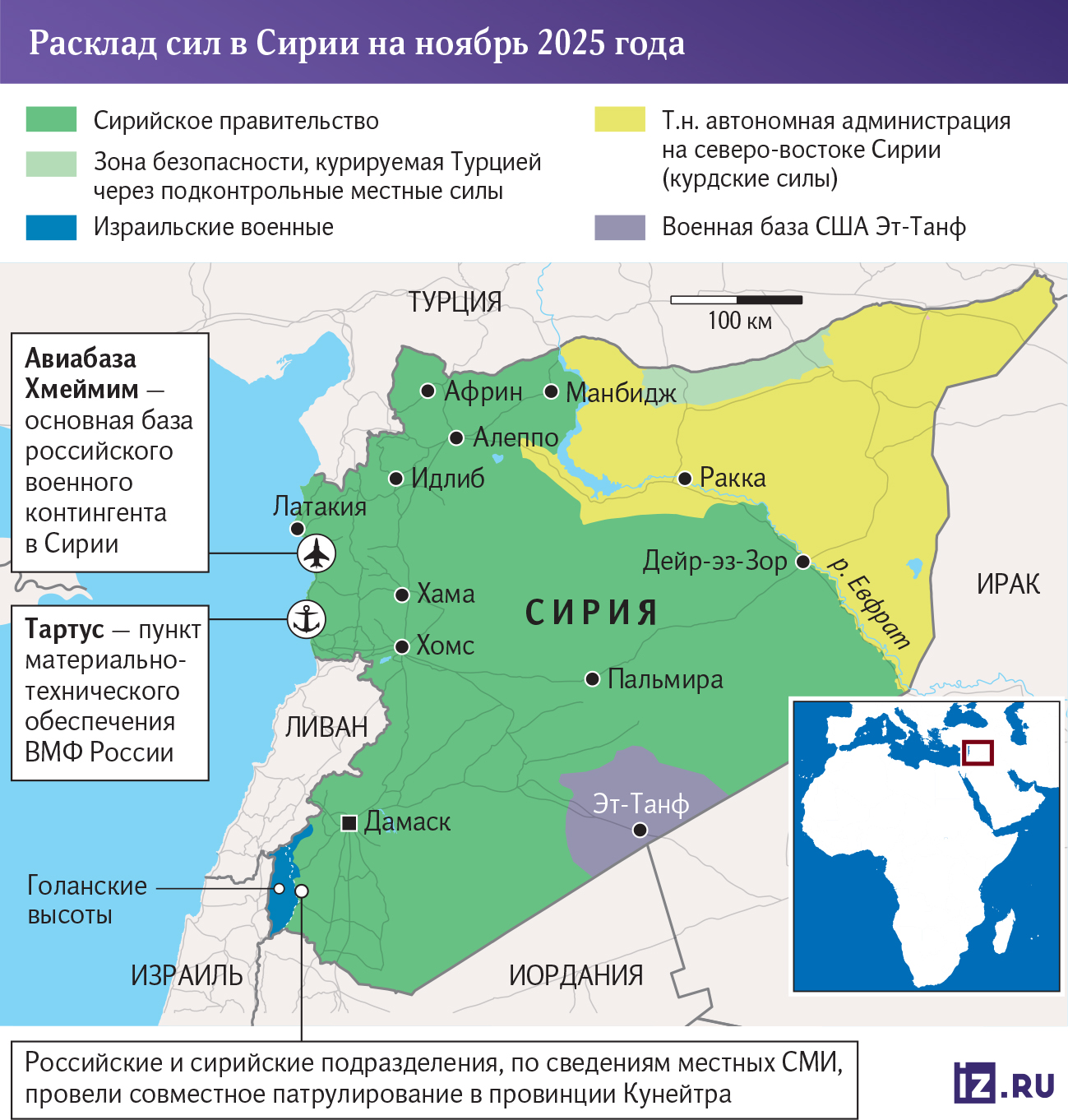
According to the expert, the ongoing turbulence in Syria can also affect Russia's interests: the strengthening of terrorist networks and the possible fragmentation of the country pose risks to both regional and Russian security. That is why the Russian Federation continues to play an active role in negotiations and in cooperation between military and political structures, considering this as an element of its own strategy to prevent the spread of radicalism to neighboring territories.
To date, the Syrian crisis is far from being definitively resolved. On the one hand, the new Syrian authorities have begun to restore state institutions. However, these authorities are not accepted in the whole country. Fierce fighting periodically breaks out between the troops of the central government and the Kurdish units in the northeast of the country. Although back in October, Syrian Defense Minister Murhaf Abu Qasra and the leader of the military wing of the Kurdish administration (the Syrian Democratic Forces, SDF), Mazlum Abdi, agreed on a cease-fire.
The examples of bloody ethnic cleansing by the Syrian security services in areas densely populated by Syrian Alawites and Druze do not contribute to reconciliation.
Переведено сервисом «Яндекс Переводчик»
