Good rhenium: new superconductor will create "pocket" supercomputers


Russian scientists have created a new material for ultrafast electronics — nanofilms made of amorphous rhenium. They are capable of conducting current without loss of resistance at a higher temperature than their counterparts. In particular, the development opens the way to the creation of superconducting transistors, which can become a link between conventional and quantum computing systems. In the future, as technology develops, such materials can bring closer the emergence of "pocket" supercomputers — compact devices with integrated AI capable of processing complex tasks locally, without an Internet connection. For more information, see the Izvestia article.
How superconducting materials are produced
Russia has obtained a material that can become the basis for compact supercomputers, high-precision detectors and ultrafast electronics. It is based on nanofilms made of amorphous rhenium, which are resistant to impact and possess the property of superconductivity at relatively high temperatures. Scientists from the Lebedev Physical Institute of the Russian Academy of Sciences (FIAN), the Moscow Institute of Physics and Technology and the Higher School of Economics worked on the project.
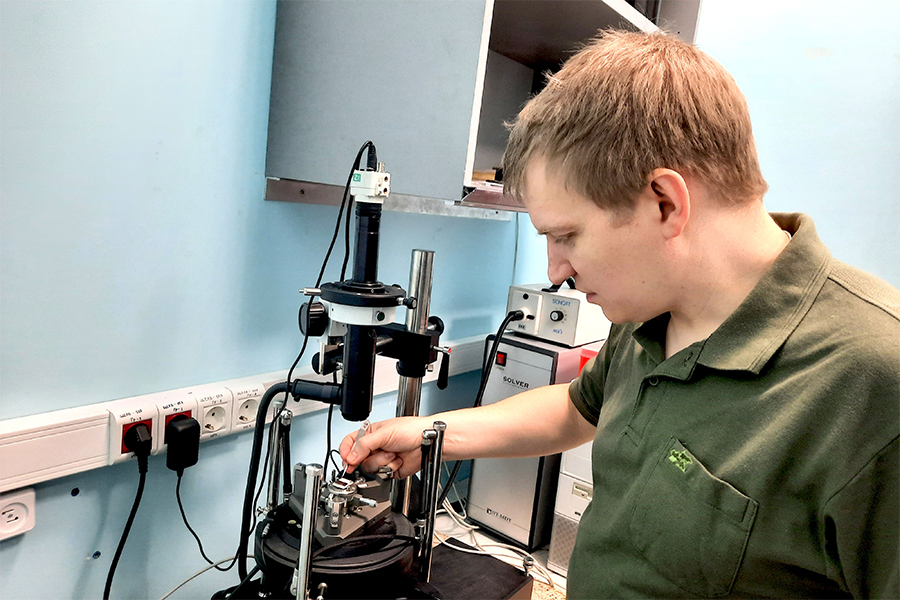
— Amorphous metals have a disordered structure, which gives them new properties. In the case of rhenium, this led to increased superconductivity. Superconductors are materials whose electrical resistance becomes zero at ultra—low temperatures. In crystalline form, rhenium is also a superconductor, but its critical temperature (at which this state occurs) is quite low — about 1.5 degrees Kelvin. In its amorphous form, it jumped to 7-8K," Alexander Kuntsevich, Doctor of Physico–Mathematical Sciences, leading researcher at the FIAN and professor at the HSE Faculty of Physics, told Izvestia.
In general, almost half of the chemical elements have superconductivity, but few are suitable for real-world applications. To win a "place under the sun," the material must have unique properties, the scientist explained. In particular, crystalline rhenium is one of the most refractory and dense simple substances. To vaporize it and spray a thin film, scientists heated the substance with a focused beam of electrons in a vacuum. Thanks to this technology, stable amorphous films with a thickness of several tens of nanometers have been obtained, suitable for practical development.

In addition, rhenium is resistant to oxidation and is not covered with an oxide film. At the same time, its high critical temperature makes it possible to use the cheapest cooling systems to work with it.
These properties open up the possibility of creating various promising devices based on amorphous rhenium, for example, superconducting transistors. As Alexander Kuntsevich explained, the transistor controls the flow of electrons, but in the case of superconductors, we are talking about "overcurrents" that do not dissipate heat and provide a significantly higher switching speed compared to conventional electronics.
— One of the ideas is to combine amorphous rhenium with graphene, an ultrathin carbon layer one atom thick. When a superconductor comes into contact with this material, its superconductivity "penetrates" into graphene to a certain depth, the scientist explained.
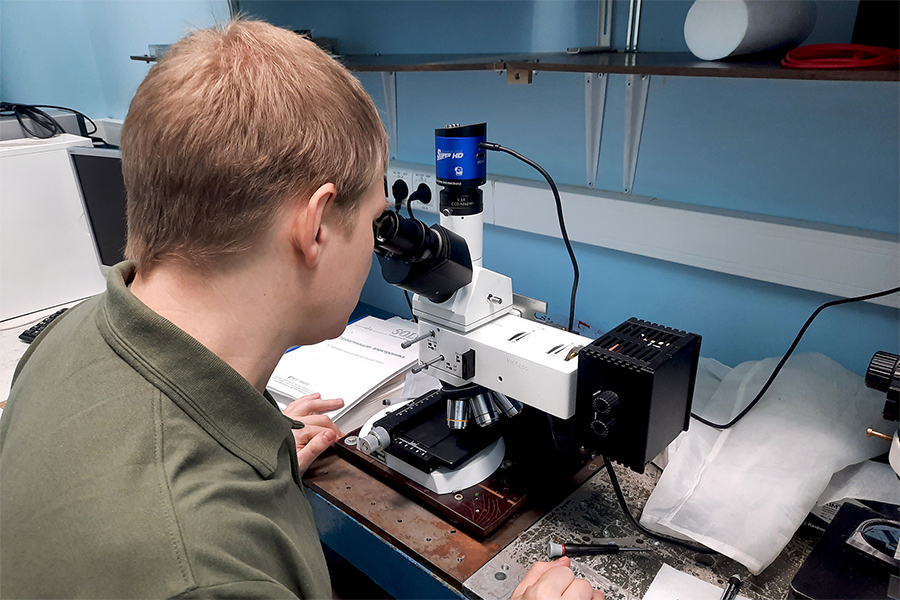
Due to this, in the case of graphene, it becomes possible to control this property using an electric field, he noted. At the same time, rhenium, unlike niobium or aluminum, is not affected by external factors, such as oxidation in air. Therefore, mass production of devices based on it becomes quite an achievable task.
According to the scientist, with the help of such "fast" transistors, it is possible to interface superconducting electronics with conventional silicon semiconductor. In particular, one of the key problems of modern quantum and classical supercomputers is the complexity of their external control, since this requires a large number of wires.
Superconducting transistors based on rhenium and graphene will allow conventional computers operating at room temperature to control in real time the configuration of devices operating at temperatures of liquid helium (about 4K and below), such as quantum ones. This paves the way for the creation of computing systems that can become available for mass use.
— If we dream about reducing cryostats (coolers) to desktop sizes in the future, then hybrid computers with enormous performance can be developed on their basis. Such smart devices will revolutionize supercomputing technologies, making them mobile and personal. For example, you can install localized artificial intelligence systems on them that work without the Internet and cloud resources," said Alexander Kuntsevich.
He noted that, in addition to superconducting transistors, the resulting material may be in demand in the production of miniature magnets and sensors for measuring weak radiation and magnetic fields.
A new superconductor for space technology
— The discovery of scientists is interesting. Now we need to understand why this is happening. This may make it possible to increase the transition temperature for other superconductors and find substances that have superconducting properties at room temperature," Alexey Troyanovsky, Deputy director of the Kapitsa Institute of Physical Problems of the Russian Academy of Sciences, told Izvestia.
It is a successful material for use in chips, but at the same time it is one of the rarest and most expensive metals. Therefore, its widespread use is limited. But in microscopic quantities, which are required to create chips, it is quite realistic, he noted.
— The development allows a simple method to obtain stable superconducting films with very good characteristics for practical applications. And their amorphousness is a huge plus for integration with a number of modern platforms. They can serve as the basis for creating single-photon detectors that can be easily integrated into chips due to compatibility with standard processes. For quantum computers, these films are a potential basis for creating qubits," says Alexey Nevzorov, a researcher at the NTI NUST MISIS Center for Quantum Communications.

The main difficulties are related to the transition from laboratory research to industrial production. In particular, rhenium films are sensitive to contamination and difficult to use with standard nanolithography, he added.
"Probably, in the near future, the proposed approach will find application for creating superconducting contacts with other materials," says Sergey Gunin, a researcher at the Laboratory of Artificial Quantum Systems at MIPT. — At the same time, in order to use it, for example, in quantum processors, the technology needs to go through a long implementation process. Similar to that of aluminum, which is now being successfully used to create superconducting artificial atoms — qubits.
At the same time, as Mikhail Maslov, Head of the Department of Solid State Physics and Nanosystems at the National Research Nuclear University MEPhI, noted, the introduction of a new technique is also associated with technological challenges. The main difficulty is the fragility of amorphous films, which can complicate production processes.
— It has also been established that the superconducting properties of films degrade upon contact with organic materials. The control of the substrate temperature is also critically important. It must remain in a narrow range (no higher than 120 °C) in order to obtain an amorphous structure without thermal stresses. At the same time, rhenium itself has a high melting point, which also complicates the film production process," the expert added.
Nevertheless, he noted, the development of scientists opens up opportunities for creating various kinds of devices. For example, a high critical current density will make it possible to create compact superconducting switches and integrated circuit elements. In medical equipment, films can be used to measure very weak magnetic fields; in space technology, oxidation resistance and high critical parameters make the material promising for cosmic radiation detectors and quantum communication systems on satellites.
Переведено сервисом «Яндекс Переводчик»
