- Статьи
- Science and technology
- Walking under the probe: space debris can fall anywhere on Earth at any moment

Walking under the probe: space debris can fall anywhere on Earth at any moment

The remnants of space technology in orbit can fall to Earth within 10 minutes, even with a slight change in its trajectory, scientists show calculations. According to the researchers, more than 25,000 large objects are currently circling our planet, and their behavior is so chaotic that it is impossible to predict the impact site, so they can fall anywhere on Earth. Earlier in the Moscow region, an object similar to a meteorite was recorded in the sky. Scientists believe it could be space debris. Read more about the dangers of extraterrestrial waste in the Izvestia article.
The trajectory of space debris
South African scientists have created a model for calculating the trajectories of falling space debris, which has shown that the danger of objects is underestimated. The new study describes the process of reducing the remnants of space technology from low orbits more realistically, as it takes into account a larger number of factors, such as wind and gravitational disturbances. According to these calculations, many large objects can break out of orbit with the slightest change in trajectory.

"Using extensive numerical simulations, we have shown that small changes in the angle of entry into the atmosphere can lead to radically different results, including the direct return of space debris objects to the surface and passage through the atmosphere. Critically, several high—speed trajectories result in a collision with the surface in less than 10 minutes," according to an article in the scientific journal Space Exploration.
According to the study, the fall of an object weighing 1 kg from orbit is equivalent to the explosion of an aircraft rocket with 12 kg of TNT. Currently, there are more than 6 thousand tons of space debris around the Earth. And by 2030, the number of artificial satellites will increase by another 60,000, which will significantly worsen the problem, the article says.

Space objects fly at a very high speed. Small debris particles fall constantly, but burn up before reaching the surface. Large ones are rarer, but the calculations of South African scientists look plausible, said Natalia Zavyalova, head of the Laboratory for Modeling Mechanical Systems and Processes at MIPT.
— It all depends on the speeds of the objects. But if they manage to "cling" to the planet's orbit, start rotating and hit the atmosphere, then they can fall very quickly. It can happen not even in 10 minutes, but in two. We did such calculations," she said.

On October 27, a video of an unknown glowing object falling appeared online. The shooting was done around 06:30 in the Moscow region. The body radiating a green glow leaves a fiery trail in the sky. As explained by Sergey Bogachev, a professor at the Space Research Institute of the Russian Academy of Sciences, it was most likely a fall of space debris.
— This is either a meteorite about 10 cm in size, or a fragment of space debris. I would say that it is garbage, because it is very actively crushed in flight. The green color gives nickel. It is found both in meteorites and in products made by humans. Almost certainly, nothing reached the Ground," the specialist said.

Natalia Zavyalova is inclined to the same version.
— The object is flying too fast for an airplane or UAV. Green is a glowing nickel. Meteorites are often composed of iron and nickel. Therefore, either it is a meteorite with nickel. And they can fly at different speeds. Or a spacecraft, where there is also a lot of nickel, for example, in a battery," she said.
On the night of October 28, it became known that NASA had restricted access to information about asteroid 2025 US6, which may be related to the fireball seen on October 27 morning over Moscow and the Moscow region. This was reported in the Telegram channel of the Laboratory of Solar Astronomy of the Institute of Space Research (IKI) of the Russian Academy of Sciences.
According to scientists, a celestial body with a diameter of about 2 m was supposed to pass at a distance of about 150 thousand km from Earth on October 28.
"It is highly likely that the body can be considered in a possible connection with today's events in Central Russia," the laboratory experts emphasized.
Earlier in the day, the IKI RAS stated that the space object spotted over Moscow could be not only space debris, but also an asteroid. A version is also being considered that this is a fragment of a spent Chinese satellite.
How space debris is monitored
According to Alexander Volvach, deputy director of the Crimean Astrophysical Observatory, it is possible to determine unequivocally whether an object near Moscow was space debris if its trajectory is compared with data on large objects in orbit that are being monitored.

— The coordinates of all such objects are known, as particles larger than 10 cm are catalogued and closely monitored. If it burned and glowed, it means that its size was large enough. If the time of the fall is known, then all this can be calculated," the specialist said.

According to him, the objects in orbit left over from human activity are distributed randomly, they are detected by the reflections of the sun and are included in a special catalog. About 25 thousand are now known. Particles less than 10 cm are found using radio telescopes. The minimum size for them is 1 mm. Since space technology is usually made from materials that withstand atmospheric effects during flight, space debris has a high chance of reaching the Earth's surface and causing destruction without burning up in the atmosphere.
— If the body did not burn up in the atmosphere during takeoff, then it would just as well not burn up during the fall, so objects of 80 kg or more fall. Since this "swarm" around the planet is already very large, and gravity acts differently when falling on it, it is impossible to predict where something will fall. This can be clarified only before the fall," the scientist said.

According to Natalia Zavyalova, in Russia, dangerous space objects are controlled by the Roscosmos Automatic Warning System for Dangerous Situations in Near-Earth Space. Ground-based telescopes constantly monitor the orbit and use the collected data to plot the trajectories of objects located on it. They are used to calculate whether there is a danger to the Earth and what is the probability of debris colliding with active satellites. This happens in real time.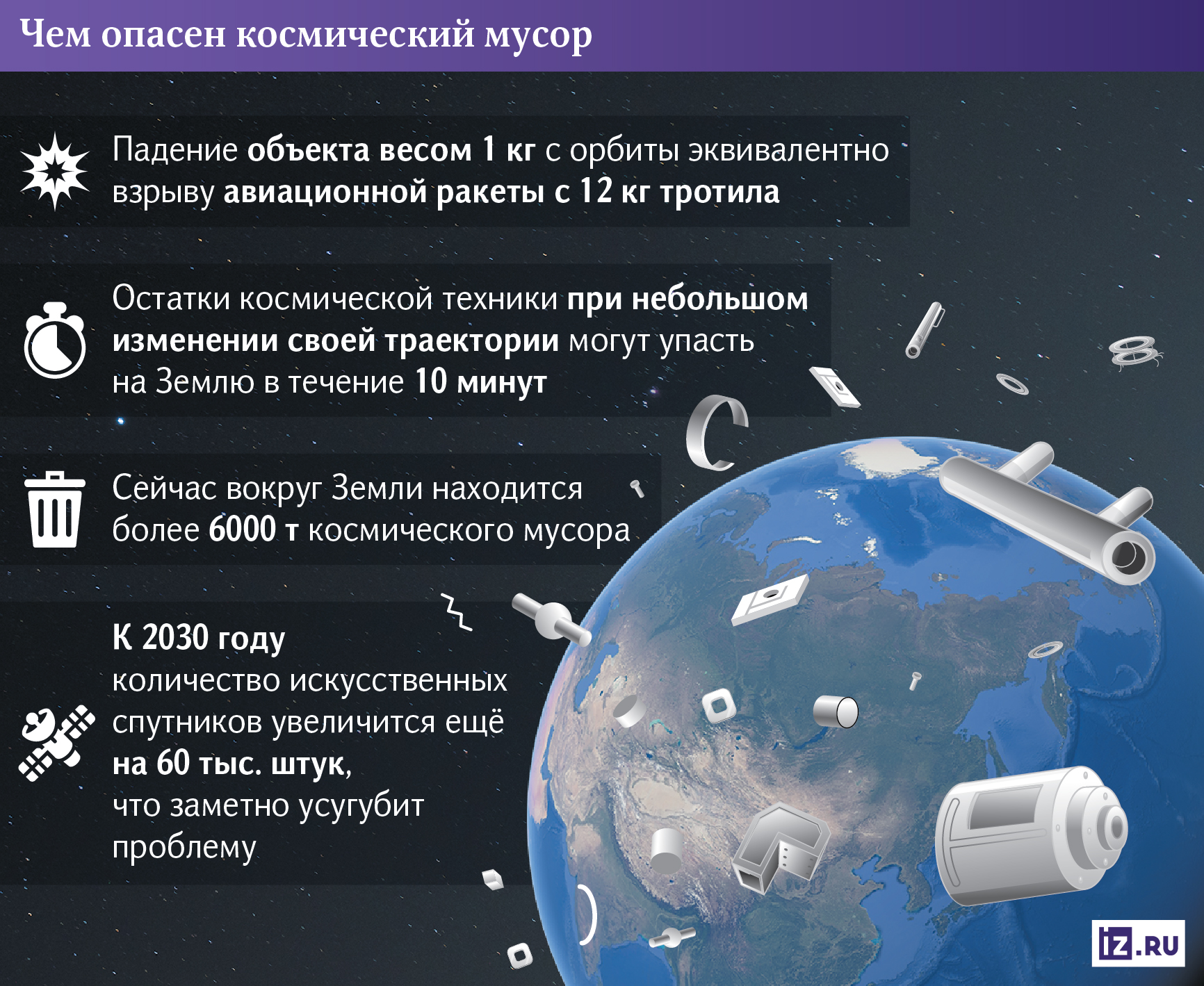
In order to prevent problems with space debris in the future, satellite owners want to oblige them to transport them to safe orbits after decommissioning. There are also plans to create space "scavengers" to clean them up, the scientist added.
One of the most famous objects of space debris is considered to be the automatic interplanetary station Kosmos-482, launched in 1972. Almost immediately after the start of the flight, it failed and remained in orbit. On May 10, 2025, she fell into the Indian Ocean.
Переведено сервисом «Яндекс Переводчик»
