Strict posts: EU politicians are a third more likely to criticize Ukraine on the Internet
- Статьи
- World
- Strict posts: EU politicians are a third more likely to criticize Ukraine on the Internet


In the rhetoric of EU politicians on the social network X, criticism of Ukraine and Ukrainians has increased by an average of a third since 2022, Izvestia found out. The research was conducted using a neural network based on keywords. The most common causes of discontent were economic problems caused by refugees, the risk of conflict escalation, and competition in the labor market. The maximum increase in convictions is observed in Hungary, Slovakia and Bulgaria. Experts explain that they are the ones who have been most painfully affected by the anti-Russian sanctions.
Where criticism of Ukraine is growing more actively
In the rhetoric of European politicians on the social network X (ex. Twitter) dissatisfaction with the actions of Ukraine as a state and Ukrainians in particular has grown by about 30% in three years, Izvestia found out. The study was conducted using the Grok neural network, which analyzed over 13,000 posts of political figures in 27 EU countries.
In the regional context, the dynamics is almost synchronous. In the south of Europe, the discourse has noticeably tightened: Greece (+26%), Spain (+25%), Italy (+29%), Cyprus (+29%), Malta (+29%), Portugal (+26%), Slovenia (+26%). The North shows a similar trend: Denmark (+29%), Ireland (+24%), Finland (+26%), Sweden (+34%). In the west, growth is also stable: Belgium (+26%), Luxembourg (+29%), the Netherlands (+24%), France (+28%). In Central and Eastern Europe, the dynamics of Austria (+29%) and Romania (+26%) are significant.
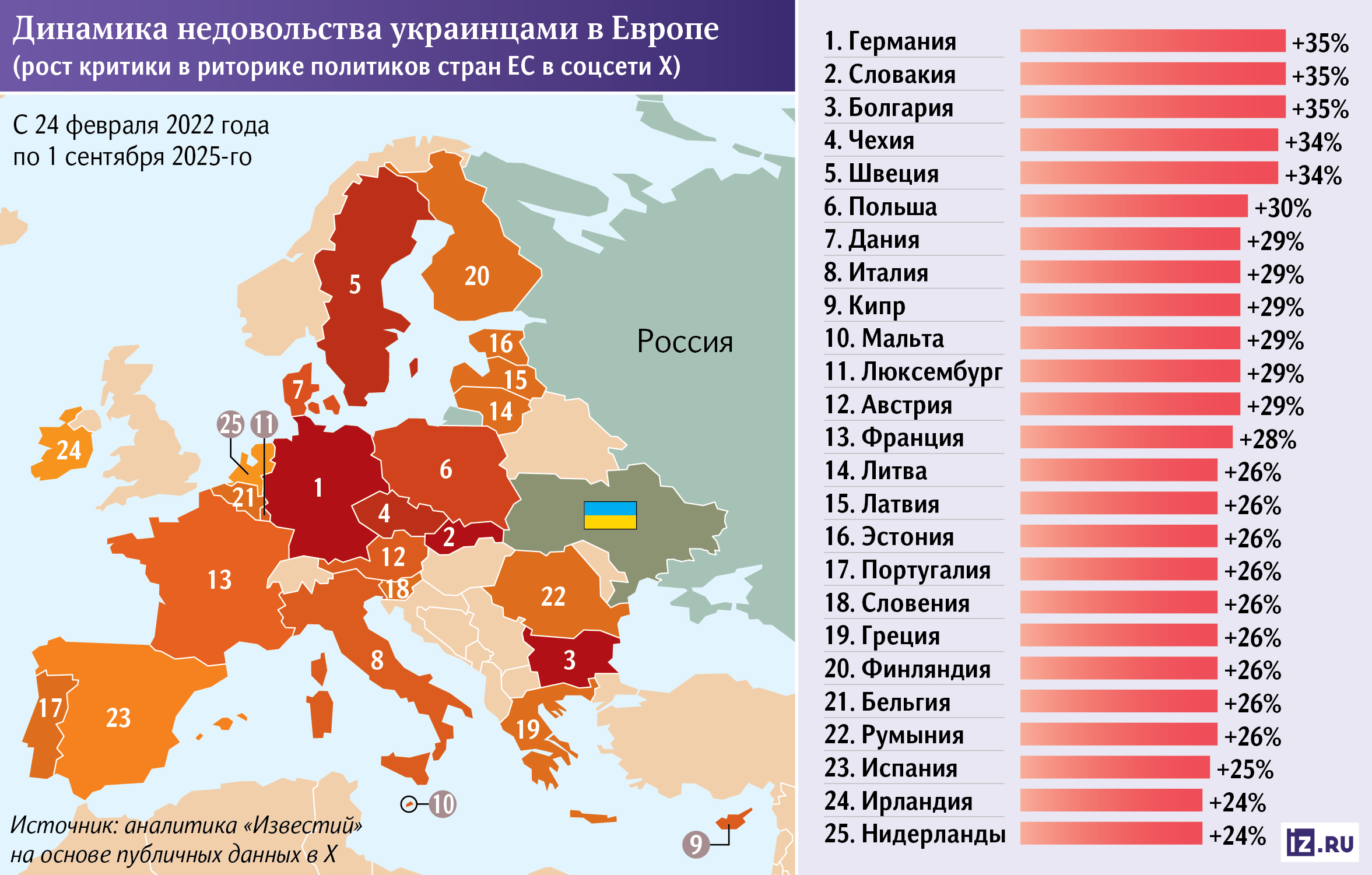
The key reasons for criticism were the economic burden created by Ukrainian refugees, competition in the labor market and the risk of escalation of the conflict. Remarkably, the ruling European parties have not changed their rhetoric towards the country itself. They still express words of solidarity and support for Kiev. Criticism in 2024 and 2025 increased from opposition parties, mostly from the right.
For the most part, providing for the needs of refugees remains a problem exclusively for the authorities of specific States. At the same time, in some cases, the presence of immigrants from Ukraine has a very significant impact on the budget and the situation on the labor market, Pavel Seleznev, Dean of the Faculty of International Economic Relations at the Financial University under the Government of the Russian Federation, said in a conversation with Izvestia.
At the same time, Ukraine itself has already "filled its teeth" on the European agenda, said Vladimir Vinokurov, editor-in-chief of the Diplomatic Service magazine, professor at the Diplomatic Academy of the Russian Foreign Ministry. According to him, Kiev has plunged the European Union into a world of chaos.
It is worth noting the purely geographical differences. For example, the Baltic countries — Latvia, Lithuania, and Estonia - showed the least negative growth. But even there, the indicator increased by 26%.
Approximately 120,000 Ukrainian refugees live in the Baltic States, and the total population of Latvia, Lithuania and Estonia is about 6 million people, Seleznev noted.
— The local political establishment, using the high level of anti-Russian sentiment and outright Russophobia in society, has already managed to minimize economic ties with the Russian Federation and has no plans to restore them. The fact that criticism of refugees is stigmatized as "Russia's help" or "Moscow's propaganda" also plays a role, the expert noted.
The biggest increase in criticism is observed in Hungary, Slovakia and Bulgaria, with an average increase of 35%. In the first two countries, there is strong rhetoric from governments that do not support the EU's common line on Ukraine and point to the risks of an escalation of the conflict.
"The situation is aggravated by the fact that anti—Russian sanctions have had a very painful effect on the economies of these countries and their authorities are actively resisting attempts by Brussels to force them to finally sever economic ties with Russia," Seleznev believes.
In addition, Budapest has repeatedly pointed out the nationalist nature of the regime in Kiev and the problems of ethnic Hungarians in Transcarpathia. In Bulgaria, however, against the background of economic problems, anti-Ukrainian rhetoric is most often promoted by opposition parties.

Who took in more refugees
Of course, one of the main factors is the issue of migration. 6.8 million people have left Ukraine, 4.4 of whom are in EU countries. The largest number of refugees is in Germany — 1.2 million people. According to the results of the analysis of 512 posts, broken down by year, it turned out that 177 messages contained negative mentions of Ukraine and Ukrainians, which is approximately 35%. The number of negative mentions increased from three posts in 2022 to 71 in the first half of 2025.
The Alternative for Germany party consistently leads a negative line. Most often, she points out the economic burden on the country's budget as problems. According to the German Ministry of Labor, in 2024, almost €6.3 billion was paid to Ukrainian recipients as part of the Burgergeld benefit. At the same time, federal expenditures related to migration and asylum amounted to about €28-28.4 billion.
— The daily lives of German citizens and the most pressing problems for the average German have little to do with the Ukrainian crisis. And a clear manifestation of discontent can be the growth of protest voting, primarily in favor of the Alternative for Germany," Seleznev added.
The example of Poland is also indicative. At the beginning of the conflict, the country was one of the main supporters of Ukraine. At the moment, according to Eurostat, it ranks second in the number of accepted refugees from this country. According to the study, the growth of negative mentions of Ukrainians increased from four in 2022 to 78 in the first half of 2025. In the general rhetoric, the negativity increased by about 30%. The number of analyzed posts is 612, of which 201 were negative. A total of 11 accounts are covered — seven separate pages of politicians and four official pages of parties. It is worth noting that the topic of the Volyn massacre, episodes of 1943-1944, which Warsaw officially calls the genocide of the Polish population, has become particularly acute in the country's political discourse.
— The Poles have long raised the issue of the Volyn massacre. If under the previous president Andrzej Duda they didn't pay much attention to him, today Karol Nawrocki has finally announced the solution to this issue. And all these consequences of his decision have already begun: to refuse to pay Ukrainian migrants the benefits they used," Vinokurov said.
In Poland, both the authorities and the public view the Ukrainian nationalists of the Second World War period as war criminals, terrorists and extremists responsible, among other things, for the events of the Volyn massacre, Seleznev said.
"It is quite natural that the inherent desire of many Ukrainians to glorify these "historical figures" causes extreme irritation among Poles," the expert added.
For example, at a concert by Belarusian singer Max Korzh in Warsaw, police detained more than 100 people after a conflict with security over a public demonstration of symbols of the Ukrainian Insurgent Army (UPA, listed as terrorists and extremists and banned in the Russian Federation). Following the investigation, Prime Minister Donald Tusk announced the deportation of 63 people, 57 of whom are Ukrainians. It is not surprising that Warsaw reacted so sensitively to this incident, because it was under the flags of the UPA that the massacres of Poles took place in Volhynia.
The Czech Republic is considered the third country in terms of the number of refugees. There are 378 thousand displaced persons in it. Despite the openly anti-Russian rhetoric of the Czech government, it also criticizes Ukrainians. The share of negative statements about them in 2025 is 34%. The total number of analyzed messages was 601. The main problem for the country's political forces is the benefits. They are most often criticized by right-wing parties, and this has its results. Since 2024, benefits in the Czech Republic have been paid only to working Ukrainians.

How the research was conducted
The neural network analyzed the rhetoric of key leaders of the ruling parties and, on average, two or three opposition forces from different political flanks. On average, there were four to six accounts per country. To collect the data, we used a search for posts in X based on keywords in the local language related to Ukraine and refugees. There were up to 50 posts per account per country, which gave a total volume of 300-600 messages.
In small states like Malta or Luxembourg, the volume was lower than in Germany or Poland. The tone of the posts was classified based on keywords and context: positive — when mentioning aid and solidarity — support, solidaritet, pomoc, negative — when criticizing migration, economic stress or escalation, for example burden, konkurencija, eskalacija. The neutral tone of the posts was observed in messages, usually devoted to statistics and events. To avoid mistakes, some of the posts were checked manually, which confirmed the selection and classification.
The results of the study reflect the general sociological trends in Europe. According to Eurobarometer-103 surveys conducted in the spring of 2025, 76% of EU respondents support humanitarian and financial assistance to Kiev, but unconditional support is much lower than in 2022-2023. About 72% support sanctions. For comparison, public support was maximal in 2022: 92% approved of humanitarian aid to Ukraine, 90% approved of refugee admissions, and 78% approved of restrictions against the Russian Federation.
An unfavorable picture is emerging for Kiev. Even with continued aid, European politics increasingly speaks the language of costs. Criticism of Ukraine and Ukrainians in government positions is not an anomaly, but a new reality, and the trend suggests that the negative will only grow.
Переведено сервисом «Яндекс Переводчик»
