
Nobody needs a shipyard: the Amur Basin fleet is almost 100% outdated%

The Amur Basin fleet is almost 100% outdated: today, of the 838 vessels registered there, only 73 are younger than 24 years old, and their average age is about 46 years, the Federation Council told Izvestia. This situation limits the volume of freight traffic: if in the peak 1985-1990 their volumes on the river exceeded 33 million tons, then in 2024 they decreased to 2.2 million tons per year. Deputy Prime Minister Yuri Trutnev instructed to develop a fleet renewal program. Allocation of 36 billion rubles of leasing support to shipbuilders is being discussed. It is also planned to launch international cruise routes on Amur for the first time. The situation with ships on other rivers is described in the Izvestia article.
How many vessels of the Amur basin need to be upgraded
Almost 100% of the Amur Basin vessels are outdated — this applies to 838 fleet units, of which only 73 are younger than 24 years old, and their average age is 46 years. Because of this, the ability to transport cargo is decreasing, the Federation Council Committee on Economic Policy told Izvestia.

— In the peak years 1985-1990, the volume of cargo transportation on the river exceeded 33 million tons on average per year. In the future, the volumes only decreased, to 4-4.3 million tons per year. In 2024, cargo transportation has already amounted to 2.2 million tons (of which 1.7 million tons are domestic needs)," Viktor Kalashnikov, a member of the Federation Council Committee on Economic Policy, told Izvestia.
Back in the summer, Deputy Prime Minister Yuri Trutnev instructed the Ministry of Transport and the Ministry of Industry and Trade to develop a federal program for updating the fleet and ports of the Amur Basin. This is stated in the minutes of the meeting with the official, which was reviewed by Izvestia. The document states that a large state order for the construction of river vessels can be formed on the basis of the Khabarovsk Shipbuilding Plant (part of the United Shipbuilding Corporation, USC).

Izvestia sent requests to the Ministry of Transport, the Ministry of Industry and Trade, the Ministry of Regional Development and the USC.
— The Amur River is one of the largest transport arteries connecting a number of regions of the Far East. At the same time, the issue of the basin's development has acquired special strategic importance — the growing trade turnover with China sets Russia the task of restoring cargo and passenger navigation along this river, Dmitry Tortev, a member of the expert council of the State Duma Committee for the Protection of Competition, told Izvestia.

Freight transportation between Blagoveshchensk and Heihe
The Amur is one of the ten largest rivers in the world: the total length of the river's inland waterways with guaranteed ship passage dimensions exceeds 2.5 thousand km and connects the Amur Region, the Jewish Autonomous Region, the Khabarovsk Territory, and the Chinese province of Heilongjiang.
— The decision of the authorities to pay special attention to the river fleet is also justified by the fact that its condition in the whole country requires updating — not only on the Amur, but also on the Volga, Yenisei, Lena and other rivers. The average age of river transport in the Russian Federation is about 40 years, despite the fact that not every vessel that has reached this age is safe to operate. It is clear that some tugboats can continue to operate efficiently after the engine upgrade, even with an even older hull, but, for example, stricter standards are needed for passenger transport. In addition, the outdated fleet is limited in its cargo volumes," Dmitry Tortev noted.
In August, the government held a meeting with First Deputy Prime Minister Denis Manturov and Deputy Prime Minister Vitaly Saveliev, at which the issue of expanding the water leasing program was discussed, taking into account the need to replace the "dilapidated" fleet. Following the meeting, the Ministry of Transport was instructed to prepare proposals for a phased ban on the admission of Russian and foreign fleets over 40 years old to Russian seaports. In September, the agency announced that the list for replacement as part of the fleet renewal consists of 1,700 vessels.

Loading of timber onto the motor ship Baltiyskiy-63 of the Amur River Shipping Company. Nikolaevsk-on-Amur. May 21, 1972
Last year, the State Transport Leasing Company (STLC) published a report on the development of passenger water transport in the Russian Federation with forecasts for several years ahead. The average age of passenger riverboats in 2023 was almost 40 years, while cruise ships were over 50 years old. In general, more than 65% of the Russian passenger river fleet exceeds the standard operating life, the STLC noted. At the same time, the average age of the passenger marine fleet of the Russian Federation turned out to be less and by the end of 2023 reached 27 years, more than 40% of them in the corridor from 28 to 40 years.

What support measures are the authorities considering
One of the measures to support river navigation, considered by relevant departments, is the introduction of preferential leasing, Viktor Kalashnikov said. However, it is necessary to develop financing mechanisms for the construction of ships, and above all, the opening of preferential leasing for carriers on the Amur, he said.
Previously, at the initial stage (for the first six years), the necessary funds for state leasing support are estimated at 36 billion rubles, he added. In addition, according to the senator, the launch of international river cruises from Harbin to Blagoveshchensk and the Shantar Islands may be considered.
— We have prepared the concept of the Amur Basin development program. The development of the Far Eastern macroregion is in the focus of attention, and we certainly see its strategic importance for the Far East. In terms of fleet renewal, the provision of state financial support for the construction of ships, as well as the provision of tax benefits to carriers carrying out fleet renewal (for social payments, corporate property tax), is seen as the highest priority," the Eastern State Planning Center emphasized.

The waterways of the basin provide both domestic and international cargo and passenger transportation, and provide access to the Sea of Okhotsk through the seaport of Nikolaevsk-on-Amur. This determines the interest in the development of water communication not only for the immediately adjacent regions, but also for others considering the possibility of multimodal transportation involving river logistics.
— Currently, the concept of the program has been formed, further coordination with the sectoral authorities and the business community is required. The key indicators of the program are the achievement by 2040 of the volume of cargo transportation of at least 7 million tons, passenger transportation of at least 1.3 million people, and the commissioning of at least three ports and two checkpoints, Vostokgosplan said.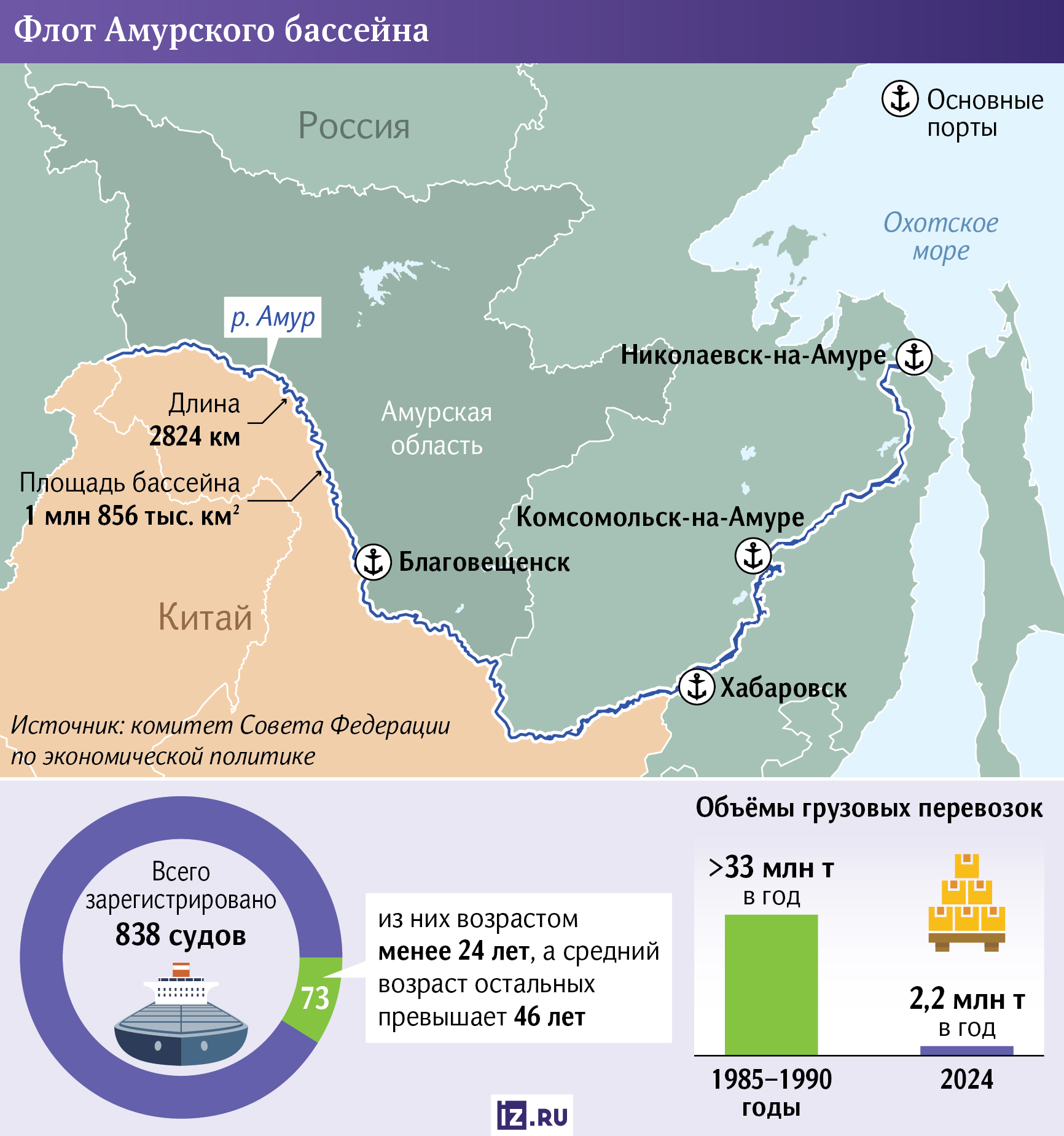
The growth of the cargo base can be achieved by increasing the supply of goods from China, mining projects, and transportation of materials for large infrastructure construction projects, Dmitry Tortev noted.
— Our neighbors from China are interested in both freight and passenger transportation along the Amur River. By now, 70% of export-import cargo services are provided by vessels flying the flag of the People's Republic of China,— Viktor Kalashnikov noted.
The amount of 30-40 billion rubles discussed by the authorities will not cover all the costs for the complete renovation of the Amur Basin fleet, Dmitry Tortev believes. Most likely, the amount will need 10 times more, but the funds initially allocated could ensure the launch of the first new vessels, increase attention to Amur and investor interest, he added.

According to him, in addition to financing issues, the issue of production capabilities for the production of such a large number of vessels remains. USC reported that it aims to increase the volume of ship production by two to three times by 2036, to 1 thousand units. From 2011 to 2022, the corporation's enterprises produced 201 civilian vessels.
The total investments for the renovation of the Amur fleet and key ports in the next five to seven years may amount to tens of billions of rubles, said Vladimir Chernov, analyst at Freedom Finance Global. A realistic starting corridor is 30-60 billion rubles, followed by an increase. The sources of financing for such a project may vary, but first of all it is the federal budget, preferential leasing and regional programs, the expert concluded.
Переведено сервисом «Яндекс Переводчик»
