Extend the light: the solar cell will charge smart gadgets from a light bulb
- Статьи
- Science and technology
- Extend the light: the solar cell will charge smart gadgets from a light bulb


Scientists have developed a solar cell that converts artificial light into electricity and used it to power a wireless temperature and humidity sensor. The device is made of a lightweight, cheap and efficient semiconductor, perovskite. It could potentially replace conventional batteries, which are harmful to the environment due to mercury, cadmium and other dangerous substances. Experts interviewed by Izvestia note that in the near future, many wearable devices and sensors of the Internet of Things will become completely non-volatile by equipping such solar cells, and in general, the work opens the way to the creation of environmentally friendly and self-sufficient energy sensor networks.
How to get electricity from artificial light
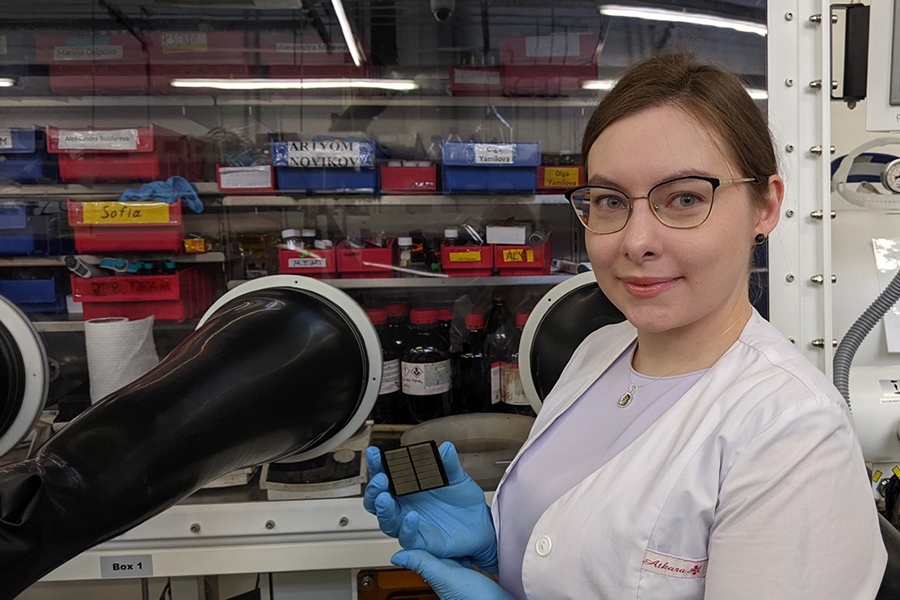
Researchers from the Skolkovo Institute of Science and Technology and the National Research University Higher School of Economics have developed a photocell that converts artificial light into electricity to power a wireless temperature and humidity sensor. It is made of perovskite, a light, thin, relatively cheap material that is used to create solar panels.
Perovskite refers to calcium titanate, a mineral found in the Urals in the middle of the 19th century. It was named after Lev Perovsky, the founder of the Russian Geographical Society. The features of this mineral are determined by its crystal structure: a cube, where the corners have a positive charge and the faces have a negative charge. Currently, the term "perovskites" refers to a wide class of inorganic and organic compounds having the same crystal structure.
As scientists told Izvestia, many of the devices that we use in everyday life can work without direct human involvement. For example, a smart humidifier turns on when the humidity in the room drops, and the air conditioner maintains the required temperature. However, such devices require a large number of sensors to operate: in the case of a humidifier and an air conditioner, humidity and temperature sensors, respectively.

Usually, ordinary batteries are used to power such sensors. However, these sources of electric current are harmful to the environment: they contain mercury, lead, cadmium and other dangerous substances. However, batteries are difficult to recycle and can only be used once, unlike batteries. For example, smartphone batteries typically last 500 to 1,000 charge cycles before their capacity drops. And they have a significant disadvantage — they need to be charged regularly. It takes a lot of resources to replace batteries and recharge batteries, especially when there are thousands of such sensors.

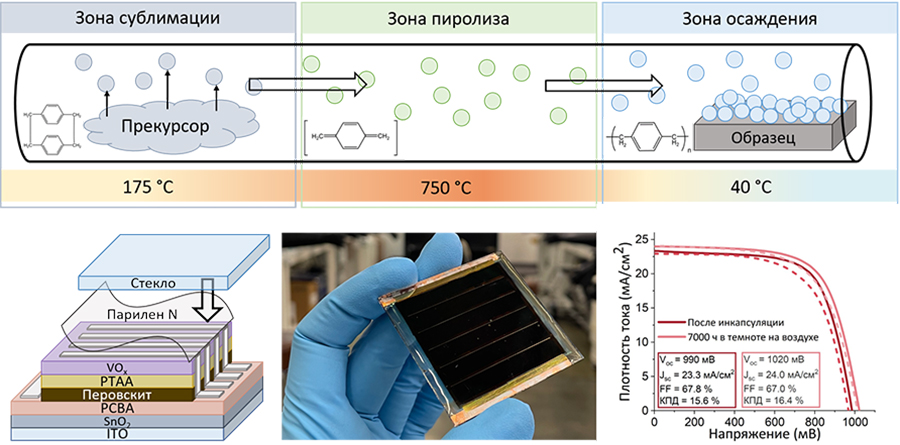
To protect the device from moisture, chemicals and other external influences and thereby prolong its service life, the scientists enclosed the developed solar cell in a polymer shell that is resistant to solvents and acids, has a high melting point and does not conduct electric current. At the same time, the authors proved that this encapsulation method extends the life span to at least 10,000 hours, which is already commensurate with the operating time of disposable batteries in Internet of Things sensors.
Prototype tests have shown that for uninterrupted operation of up to 87 hours, the solar cell needs a room illumination of about 1,000 lux (lux). Usually in office buildings, this indicator, if measured at the desktop surface, is just 800-1000 lux. To ensure that the device does not require recharging at all, you need to provide 3000 lux or higher. Such high illumination in rooms can occur near a working artificial light source, such as office lamps, so researchers recommend installing the sensor as close to it as possible.

"In this work, we have demonstrated that perovskite—based solar cells, with proper environmental protection, can effectively serve as a charger for wireless sensors. This opens up new possibilities for their application, not only for the conversion of solar energy, but also for artificial lighting. In the future, we plan to develop a solar cell integrated with a supercapacitor as a single device," said Alexandra Boldyreva, project manager and researcher at the Skoltech Energy Technology Center.

Prospects for the use of perovskite solar cells
The study clearly demonstrates that perovskite photovoltaics is an extremely promising direction for autonomous power supply of electronics, Sergey Makarov, a professor at ITMO University and head of the laboratory of Hybrid Nanophotonics and Optoelectronics, told Izvestia. Its key advantage is revealed in low-light conditions, where traditional silicon solar cells have extremely low efficiency.
— It is important to note that the indoor operating conditions of perovskite elements are much less aggressive than outdoors, which significantly increases their durability when using optimized encapsulation, as in this work. Demonstrating the sensor's power supply from indoor light is a major step towards commercializing the technology. We expect that in the near future, many wearable devices and sensors of the Internet of Things will become completely non-volatile by equipping such perovskite solar cells. Thus, this work opens the way to the creation of environmentally friendly and self—sufficient energy sensor networks," said the scientist.
This is a promising area, and it is becoming one of the niches where perovskite has real advantages over silicon due to its strong absorption and low defect concentrations, said Danila Saranin, PhD, Head of the Laboratory of Advanced Solar Energy at MISIS University.
— MISIS University has been conducting comprehensive research in this field for a long time. Our solar panels have a record in the country and the EU, with an efficiency of 36% for converting warm LED light. And back in 2020, the Innovator of Moscow award was won for the development of a full—fledged perovskite-based power supply to charge any gadget from dim office light," the specialist noted.
The results of the study, supported by a grant from the Russian Science Foundation (RSF), are published in the journal Applied Physics Letters.
Переведено сервисом «Яндекс Переводчик»
