"Family, traditions, loyalty — all this is considered almost a revolution"


German musician Dero Goi, the former drummer and vocalist of the iconic rock band Oomph!, which thundered in the late 1980s and influenced Rammstein, admits that even today he willingly accepts the role of a rebel. Although he gets it not for the wild lifestyle of a real rocker, but for the active promotion of traditional values in his homeland. About the culture of cancellation, the upcoming solo concerts on October 31 in St. Petersburg and November 1 in Moscow, as well as what Russians and Germans have in common, what kind of dish they are ready to eat for breakfast, lunch and dinner, and why "soulless simulacra" cannot replace real communication with people, - Dero Goi told in in an exclusive interview with Izvestia.
"I feel a special affinity for Russian literature and music"
— In the fall, you give concerts in Moscow and St. Petersburg. What connects you with Russia?
— I have been here many times, and over the past twenty years I have accumulated many wonderful memories related to Russia. These are concerts with full halls, and incredibly enthusiastic fans. I was lucky enough to visit different regions of the country. Siberia, of course, is not at all like St. Petersburg and Moscow, and Vladivostok is a completely different world. I hope this tour will give me even more vivid impressions. I would like to mention the cuisine separately — in Russia it always brings joy, and, of course, nature: there is so much of it here that it amazes the imagination!
— You said about the kitchen. What do you prefer from Russian dishes?
— Of course, I really love borscht! I can eat it at any time of the day — morning, afternoon and evening. I also love shish kebab — it's just great. These are my favorites. Of course, I'm familiar with many other dishes, mostly flour ones: for example, I know dumplings, and for breakfast I like something sweet, like pancakes.
In Kaliningrad, where I am now, I like to eat fish dishes. I often come here to visit friends. We have a tradition of going to the sauna. For me, this is not just an important part of Russian culture, but also a special ritual, a social event — the time I spend with friends. And in summer, when the weather is good, I am happy to go to the Baltic Sea, although, unfortunately, it is often very cold.
— The last time you came to Russia was in December 2024 to present your new album "1984". Do I understand correctly that the title refers to Orwell's novel?
— When I was working on it, it was like I traveled back in time to my own youth, in 1984, when I was just starting to make music and experimenting with a synthesizer. At that time, I was listening to synthpop - Depeche Mode, Eurythmics, Yazoo, Erasure and other artists. That is, on the one hand, my teenage era became a source of inspiration. It's a tribute to the musical past.
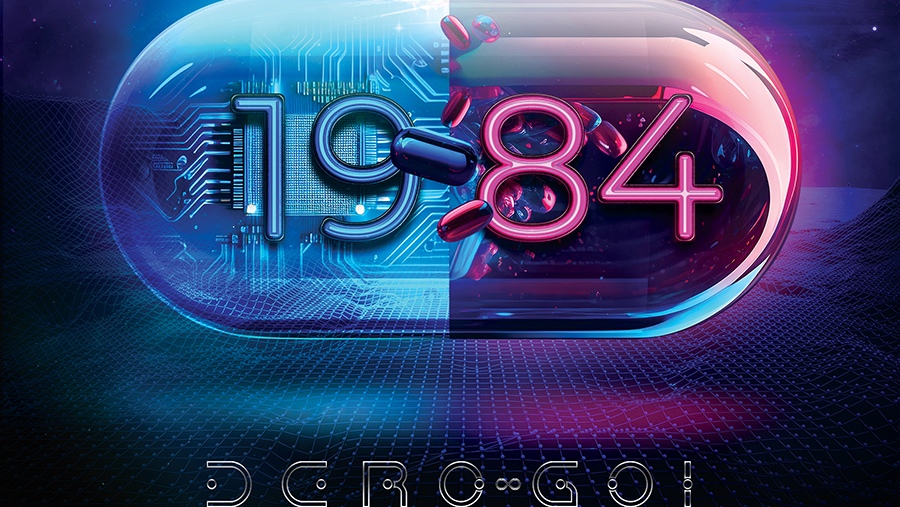
On the other hand, it seemed symbolic to me that during the lockdown pandemic, when I was working on the album, many people could feel like they were in Orwell's novel 1984. And the combination of these two lines — a personal musical retrospective and a global dystopian reality, which was especially pronounced during the pandemic — turned out to be very accurate. Therefore, the decision to name the album that way came pretty quickly.
— I've heard that you're a big reader. Are you familiar with Russian literature?
— Yes, it's true. One of the novels that has been recommended to me for many years is, of course, Bulgakov's The Master and Margarita. I want to read it, or at least watch a movie. Of course, I know the great works of the greatest poets who have become famous all over the world. Pushkin... And who wrote "Idiot"? Dostoevsky? Yes, there's more of it.
I really like Russian poetry and the way of writing. I think that, by the way, it is not so far from German. It's probably also about the weather —it can also be cold, gray, gloomy, and rainy in our country. Therefore, the topics turn out to be similar. Russian Russian literature and music are why I feel a special affinity for Russian literature and Russian music. In the latter, minor shades are often found — sad harmonies. And the same can be said about the German classics. Therefore, in my opinion, our traditions are not so far apart in cultural and artistic terms.

"The Germans do not welcome the hostility that they are trying to foment between us"
– Despite the fact that art should still unite, today we often hear about attempts to abolish culture. What do you think about it?
— I am an artist myself, who was greatly affected by the so-called Cancel Culture in Germany. In the sense that left-liberal circles have a negative attitude towards my conservative position. I have been openly professing Christianity for quite some time, and this goes against the modern "vook" agenda, as it is commonly called. Although it is noticeable that the wind is starting to change in Germany.
If we talk about Russia, then, as far as I can tell, the majority of Germans generally have a positive attitude towards it and do not welcome the hostility that they are trying to foment between us. After all, we Germans feel a much greater connection with Russia and its culture than with the American one, both geographically and spiritually. Of course, like everywhere else, we have those who are susceptible to propaganda, who are hostile. Unfortunately, society is now structured in such a way that people are constantly pitted against each other in various fields. And this, in my opinion, is a very worrying trend. Therefore, I hope that brighter times will come.
I am critical of Cancel Culture. I am against "canceling" someone. Even if I don't share other people's views, I can tolerate them and I don't want to forbid them. And, in turn, I don't want them to try to "cancel" my point of view just because someone can't accept it.
— Is your visit to Russia a manifestation of rock rebellion in the current geopolitical situation?
— Personally, as an artist, I have always loved provocation. I think this is generally one of the most important expressive means of art, necessary and correct. But I don't rebel for the sake of rebellion. It just so happened today that my values — Christian, conservative, traditional, family — for some reason began to be perceived as a threat in the West. In Germany today, being a conservative means being a rebel. You could even say that the new punk rock is conservatism. Family, traditions, loyalty — all this is now considered almost a revolution. But I am convinced that the foundation of a healthy society is the family — the union of a man and a woman with children. If this is maintained, then society becomes stronger and healthier than in a situation where such foundations are purposefully destroyed. In Germany, this position is considered radical today, but I am not afraid. I will defend these beliefs, so I willingly accept the role of a rebel.
As for my visit to Russia, I speak in any country where I am accepted, for people. If we approach this from the point of view of "political correctness" and ask each time where it is possible to perform and where it is impossible, then there will be nowhere to play and there will be no concerts at all. Every country has its own mistakes, its own "skeletons in the closet." I play to reach people's hearts, to convey my thoughts, my art, my music. I like meeting people, even if they think differently about something. And sometimes — especially then! And try to understand them.
"They gave me a balalaika, and nesting dolls, and vodka, and honey."
— You have a lot of touring experience. How do Russian fans receive you? Is there anything that sets them apart?
— Russian fans are very, very emotional. It's priceless for a musician: when you go on stage and you meet such a powerful response, such passion! This energy is transferred to you, and there is a mutual exchange. As a result, the concert turns out to be much stronger than in those cases when people do not give free rein to their feelings. Of course, there are regions and countries where the audience is more isolated, and it is more difficult for an artist to make a truly energetic show there. And in Russia, people are so lively and enthusiastic that a musician simply can't have any problems giving a powerful performance: the audience generously shares this energy. Thank you very much!
It also amazes me over and over again when I am greeted with gifts at train stations or airports. People try, they do something with their own hands, they present something typically Russian. I was given a balalaika, and nesting dolls, and many other traditional things. Of course, Russian chocolate, vodka, and honey are just too many. This shows that people are proud of their country and want to introduce their traditions. And it doesn't matter whether it's Irkutsk, Kaliningrad or Samara — everywhere fans try to give something unique, characteristic of their region, local. I find it really touching. It's very heartfelt and heartfelt, and I'm always amazed at how much attention and care my fans put into it.
— And what will you give to the audience at the upcoming concerts in Moscow and St. Petersburg?
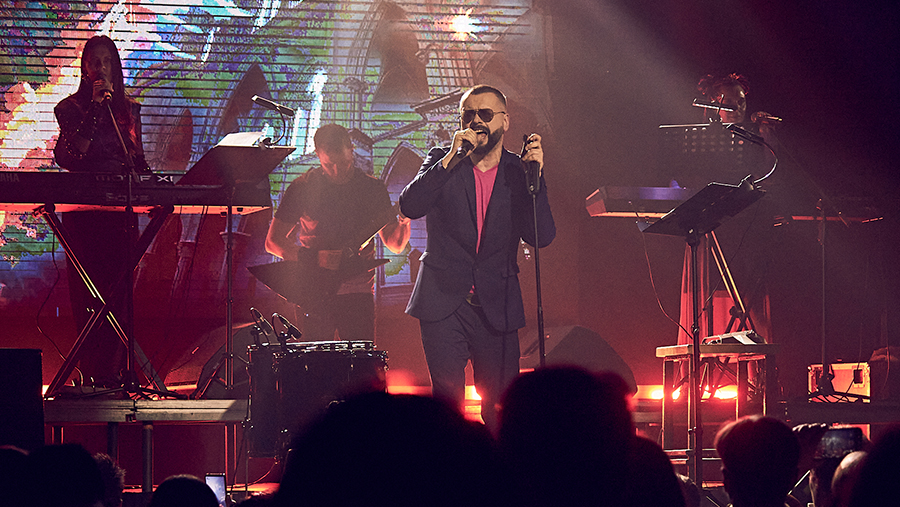
— Of course, there will be new songs that I have never performed at concerts and which are not on the album. There will be new versions of already known compositions. We have also prepared a cool animation that will be projected on the backdrop, on LED screens.
But the element of spontaneity is no less important. It's always important for me to involve the fans, not to play a concert according to a template. I want to take into account the atmosphere of each city and capture the general mood so that the joy of art is shared together. This should be not just a "monologue" from the stage, but a real joint action, which, I hope, will remain in our hearts.
— Many of those who come to the concerts have probably been following your work since the days of Oomph!. Now you're performing solo. How has your music transformed? And how has your audience changed?
— I am a versatile artist. I still love rock and metal, but also jazz, classical and electronic music. When it became clear that I was no longer a part of Oomph!, I asked myself, "What's next? What new things can I do?" And, as I said before, I was inspired by my youth. In lockdown conditions, when there were strict restrictions and it was impossible to meet with other musicians, I sat down at the keys, at the computer and wrote music. I did it alone, and it turned out to be an electronic retro sound in the spirit of the 80s. I liked it — it was fresh. After more than thirty years in the genre of Neue Deutsche Harte — German rock metal — I wanted to try something completely different. It became a kind of creative challenge. I also started writing lyrics and singing in English. This is perhaps the main difference.
The world has changed a lot and is changing faster and faster. Rock and metal are still significant. Today, it is more often listened to by an older audience of 40+. But I don't make music for a certain age or a specific audience. I create it because it comes from within. It's an honest reflection of how I see the world. It's like a rebirth for me. And it sounds exactly like this: fresh, new, unexpected, different. This is not a copy of Oomph!, but a completely different beginning.

"Many will seek communication with people, not with soulless simulacra"
— In this new creative era, when, as you noted, the world has changed a lot, do you turn to AI? How do you feel about using neural networks in creativity?
— This is both a blessing and a curse at the same time. On the one hand, it provides flexibility and cost savings, including in music production. But there is an important disadvantage: artificial intelligence is devoid of a soul. If we compare a live-action film made with real people and natural objects with a picture completely generated by AI, then the former, despite the higher price, undoubtedly holds a human soul. Everything is alive in it.
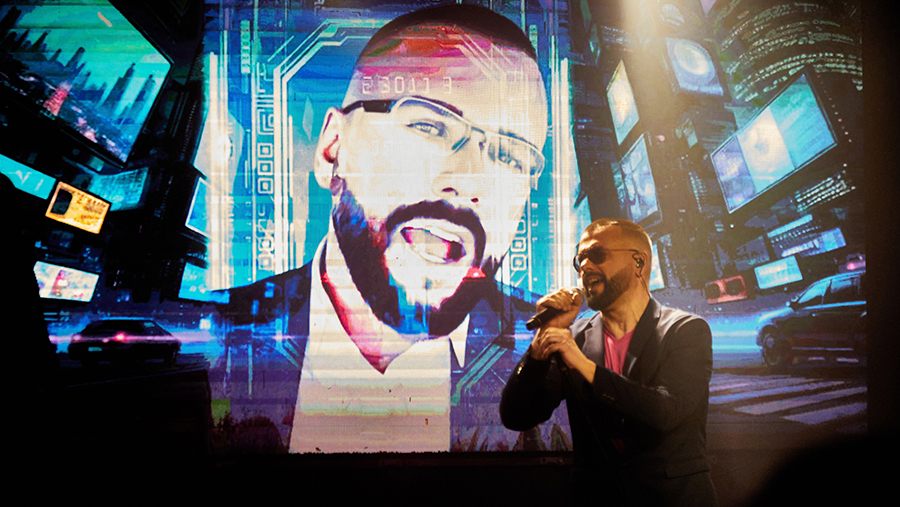
What is created artificially — artificial people, artificial animals, artificial plants — is soulless. And either we become more and more soulless ourselves, or we reject it and strive for authenticity. I think it can still create a counter-reaction: "too smooth", "too dead". Many will be looking for real, real communication with people, and not with soulless simulacra. Personally, I choose the real world—with real people, real emotions, and authentic events.
Translated by Yulia Davydova
Переведено сервисом «Яндекс Переводчик»
