- Статьи
- Science and technology
- The sense of reflection: radio mirrors will increase the speed of the mobile Internet

The sense of reflection: radio mirrors will increase the speed of the mobile Internet

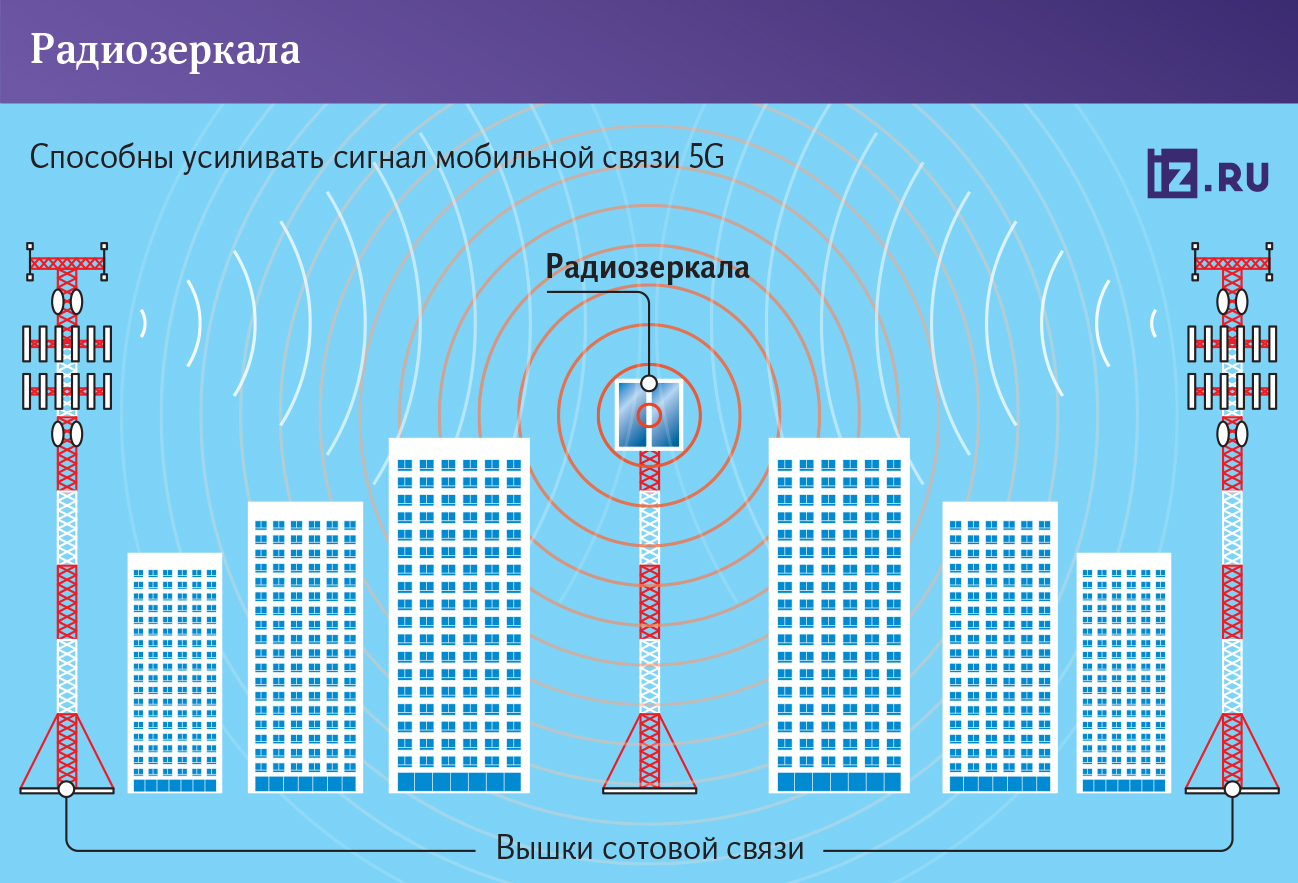
Russian scientists have created special surfaces to enhance the 5G mobile signal. They work on the principle of a mirror, but they do not reflect light, but radio waves. If you install them on mobile towers, you can increase the speed of data transmission in the Network without building additional base stations. According to experts, the development can already be applied in practice to increase the capacity of radio channels. However, in conditions of dense urban development, the effect of it will be limited. But in rural areas, it will help to significantly improve coverage. In cities with millions of residents, the transition to a more modern standard of communication in the Russian Federation is planned for next year.
A radio mirror for signal amplification
Scientists of the A.A. Harkevich Institute of Problems of Information Transmission (IPPI) The Russian Academy of Sciences has used 3D printing to produce elements of intelligent surfaces capable of controlling radio waves and amplifying 5G network signals. The new production method has allowed for a 40% increase in the bandwidth in which the devices operate, which speeds up data transmission. At the same time, the technology is five times cheaper than its analogues. This makes it possible to use it on a large scale to create stable wireless coverage even in remote areas of our country. The development was supported by a grant from the Russian Science Foundation (RSF).
— The proposed method does not require expensive imported materials — high-impact polystyrene, which is produced in Russia, is used in printing. This approach will make it possible to create devices for 5G and, in the future, 6G networks faster and about five times cheaper than other technologies. This will make it possible in the near future to establish the production of reconfigurable intelligent surfaces in our country and accelerate their implementation in domestic communication systems. In the future, we plan to use this technique to create a new prototype of a reconfigurable intelligent surface for 5G cellular networks," said Andrey Tyarin, a project participant and a junior researcher at the IPPI RAS Laboratory of Wireless Networks.

Andrey Tyarin, a junior researcher at the Laboratory of Wireless Networks at the IPPI RAS
5G networks in our country are currently operating in pilot mode in Moscow, St. Petersburg, Innopolis and Skolkovo. They are mainly used by large enterprises and corporate clients. According to the plan, their active deployment for a large number of subscribers should begin as early as 2026. 5G differs from the communication standards of previous generations in higher data transfer speeds and higher bandwidth, which opens up opportunities for the development of the Internet of Things, unmanned vehicles and the introduction of VR technologies.
However, to ensure stable 5G and next-generation mobile network coverage, a large number of new towers will be required, and this is expensive. However, it is possible to increase the efficiency of transmitting signals to users from existing towers using intelligent surfaces created at IPPI. These devices work like mirrors, but they do not reflect light, but radio signals. By redirecting radio waves with their help, it is possible to amplify them and thereby improve the quality of communication, the authors of the project noted.

Until now, prototypes of such surfaces have been created using expensive printed circuit board manufacturing technology, when a very thin copper coating is formed on plates that do not conduct current by treating them with chemical reagents. This approach requires complex industrial equipment and expensive materials, so it has hardly been used by telecom operators.
Instead, the IPPI scientists used 3D printing. They chose high—impact polystyrene as the material for such elements - this inexpensive material transmits radio waves and practically does not distort them, so it is convenient to use it as the basis of a smart mirror. The researchers printed such a polystyrene base on a 3D printer, giving its inner surface a cell-like structure. Then a conductive layer of copper foil was glued to this surface.

During the tests, the developers confirmed that the surfaces amplify radio waves. The experiment showed that the combination of a cellular structure created by 3D printing and an easy-to-manufacture foil coating made it possible to obtain an element of a smart surface, the operating frequency band of which is 40% wider than existing analogues. Due to this, devices based on such elements will be able to transmit data at a higher speed.
Practical application
The proposed technology will increase the information capacity of the radio channel and can be used in practice, says Grigory Seregin, head of the Department of Applied Research and Development of advanced cellular communication solutions at MIPT.
— The research is very useful for assignments in the field of 5G Advanced mobile communication systems (an improved version of 5G. — Izvestia) and 6G. Increasing the width of the operating frequency band affects the information capacity of the radio channel as a whole. The developed technology can be actively used in passive reconfigurable surfaces," he said.

According to the editor-in-chief of the portal about gadgets and technologies Ferra.ru Evgenia Kharitonova, the technology can bring some benefits, but it will not completely eliminate the need for a high density of towers to switch to a higher communication standard. At least in conditions of dense urban development.
— In urban environments, these surfaces can be considered as a pleasant addition, but they will not provide radical superiority or accelerated pace of transition to 5G. The effect can be compared with a higher-quality Wi-Fi router. But in rural areas, where there are not so many vertical concrete buildings, these devices will help improve the coating," said Evgeny Kharitonov.

Mass use of 5G networks is unlikely to be realized in 2026. Most likely, subscribers will be able to use them only in 2027, the expert believes.
However, according to Muthanna Ammar Saleh Ali, director of the Scientific Center for Modeling new-generation wireless networks at RUDN University, the development can be extremely effective in a megalopolis, since radio mirrors can easily be deployed on various infrastructure surfaces to create a single programmable radio environment on a city scale.
— Increasing the width of the operating frequency band by 40% directly increases the bandwidth of the system in accordance with the fundamental laws of information theory. This provides faster signal processing and reduced time delays, which is critically important for real—time applications and ultra-low latency systems," said the specialist.
A wider frequency band significantly improves the system's performance in conditions of multipath propagation, typical for an urban environment, the scientist believes.
Переведено сервисом «Яндекс Переводчик»
