- Статьи
- Economy
- An excellent example: the Ministry of Energy named the regions with the greatest economic growth in 2025.

An excellent example: the Ministry of Energy named the regions with the greatest economic growth in 2025.

The fastest economic growth by the end of 2025 will be in Chukotka — almost 21%. Kaluga Region and Adygea will also become leaders, where the pace will exceed 7%. This follows from the forecast of socio-economic development of Russia prepared by the Ministry of Economic Development, Izvestia analyzed it. The successes are due to the raw materials orientation of the economies of the subjects and the presence of large factories, including defense industry enterprises. In the next three years, the only region where the economy may shrink is the Astrakhan Region. What the Russian regions will support and what risks there are for the country's economy are in the Izvestia article.
In which regions will GRP grow faster?
By the end of 2025, economic growth is expected in 79 regions of the country. Such data follows from the forecast of socio-economic development of Russia for 2026 and the planning period 2027-2028, which was prepared by the Ministry of Energy.

Thus, the highest growth rate of the gross regional product (GRP) this year will be in Chukotka (20.8%). In addition, Kaluga Region (7.7%), the Republic of Adygea (7.3%), Udmurtia (5.6%), Kabardino-Balkaria (5.5%), Sevastopol (5.3%) became the leaders.
The gross regional product is the total market value of all final goods and services created by enterprises in a particular region over a specific period.
The Kemerovo Region (-4.1%), the Komi Republic (-3.3%), and the Krasnoyarsk Territory (-2.5%) will become outsiders in this indicator in 2025, the Ministry of Energy expects.
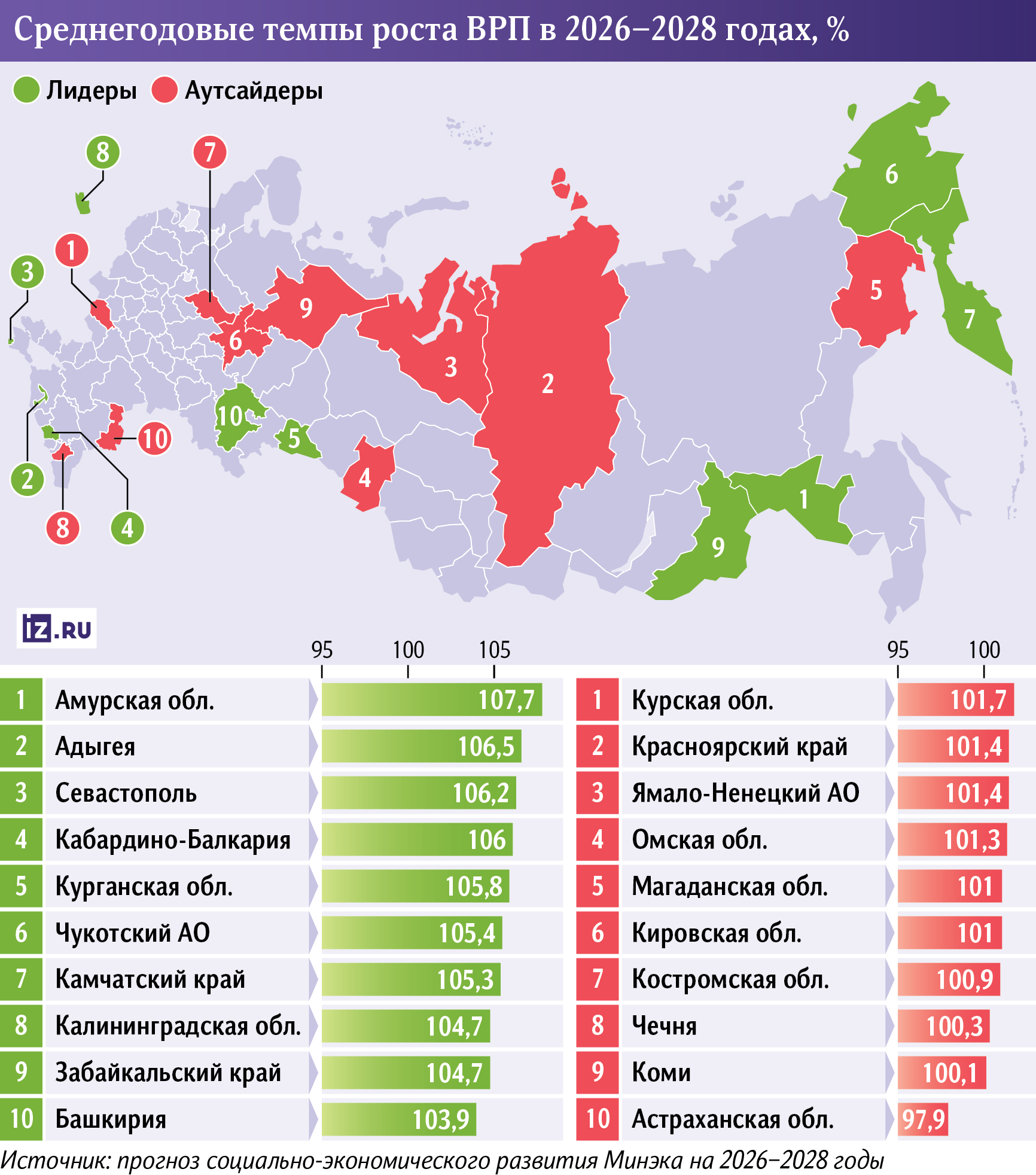
However, in the medium term, the list of leaders in terms of economic growth will be somewhat different. The Amur Region will demonstrate the highest average annual GRP growth in 2026-2028 — its economy will grow by an average of 7.7% per year. Adygea is in second place (6.5%), Sevastopol is in third (6.2%). This is followed by the CBD (6%), Kurgan Region (5.8%), Chukotka (5.4%), Kamchatka (5.3%), Kaliningrad Region and the Trans-Baikal Territory (4.7%). Bashkiria closes the top ten (3.9%).

The Ministry of Energy has also formed the top 10 regions in which the worst dynamics of average annual economic growth rates are expected in 2026-2028. According to forecasts, the situation in the Astrakhan region will be the most difficult.: This is the only region where the indicator is expected to reach -2.1% annually, which is associated with a reduction in the volume of mining, the document added. A near-zero increase is also predicted in Komi (0.1%) and Chechnya (0.3%).
According to the document, GRP growth will amount to 0.9% in the Kostroma Region, 1% in the Kirov and Magadan Regions, 1.3% in the Omsk Region, and 1.4% in the Yamalo—Nenets Autonomous District and the Krasnoyarsk Territory. Finally, the economy in the Kursk region will grow by 1.7%.

The Ministry of Energy's press service told Izvestia that the forecast generally reflects a key trend - regions with diversified economies and new investment projects are showing growth, and dependence on mining makes this dynamic vulnerable.
Izvestia asked the regions what their economic growth would be based on in the coming years. The government of St. Petersburg said that in 2025, GRP is expected to increase at the level of 3% per annum. The key factor of economic development in the coming years will be the industrial sector and the construction complex. In addition, the consumer market will return to steady growth in the medium term due to an increase in household incomes and tourist traffic.
The press service of the Information Policy Department of the Ministry of Mass Communication of the Tula region clarified that this year the region's economy will increase by 4.6%. The growth will be supported by industrial production, as well as the development of the agro-industrial complex, trade, IT, science, construction and the social sphere.
Why the economy will grow in a number of regions
The different economic growth in the regions is a natural phenomenon for a large country, said Valery Tumin, a member of the Expert council on the development of the digital economy under the State Duma Committee on Economic Policy. According to him, the subjects have historically been formed with different industry specialization — they have uneven access to resources, transport infrastructure and investments.

The different level of GRP growth is also explained by climatic factors, says Ekaterina Golubtsova, Associate Professor of the Department of State and Municipal Finance at Plekhanov Russian University of Economics. She added: all these circumstances can slow down the process of improving indicators, even with the active work of regional authorities and federal assistance.
— Chukotka's leadership is explained by a combination of a number of factors: the active development of mineral deposits, the work of residents of priority development territories (they have various benefits, including tax benefits — more than 100 companies in this zone have invested over 350 billion rubles) and the reduction of energy tariffs to the average Russian level. This, in turn, has dramatically improved the investment climate," believes Valery Tumin.

According to the press service of the Ministry of Energy, the region will become a leader in 2025 due to the launch of the Kekura gold deposit at full capacity.
The Kaluga Region, which will take the second place in terms of GRP growth this year, has been actively working for a long time to create comfortable conditions for investors — the automotive industry and the IT industry are developing here, Ekaterina Golubtsova noted. There are also many enterprises of the military-industrial complex (MIC) involved in the region, Ilya Fedorov, chief economist of BCS World of Investments, added.

Udmurtia (one of the five leaders this year) is an industrially developed region with large enterprises of the defense and energy complex, Ekaterina Golubtsova recalled. In addition, the region actively participates in federal industrial support programs.
As the Ministry of Energy explained in its forecast, the key factor in the high growth of GRP in the Amur region is the development of large manufacturing industries. The press service of the department, in turn, explained that we are talking about the Amur gas Processing plant, the development of gold deposits and the modernization of the BAM and Transsib.
And in Adygea, the steady pace is associated with the implementation of two large projects — the creation of an industrial zone in Takhtamukaysky district with a ready-made transport and engineering infrastructure and the Lagonaki ski eco-resort, the ministry said.
— The projected dynamics of the Astrakhan Region's GRP after 2026 (-2.1%) is due to the region's dependence on the extractive industry, the gradual development of major oil fields and a reduction in gas production. At the same time, the economy of the region will be supported by the agro-industrial complex, trade, transport and construction. The development of new deposits of salt, gypsum and other minerals will also make a positive contribution," the Ministry of Energy explained to Izvestia.

Nevertheless, further development of the regions will still require both comprehensive government support and the regions' own efforts to create favorable business conditions, Ekaterina Golubtsova believes. According to Pavel Rachev, an expert at the Economics Faculty of the P. Lumumba RUDN University, the regional economy will be supported by existing and new investment projects.
What will be the GDP in Russia in 2025
According to the basic forecast of the Ministry of Economic Development, the Russian economy will grow by 1% this year. The agency adjusted its estimates — in April, expectations were at 2.5%. In addition, further growth will not be so great — 1.3% in 2026. Only starting in 2027 will the economy begin to grow steadily, and by 2028, GDP will reach 2.5%.
As the Ministry of Energy noted in its document, external risks to the Russian gross domestic product may be a slowdown in the global economy. This, in turn, can affect the demand for traditional Russian exports and result in lower prices for them.

Among the internal difficulties are prolonged tight monetary conditions, which will affect investment and consumer activity. In addition, this creates certain budgetary risks associated with a reduction in revenues to the treasury and, as a result, with a decrease in certain expenditure areas, the ministry clarified in its forecast.

According to experts interviewed by Izvestia, there are other risks to our GDP. For example, there is a shortage of qualified employees — currently the economy lacks 1.5 million specialists, and 69% of enterprises are experiencing a shortage of personnel, expert Valery Tumin believes. Nevertheless, the economy can now be supported by the expansion of domestic demand, infrastructure development and new national projects.
However, he continued, the Russian economy is demonstrating resilience and adaptability, which creates the basis for confident development in the medium term.
Переведено сервисом «Яндекс Переводчик»
