- Статьи
- Economy
- Cumulative affect: a sharp decline in the key threatens to withdraw 10 trillion from deposits

Cumulative affect: a sharp decline in the key threatens to withdraw 10 trillion from deposits

In the event of a sharp decline in the key and profitability of deposits, Russians may withdraw up to 10 trillion rubles from banks, the Institute of Economics of the Russian Academy of Sciences warned. The Central Bank will make a decision on the rate on September 12 — it is expected that it will be at the level of 16-17%. If the regulator decides to weaken the policy more against the background of slowing inflation, credit institutions will again cut interest on deposits, which have already fallen to 14%. A massive withdrawal of funds can accelerate the price increase to 16.5%. How to avoid the consequences of such a scenario and what will be the key by the end of 2025 — in the Izvestia article.
What will be the inflation rate in 2025
The Central Bank predicted a slowdown in inflation to 4.5–5% in the report "The main directions of the unified state monetary policy for 2025." If this happens, the key rate should decrease. After that, interest on deposits will decrease, which can lead to a massive outflow of funds from deposits. As a result, a huge amount of money will pour into the market — up to 10 trillion rubles, Alexander Rubinstein, senior researcher at the Institute of Economics of the Russian Academy of Sciences, estimated. He wrote about this in the article "On the issue of lowering the key rate," published in the latest issue of the Bulletin of the Institute of Economics of the Russian Academy of Sciences.

With a sharp reduction in the key rate and the entry of a "monetary overhang" of 10 trillion into the market, price growth may accelerate to 16.5%, the author of the article warns. According to the latest data from Rosstat, annual inflation was 8.2% in September. Izvestia sent a request to the Central Bank.
"These risks are well—founded," said Mikhail Gordienko, Professor of the Department of Finance for Sustainable Development at Plekhanov Russian University of Economics. — Moreover, the estimate of 10 trillion rubles even looks optimistic, because the volume of liquid ruble deposits of Russians in the first half of 2025 approached 60 trillion and continues to grow. With a sharp drop in deposit rates, a significant portion of interest income ceases to deter people from delaying consumption. As a result, some of the savings may go to consumer markets, driving up prices, as well as into riskier assets.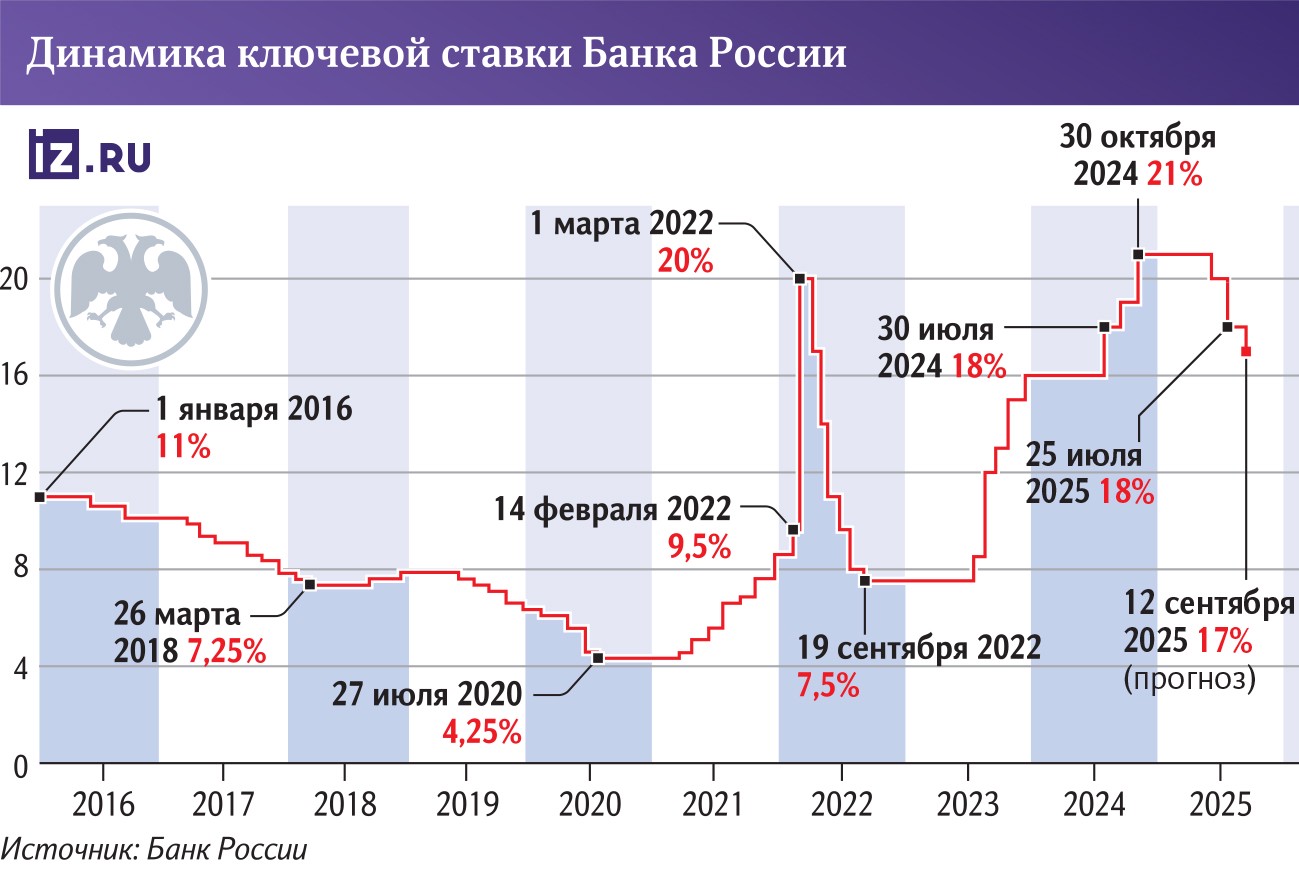
Currently, deposit rates for periods from three to 12 months have decreased to 14.6%, according to data from the Finuslugi marketplace. For comparison, at the beginning of the year, according to estimates by Izvestia, they were about 21%.
At the same time, there is currently no sharp outflow of funds from deposits, said Dmitry Gritskevich, Head of Banking and Financial Market Analysis at PSB. According to him, the transition from a savings model of behavior to a consumer one may take about six months. During this time, inflation will have time to turn up, and the regulator will probably have to sharply raise the rate again.

At the same time, a slowdown in inflation to 5% by the end of 2025 is possible, but for this to happen, the seasonally adjusted price growth rates should be much lower in the remaining months, said Viktor Grigoriev, chief analyst at Bank Saint Petersburg. According to him, the figure is likely to slightly exceed 6%. At the same time, the economy is cooling faster than the regulator expected: while the Bank of Russia predicted GDP growth of 1.8% in the second quarter, the actual data from Rosstat showed only 1.1%.
— A slowdown in inflation in 2025 to 5% is possible only in the event of a major shock. On the contrary, higher rates of price growth are now being supported at least by the weakening of the ruble and higher import prices, inflated expectations of the population and businesses, as well as stimulating fiscal policy," said Vladimir Eremkin, senior researcher at the IPEI Structural Research Laboratory at the Presidential Academy.

What will be the key rate at the end of the year?
However, even with inflation slowing to 5%, the Central Bank is unlikely to decide on a sharp reduction in the key rate due to the remaining risks, Dmitry Gritskevich believes. Expectations of price growth among the population are stable at about 13% at a normal level of 7-9%, and it is this factor that plays a crucial role for the regulator.

There is no reason for a drastic change in the key rate now, according to the Director of Macroeconomic Analysis at Dom Bank.Russian Federation" by Zhanna Smirnova. According to her, this is possible only with serious negative shifts in demand, falling incomes and deteriorating economic sentiment.
According to the expert's forecast, at the next meeting of the Central Bank on September 12, the rate may be reduced to 17% from the current 18%. This is facilitated by a number of factors: high heterogeneity in price dynamics (especially rapid growth in the market services sector — about 10% year-on-year), continued labor market tension and wage increases, as well as accelerated consumption and rising inflation expectations.

By the end of the year, the key rate may drop to 14-15%, unless new difficulties arise, says Pavel Biryukov, chief economist at Gazprombank. These include a significant deviation of the budget from the stated goals, increased volatility in the foreign exchange market and the persistence of high inflation expectations, which should decline after a seasonal surge in August.
— However, there is an alternative option in which inflation and public expectations will accelerate again, for example, due to exchange rate fluctuations or a noticeable expansion of the treasury deficit. In this case, the year may end with a rate of 17%," Zhanna Smirnova added.

At the same time, the PSB expects that the regulator will reduce the key rate to 16% on September 12. They agreed that by the end of 2025 it will drop to 15%, and by the end of 2026 - to 12%. The probability of its reduction below 10% may not be realized until 2028, Dmitry Gritskevich from the PSB believes. In turn, Vladimir Eremkin from the Presidential Academy admits that in an optimistic but quite possible scenario, it may become unambiguous in the second half of next year.
Mikhail Vasiliev, chief analyst at Sovcombank, also expects a reduction in the key rate to 16% as early as this Friday. According to his more optimistic forecast, it may drop to 13% in December 2025. In this case, the deposit yield will decrease to 11-12% by the end of the year and possibly even lower.

What to do with rising prices
However, if the rate is sharply reduced, the RAS expert suggests a number of measures to mitigate the consequences in the article. Among them is an increase in imports, which will temporarily support the ruble and increase supply on the market. According to his calculations, if 10 trillion rubles enter the economy, then an increase in imports of about $120 billion will be required to compensate.
The economist also suggests that funds from the National Welfare Fund should be invested in new technologies and modern production facilities. At the same time, according to the expert, it is necessary to invest more budget money in factories, equipment and infrastructure and do it in advance, since time always passes between such investments and production growth. In addition, production should be more involved.

But in all this, strict financial control is necessary — the digital ruble will help in this.
The measures proposed in the article are not suitable for rapid response to shocks, as their effect will manifest itself only in the medium term and will not help to contain the sharp outflow of deposits, said Vladimir Eremkin from the Presidential Academy. According to him, the main thing is to prevent such a situation altogether and reduce the key rate gradually. This will give the market time to adjust.
This year, information appeared on Telegram channels about the risks of freezing deposits — allegedly, banks can take such a measure to prevent the outflow of funds from deposits. However, in August, Alexey Zabotkin, Deputy Chairman of the Bank of Russia, denied these rumors, stressing that such a decision was impossible and would have dealt a serious blow to the economy.
Переведено сервисом «Яндекс Переводчик»
