- Статьи
- Economy
- Exposed: six banks saw the risks of problems due to the similarity with the "Tavrichesky"

Exposed: six banks saw the risks of problems due to the similarity with the "Tavrichesky"

Experts saw the risks of problems for six Russian banks due to their similarity to Tavrichesky. He was betting on the highest possible returns at 17-20%, attracting a mass investor. However, this led to a cash gap after the key reduction: it became impossible to service an expensive customer base without a full-fledged loan portfolio, and on September 3, the bank lost its license. Other small players with a similar model and risks include Metallinvestbank, First Investment Bank, Transcapitalbank, and the sanitized Investtorgbank. High rates may indicate an attempt to raise money to cover difficulties, experts warned. Why they saw the risks even at UBRiR and SKB-bank is described in the Izvestia article.
Can other banks follow the path of the Tavrichesky
A number of banks may have financial difficulties, Izvestia found out. On September 3, the Central Bank revoked the license of the Tavrichesky Bank, despite a ten-year rehabilitation. The player attracted a mass depositor with the help of the highest possible profitability of retail deposits, said Ekaterina Kosareva, managing partner of the VMT Consult analytical agency.

Recently, it was about 16%, which is higher than the market average. But earlier, rates in some cases reached up to 20% per annum, added Vladimir Chernov, analyst at Freedom Finance Global. The distortion of the business model led to a cash gap, Ekaterina Kosareva emphasized. She explained: when the key went down, it became impossible to serve an expensive customer base without a normal business loan portfolio.
— After the Central Bank cut the key rate twice for Tavrichesky, it turned out to be disastrous, as expensive "liabilities" (already existing deposits at high rates) remained on the balance sheet, and the profitability of assets (including money from new loans at lower interest rates) fell. As a result, the loss of capital and the revocation of the license. Similar risks are typical for everyone who relies on expensive and short—term deposits, as margins shrink, liquidity becomes unstable, and therefore capital melts before our eyes," added Yulia Khandoshko, CEO of European broker Mind Money (ex Cerih).

The situation with Tavrichesky may be indicative for other banks with a similar model, Vladimir Chernov warned. For example, Investtorgbank actively offered high interest rates on deposits, which may indicate a desire to raise funds to meet the challenges of increasing liquidity.
Independent expert Andrey Barkhota also called him potentially problematic. Initially, the bank was transferred to Transcapitalbank for rehabilitation. However, they did not differ much in size — the first occupied two thirds of the balance of the second, and the volume of problems was simply underestimated. Because of this, Transcapitalbank has been showing a lot of losses for a long time during the rehabilitation process, the expert emphasized.

Only on August 29 of this year, it was decided to transfer the bank to the Deposit Insurance Agency (DIA) for rehabilitation. However, the risks of these two organizations remain. Moreover, the expert potentially admits the possibility of revoking the license from Investtorgbank. According to him, such players attracted expensive liabilities from the population by offering high interest rates to depositors, and placed them in low-quality assets, often in one-day firms or potentially bankrupt legal entities. And this creates risks for the loss of the bank's capital.

The situation with this bank looks ambiguous today, Ekaterina Kosareva from VMT Consult noted. On the one hand, he is still in rehabilitation, and he has the support of the state. On the other hand, its operating scheme really resembled that of the Tavrichesky, especially in 2022-2023.
Bank rehabilitation is a set of measures for its rehabilitation. There are two ways it goes through. In the first case, the initiator is the bank's management. Management can remain in the hands of the owners, and they will make decisions to eliminate problems. The second option, which occurs more often, is that the Central Bank initiates the rehabilitation, and the powers of the management are suspended. The regulator transfers the bank under the management of the interim administration. It may include representatives of the Central Bank itself, the DIA, and sanators. The Interim Administration has the right to change management scenarios and set deadlines for recovery. Restoring a bank is a costly process that is appropriate in cases where a player has a good reputation and important transactions are going through him.
Nevertheless, the depth of DIA support remains a crucial factor. This makes the scenario of abrupt license revocation unlikely. According to Oleg Skapenker, Associate Professor of the Department of Global Financial Markets and Fintech at Plekhanov Russian University of Economics, in the case of Investtorgbank, it will be more about joining the sanatorium than about abandoning its further development. Therefore, the license should be revoked only in case of incorrigible violations.
Which other banks in Russia are at risk?
— Now we can mention a number of small banks outside the rehabilitation, which continue to actively compete with rates. According to aggregators, we are talking about SKB-bank (Sinara), Metallinvestbank and several regional players whose deposit yields rise above 14-15%. For them, the risks are the same — reducing the key cuts off the margin, and if the loan portfolio does not generate comparable income in parallel, the gap becomes systemic," Ekaterina Kosareva added.

According to her, under the control of the Central Bank, banks will either adjust rates downwards or will be forced to seek emergency funding.
Vladimir Chernov from Freedom Finance Global also noted the risks of small regional banks that focus on high-yield deposits. Among them is the First Investment Bank.
The problem is also that small and medium-sized players have difficulty placing assets in high-yield and low-risk projects, so they tend to resell liquidity on the open market, said Alexey Bykov, founder of the RusCoin fund. At the same time, small banks sin by placing liabilities in projects of their owners, founders, and real estate on the local market. And if the demand for housing is falling due to high inflation, then they have a cash gap. Non-payments by customers on loans also aggravate this process.

Other banks that potentially have risks are SKB and UBRiR, independent expert Andrey Barkhota said. These are fairly large players who are registered in Yekaterinburg and work in a particularly intensive area of the Ural Federal District. They are both involved in wellness projects as sanitarians. The Central Bank's plan provides for the joining of Gazenergobank to SKB-bank by the end of 2028. And at the end of this year, it is planned to join the University Bank to UBRiR.
At the same time, their business models are based on attracting expensive public liabilities and investing money in low-yield, and sometimes low—quality corporate loans. Expensive financing (that is, high interest rates on deposits) also requires expensive loans. And corporate loans cannot be such, they have limited margins, the expert emphasized. Therefore, such players are at risk.

The Central Bank can issue regulations to them so that they can improve their financial condition. When risks are realized, the first step may be to free them from the banks being rehabilitated. And only then — sending larger players to the DIA for rehabilitation or revoking the license, Andrei Barkhota admitted. The latter is possible when the macroeconomic situation worsens or serious misconduct is detected, for example, deterioration in the quality of the loan portfolio.

Izvestia provided an opportunity for the listed banks to comment on this topic and asked the Central Bank if they saw risks of deterioration in the financial condition of these players.
Will the money be returned to the depositors of Tavrichesky
The situation with the Tavrichesky is the most notorious in recent years. The bank has been undergoing rehabilitation since 2015. He became the first Russian market player to be stripped of his license during the "recovery" period. The DIA estimates the amount of payments due to depositors at 56.5 billion rubles. At the same time, the credit institution ranked only 60th in the country in terms of assets.

If the actual volume is not lower than this estimate, it will be one of the largest cases in the history of the deposit insurance system in the country, Alexey Bykov from RusCoin estimated. According to the regulator, the decision to revoke the license was made due to the lack of prospects for further rehabilitation and the bank's complete loss of equity.
Tavrichesky stopped making payments at the end of 2014. Next, it introduced external control. Since March 2015, JSCB International Financial Club JSC has been appointed as the bank's sanatorium. In addition to the Deposit Insurance Agency and the sanatorium, the largest creditors, Lenenergo and IDGC of the North—West, are involved in the rehabilitation of the bank.

Billions of rubles were wasted on the rehabilitation of the bank. IFC announced the attraction of a loan for the rehabilitation of Tavrichesky for 28 billion rubles with a maturity until 2030. Thus, the approximate amount of IFC investments for the rehabilitation of the bank can be estimated at about 30 billion rubles, Alexey Bykov said.

The regulator reserves the right to terminate the rehabilitation plan and revoke the license of the rehabilitated bank if such a decision does not pose risks to the sustainability of the entire sector, does not lead to significant losses for depositors and reduces the costs of the Bank of Russia, the Central Bank told Izvestia.
After the bank's license is revoked, Russians will receive back 100% of their remaining funds under the deposit insurance system, but no more than 1.4 million rubles in one hand, including accrued interest. DIA announced that it will begin payments to Tavrichesky's clients no later than September 17 this year.
You can apply for compensation during the liquidation period of the bank, which lasts at least a year, the DIA told Izvestia. The first way is to apply through the DIA website or the Gosuslugi portal. The funds will be transferred to the account details or the Mir card number specified in it. You can also contact the agent bank in person. He will be selected on a competitive basis by September 8. In this case, the money will be given out in cash or transferred to the account.
The uninsured portion of the DIA deposits could amount to 7-10 billion rubles, distributed to a narrow group of wealthy clients, Ekaterina Kosareva estimated.
— Most depositors with amounts of less than 1.4 million rubles will receive the money in the first days and weeks after September 17, if the selection of agents goes according to schedule. However, more complex cases — disputes, incomplete data, corporate deposits, claims over the limit — are resolved in a competitive procedure and may take much longer, up to the end of the year," Vladimir Chernov predicted.

A scheme with options is also possible, for example, deferred payment of these deposits for three to five years, Andrei Barkhota admitted.
At the same time, preliminary estimates show that the demands of Tavrichesky's depositors can be fully satisfied, including through the transfer of the bank's assets during liquidation, the Central Bank said.
Are mass revocations of licenses from banks possible?
Currently, a number of banks remain in rehabilitation, which are undergoing rehabilitation both through the DIA and with the involvement of investors, Ekaterina Kosareva said. Among them are BM-Bank, Mosoblbank, Peresvet, Solidarnost, VUZ-Bank, Timer Bank, Genbank, Gazenergobank and the Baltic Investment Bank. Moreover, some of these cases have been going on for many years.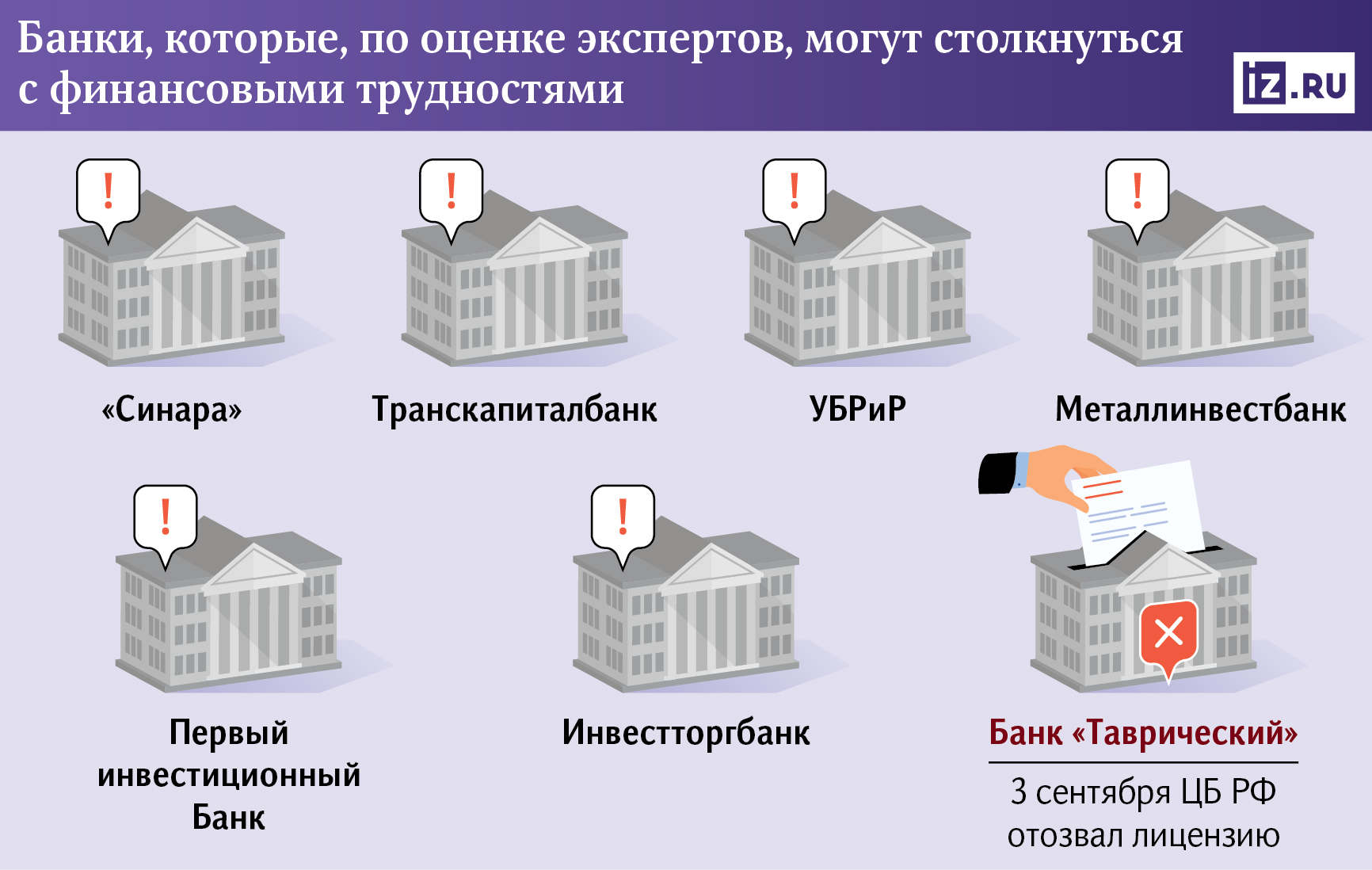
After the revocation of the license from Tavrichesky, the mass purge of banks, as in 2016-2018, is not worth waiting for, says Yulia Khandoshko from Mind Money. However, point—to-point cases are possible where the bank's strategy relies solely on expensive deposits without a cushion of capital and at the same time assets depreciate. Such spot cleaning may even become more frequent, Ekaterina Kosareva admitted.
Players who openly do not comply with the law have already been withdrawn from the market, Oleg Skapenker from Plekhanov Russian University of Economics emphasized. In addition, there are not many banks left, and each license revocation does not have the best effect on the economy. Plus, under the conditions of sanctions, the variability of banking services for transactions is a necessity.
Переведено сервисом «Яндекс Переводчик»
