- Статьи
- Economy
- Enter the tenth: the Jubilee WEF brought together deals, a Great Victory and dinosaurs

Enter the tenth: the Jubilee WEF brought together deals, a Great Victory and dinosaurs

On the opening day of the anniversary WEF, record investments in the Far East, a shift in relations with the United States from the dead end, and responsible development of AI were discussed. This year, different parts of the country were united by the theme of the 80th anniversary of Victory in the Great Patriotic War: at the stands it was possible to watch a tour with virtual reality glasses with stories of heroes. New technologies were combined with ancient finds: neural network art was juxtaposed with a recreated replica of a Nipponosaurus. And although the forum has just started, important agreements have already begun to be signed on it. 20-30% of contracts will become international, experts expect. What statements were made that day are in the Izvestia article.
What can be seen at the WEF
On September 3, the main topics of the Eastern Economic Forum were investment development and international cooperation. The sessions discussed the prospects of Russian business on the world stage, the next round of negotiations between Russia and the United States, and the tokenization of the financial market. As well as cooperation between small and medium-sized businesses with APEC countries, possible solutions for cross-border payments and responsible development of artificial intelligence. The forum also hosted the traditional Far East Street exhibition, where 11 regions presented their key projects in the economy, culture and tourism.

The grand opening began with a procession with a large St. George ribbon along the embankment. The theme of the 80th anniversary of Victory in the Great Patriotic War this year united the regions. Sakhalin Region has designed a space dedicated to the Yuzhno-Sakhalinsk operation: There, on an old telephone, you could hear music and the voice of a wartime announcer. The Trans-Baikal Territory organized an excursion in virtual reality glasses with stories of heroes. The Amur region presented a stand with photos and memoirs of veterans, and the Magadan region presented a zone about the role of Kolyma in the victory with replicas of monuments.
New technologies were actively used at the stands. For example, Kamchatka showed neural network art illustrating the structure of volcanoes, and in Primorye, virtual assistants talked about the region.

There was also a lot of "live" interactive. So, in the pavilion of the Magadan region, visitors could wash the sand in search of gold. To do this, the Izvestia correspondent was asked to put on rubber gloves by putting both hands through special holes in a glass cube. And then it was necessary to take a tray, fill it with a little sand and rinse it by shaking. Unfortunately, they were not allowed to take the honestly mined precious metal.

But gifts were offered in the "Discover the Far East" quest. The organizers distributed sticker books, which had to be filled with stickers from each stand. For the work done, they were awarded a set of merch — a raincoat and a diffuser.
The Amur stand was impressive: the guests inhaled the aromas of the Tukuringra winds (reminiscent of the smell of a sauna), Komarov's Lotus (sweet, spicy, with a hint of cinnamon) and the "East" (sea breeze). It was only necessary to open the wooden windows, from where the warm steam was coming. When asked by a correspondent what other impressions can be obtained in the region, the representative of the pavilion warmly recalled the recent gastronomic festival, where a record was set — 12 thousand dumplings were made in 20 minutes.

The forum has never been held without music and dancing. And this time I was surprised by an ensemble of bees (or rather, people dressed up in costumes) who actively invited me to try seaside honey.
At the WEF site, modern projects were juxtaposed with ancient finds: a recreated replica of a Nipponosaurus (which also realistically opened its mouth), the only dinosaur found on Sakhalin, as well as a woolly, lonely baby mammoth on the street and petroglyphs on an artificial rock in the Magadan pavilion.
Falcons were also traditionally shown wearing hoods, special headdresses that protect birds from stress. When asked what would happen if the "caps" were removed, Sokolnichy replied: they would start flying around the pavilion. However, the white bird sitting on the right, according to him, will not behave like this: "She is well-mannered."
What was discussed on the opening day of the WEF
The central theme of the tenth anniversary WEF is "The Far East — Cooperation for Peace and Prosperity." The forum is taking place on Russian Island from 3 to 6 September, it is expected that it will bring together guests from more than 70 countries and territories. It is attended by delegations from China, Japan, Korea, India, as well as countries in the Middle East, Europe, Africa and Latin America. About 90 thematic sessions will be held in three days.

On the opening day, the official representative of the Ministry of Foreign Affairs, Maria Zakharova, traditionally spoke at the forum. Speaking about the geopolitical situation, she said that Moscow is negotiating the date and location of the next round of negotiations between the Russian Federation and the United States. The diplomat pointed to the return of Russian diplomatic property, which remains a key condition for the full restoration of bilateral relations.
It is difficult to imagine a productive de-escalation process without the participation of the United States, said independent expert Andrei Barkhota. Although there is no full-fledged restoration of relations yet, the availability of a communication channel is also important for discussing issues of economic cooperation, including potential cooperation in the Arctic and the resumption of direct flights, added Yaroslav Kabakov, Director of Strategy at Finam IC.

The shift in relations with the United States from a dead end is an additional incentive for the development of the Far East, Igor Rastorguev, a leading analyst at AMarkets, told Izvestia. He recalled the agreement of the heads of state on the participation of the American oil and gas company ExxonMobil in the Sakhalin-1 project. Until 2022, ExxonMobil owned 30% of the revenues of Sakhalin's operator Exxon Neftegaz. The Russian project includes three large fields with recoverable reserves of more than 300 million tons of oil and 485 billion cubic meters of gas. Three years later, the American company will return to the project.

Today, investments in the Far East have already exceeded the volume of state funds 34 times, Presidential Envoy to the Far Eastern Federal District Yuri Trutnev said at the WEF. By the end of the year, we can expect an additional inflow of investments in the amount of 1-1.5 trillion rubles, which can bring the total volume to 11.6–12.1 trillion, estimates Vladimir Chernov, analyst at Freedom Finance Global.
The investment attractiveness of the district is primarily due to its logistics and close cooperation with China, said Yulia Kovalenko, associate professor of the Basic Department of Financial Control, Analysis and Audit at the Main Control Department of Moscow, Deputy Head of the Higher School of Finance at Plekhanov Russian University of Economics. In addition, the Far East provides more than half of Russia's fish catch and a significant share of mining, Vladimir Chernov added. According to him, investments in these territories stimulate industrial production, construction and employment, which directly affects GDP growth.
On the opening day, international business development was also discussed. Russian market participants are interested in resuming the agreement on the promotion and mutual protection of investments between Russia and India, said Alexander Shokhin, head of the Russian Union of Industrialists and Entrepreneurs (RSPP), speaking at the WEF. He also noted that he considers it realistic to prepare this document for the planned meeting between Russian President Vladimir Putin and Indian Prime Minister Narendra Modi in December.

All the events of the business program at the forum were divided into seven thematic blocks dedicated to the development of the macroregion, international cooperation, technology and digital security, partnership between business and government, creation of new transport routes, finance and investments, as well as infrastructure projects.
The first agreements have already been signed. One of them is a package of about 20 contracts worth 120 billion rubles and the Highland Gold Group's project to develop the Vostochny Dvoy gold deposits in the Amur Region and Blagodatnoye in the Khabarovsk Territory. During its implementation, it is planned to build a mining and processing complex, create transport and energy infrastructure, as well as 715 new jobs. Production is expected to start no earlier than 2028. These projects will strengthen the regional economy, increase tax revenues and export potential, Yaroslav Kabakov said.

What will the WEF-2025 give to the Russian economy?
Traditionally, agreements at the WEF cover gas processing, chemicals, transport infrastructure, shipbuilding, construction, and cooperation with China and India. The implementation of these projects contributes to the formation of new value chains and the strengthening of Russia's position in world markets, said Andrei Glushkin, a member of the Council of the MRO Delovaya Rossiya.

Among the expected results of the jubilee WEF is a record volume of investments, predicted Vladimir Chernov from Freedom Finance Global. It is planned to sign agreements worth 5-6 trillion rubles, including 20-30% of international contracts with China, India, Mongolia and the ASEAN countries, where the main focus will be on mining, energy, logistics and tourism.
"The influx of investments will increase the Far Eastern Federal District's GDP by 1-2% by 2030, create up to 100,000 jobs and provide additional tax revenues of up to 100 billion rubles per year," the analyst expects.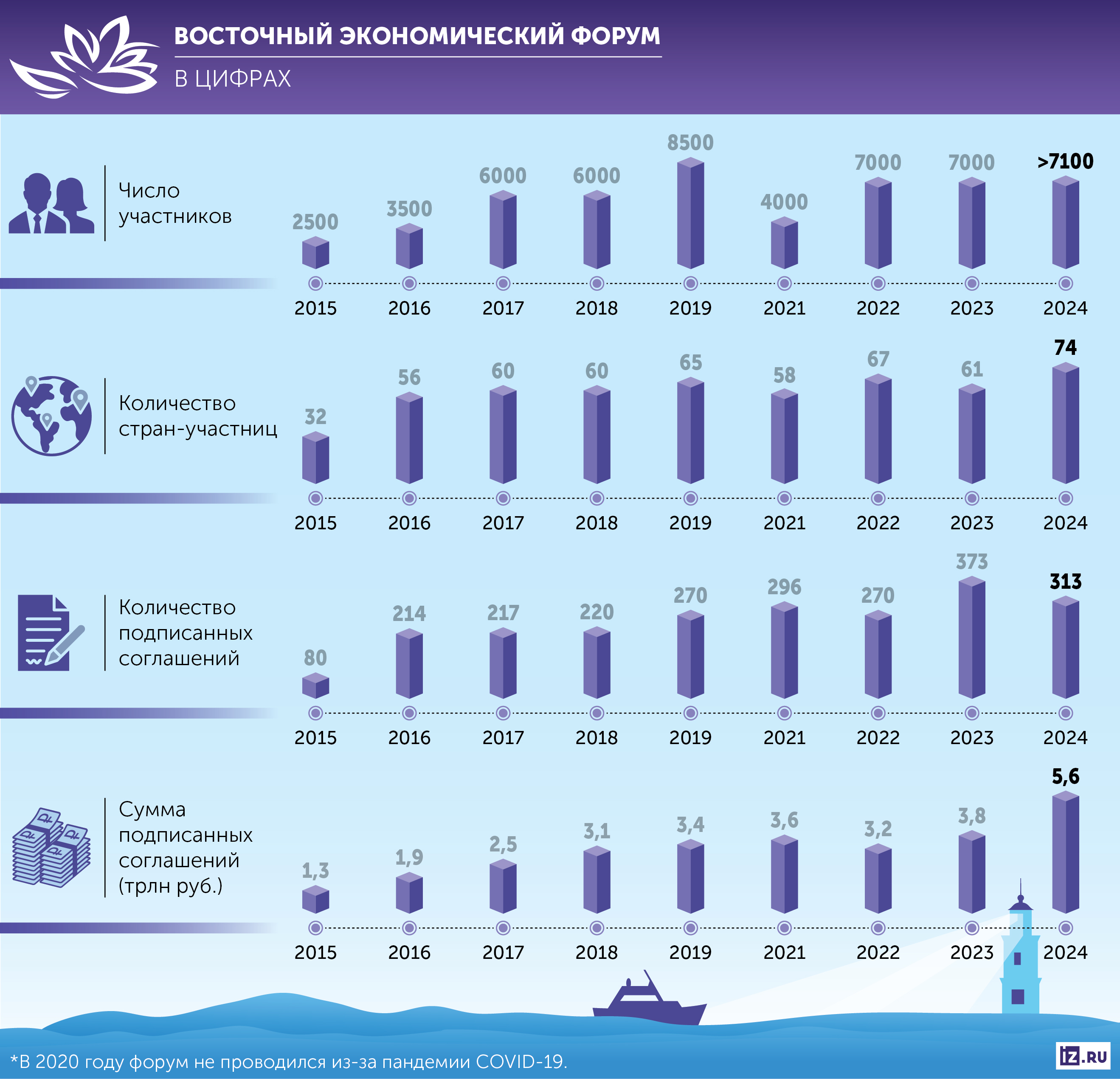
The forum will also result in the strengthening of international cooperation, against which exports to the Asia-Pacific region can be expected to grow by up to 20%, and a technological breakthrough, Vladimir Chernov added. The latter will ensure the launch of pilot projects of the Russian innovative scientific and technological center and the expansion of the Priority 2030 program, which will reduce dependence on technology imports by 5-10%, the expert concluded.
Переведено сервисом «Яндекс Переводчик»
