- Статьи
- Local news
- Day of the Georgian Icon of the Blessed Virgin Mary: strong prayers for September 4

Day of the Georgian Icon of the Blessed Virgin Mary: strong prayers for September 4

Every year on September 4, Orthodox believers celebrate the Day of the Georgian Icon of the Blessed Virgin Mary, one of the most revered shrines of the Christian world. This day is dedicated to the ancient image, which, according to church tradition, was painted by the Evangelist Luke and later ended up on Mount Athos, in the monastery of Iveron. Details can be found in the Izvestia article.
Day of the Georgian Icon of the Blessed Virgin Mary: when is it celebrated
According to legend, the origin of the Georgian icon is connected with Georgia. After the invasion of Shah Abbas in 1622, the shrine was taken to Persia. In 1625, it was acquired by Stefan Lazarev, a clerk of the Yaroslavl merchant Grigory Lytkin. Four years later, returning to Yaroslavl, he handed over the image to the owner, who sent it to the Chernogorsky (Krasnogorsky) monastery on Pinega in the Arkhangelsk land. Here Lytkin built a temple and provided it with everything necessary — books and church utensils.
The appearance of the icon in the monastery was accompanied by numerous stories of miraculous healings. In 1654, she was taken to Moscow, probably to update her image and make a new salary. At that time, the plague epidemic struck the capital, and cases of getting rid of the disease were associated with the icon brought. So, silversmith Gabriel Evdokimov, grateful for his son's recovery, ordered a list of the image for the Church of the Holy Trinity in Nikitniki. It is believed that this list was written by Simon Ushakov.

A few years later, in 1658, by order of Tsar Alexei Mikhailovich and Patriarch Nikon, an annual celebration was established on August 22 (September 4) — in memory of the appearance of the icon in the monastery. And in 1698, a new decree followed, ordering that the image be brought to Arkhangelsk for the "sanctification of the city and the people." Over time, the icon also visited Vologda, Veliky Ustyug, Pereslavl-Zalessky, Moscow and even Siberia.
In 1707, Kirill Ulanov, an iconographer at the Armory, created an accurate list of the Georgian icon "in measure and outline" from the original. He left a corresponding inscription on the bottom field. Four relics were embedded in the image. Later, many lists of the icon appeared, some of them were also revered as miraculous.
After the closure of the Krasnogorsk Monastery in 1920-1922, the shrine disappeared. They started talking about it again in 1946, when the monastery resumed its activities. Then Bishop Leonty (Smirnov) of Arkhangelsk informed the Moscow Patriarchate that the icon had participated in a religious procession through Arkhangelsk. It is not known what happened to the image next.
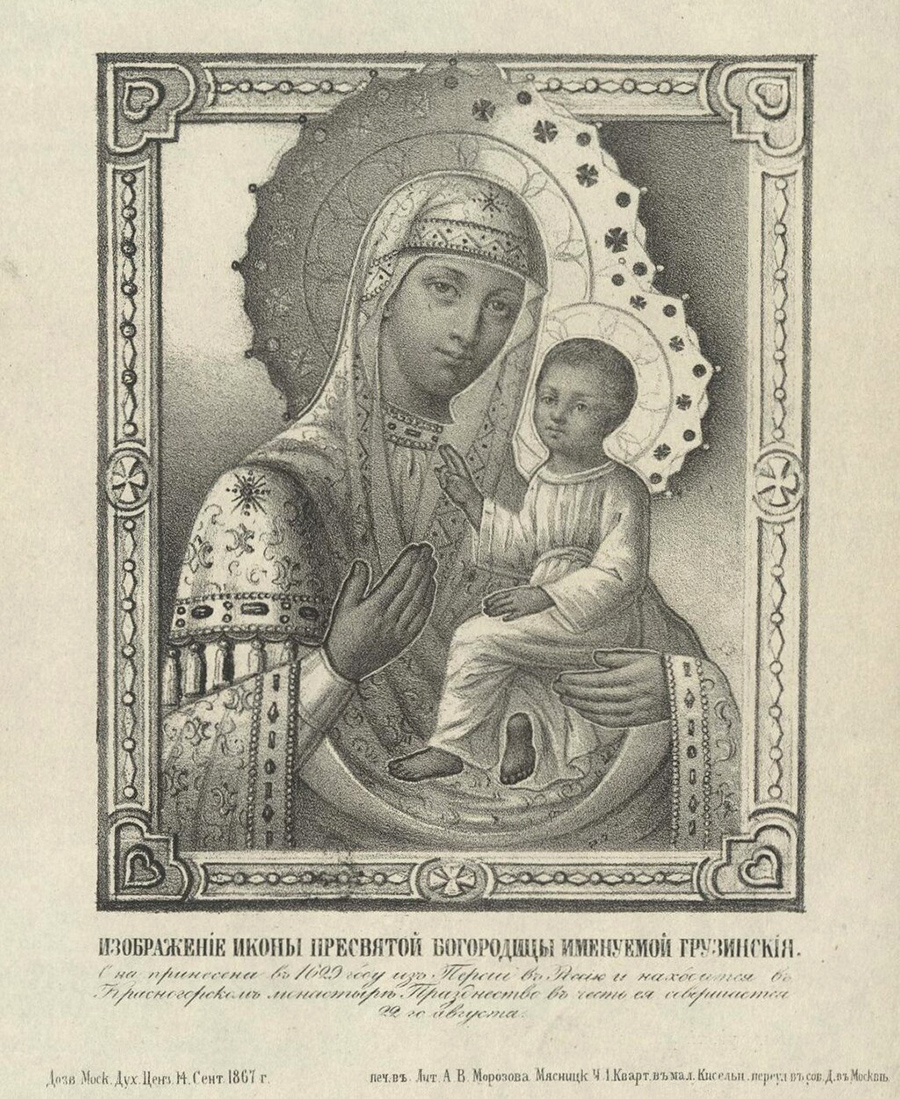
The Georgian icon belongs to the type of Odigitria and is close to the production of Perivlepta. Her iconography dates back to the Georgian monuments of the X–XVI centuries and was especially widespread in Kakheti. The Mother of God is represented sitting, slightly leaning towards the Christ child on her left arm. Jesus' head is slightly tilted back, he holds a scroll in his left hand and blesses with his right. A special detail of the image is the right foot of Christ, the naked sole of which is turned outward.
Today, September 4 is established as a church holiday in honor of the Georgian Icon of the Blessed Virgin Mary. On this day, solemn divine services and prayer services are held in churches, believers turn to the Mother of God with prayers for health, family protection and help in life matters.

Strong Prayer on September 4th:
"Accept, All-merciful Most Pure Lady, Lady Theotokos, these precious gifts from us, Your unworthy servants, who offer up singing to Your holy image with tenderness. We surrender ourselves to Your Material care and ask for the fulfillment of our prayers by faith: You relieve the sorrowful, heal the weak, heal the weak and sick, cast out demons, deliver the offended from insults, save the oppressed, forgive sinners, cleanse lepers, have mercy on small children and free the barren from infertility. Lady Lady, You free from bonds and prisons, heal all kinds of passions and illnesses, heal eye diseases and get rid of deadly ulcers. All this is possible through Your intercession with Your Son, our Lord Christ. O All-holy Mother, Most Pure Theotokos! Do not stop praying for us, Your unworthy servants, who glorify and honor You, worship Your holy image, and have unshakeable faith and hope in You. We glorify You, Ever-Virgin, Most Glorious and Immaculate, we honor and sing praises forever and ever. Amen to that."
Day of the Georgian Icon of the Blessed Virgin Mary: prohibitions on September 4
The main purpose of the September 4 holiday is to participate in divine services and venerate the miraculous image. Prayer services are held in churches in front of the lists of the Iveron Icon, where people come to pray for the protection of loved ones, healing from illnesses and well-being in business. In the regions where special lists of icons are kept, especially many pilgrims gather on this day.

Folk tradition associated September 4 with everyday and ceremonial activities. The day was considered suitable for cleaning the house and family: they put things in order, changed the bed linen, got rid of unnecessary things. The holiday was often accompanied by bathing rituals: steaming was considered a way to get rid of diseases and bad thoughts, medicinal herbs were used in the steam room to promote health.
There were also unwritten rules of conduct: they tried to avoid quarrels and insults, not to start new big businesses and not to make significant purchases that might not bring success. At the same time, good deeds, helping neighbors, and taking care of the house were welcomed.

Traditions could differ from region to region: in some places, special attention was paid to modesty in dress and behavior, in others, ceremonial treats or meetings with relatives were held. It should be emphasized that most of these rules were elements of folk culture, not church regulations.
In addition to the Day of the Georgian Icon, on September 4, the Orthodox calendar celebrates the memory of other saints, which made the date multi-festive and allowed combining different customs.

The Day of the Georgian Icon of the Blessed Virgin Mary: signs and customs
In Russia, September 4 was considered an important date for observing nature. Folk signs helped peasants predict the harvest and the weather for the upcoming season. So, a clear night sky and a large number of stars promised a good harvest, and the early crowing of the rooster foreshadowed the imminent warming.
If thick frost fell at night, it was perceived as a sign of a change in the weather: in some areas — to rain, in others — to clear weather. Fast-moving clouds from the south were often considered a harbinger of bad weather.

According to popular observations, on September 4, it was possible to predict the future season: a foggy morning foreshadowed a rainy autumn, and a dry and sunny day — a long warm season. In some villages, attention was paid to the onion harvest: a thin husk heralded a mild winter, a thick one - a harsh one.
Special attention was paid to the behavior of animals. Unusually active birds or frisky foals were perceived as a sign of an approaching change in the weather. The appearance of mushrooms in the forest in early September was considered a harbinger of a long autumn.
These signs were practical in nature and helped the peasants to plan agricultural work and prepare supplies for the winter.
Переведено сервисом «Яндекс Переводчик»
