Special care: what will lead to the withdrawal of US troops from Iraq


The United States is starting to withdraw troops from Iraq: the first military convoys have already left the base in Anbar province in the direction of Kurdistan, official sources in Baghdad told Izvestia. According to the Iraqi media, the last American soldier will leave the Ain al-Asad base on September 15. These steps are in line with the agreements on the phased completion of the coalition's mission by 2026. The Republic is facing a shortage of weapons, which increases the threat from terrorist organizations. Moscow, which Baghdad is interested in cooperating with, is capable of improving the country's security.
The first American convoys left the base in Iraq
The US military has already left the largest Ain al-Asad base in Anbar province, official sources in Baghdad told Izvestia.
— Columns of military equipment moved out of the base in Anbar province towards the Harir base in Erbil (a city in Kurdistan. — Izvestia), in accordance with the agreement on the withdrawal of forces of the international coalition, — the interlocutors of Izvestia reported.
The Donald Trump administration has notified the Iraqi authorities of the imminent start of the transfer of hundreds of troops from the base, which is in line with the agreement on the completion of the international mission, which is scheduled for 2026.
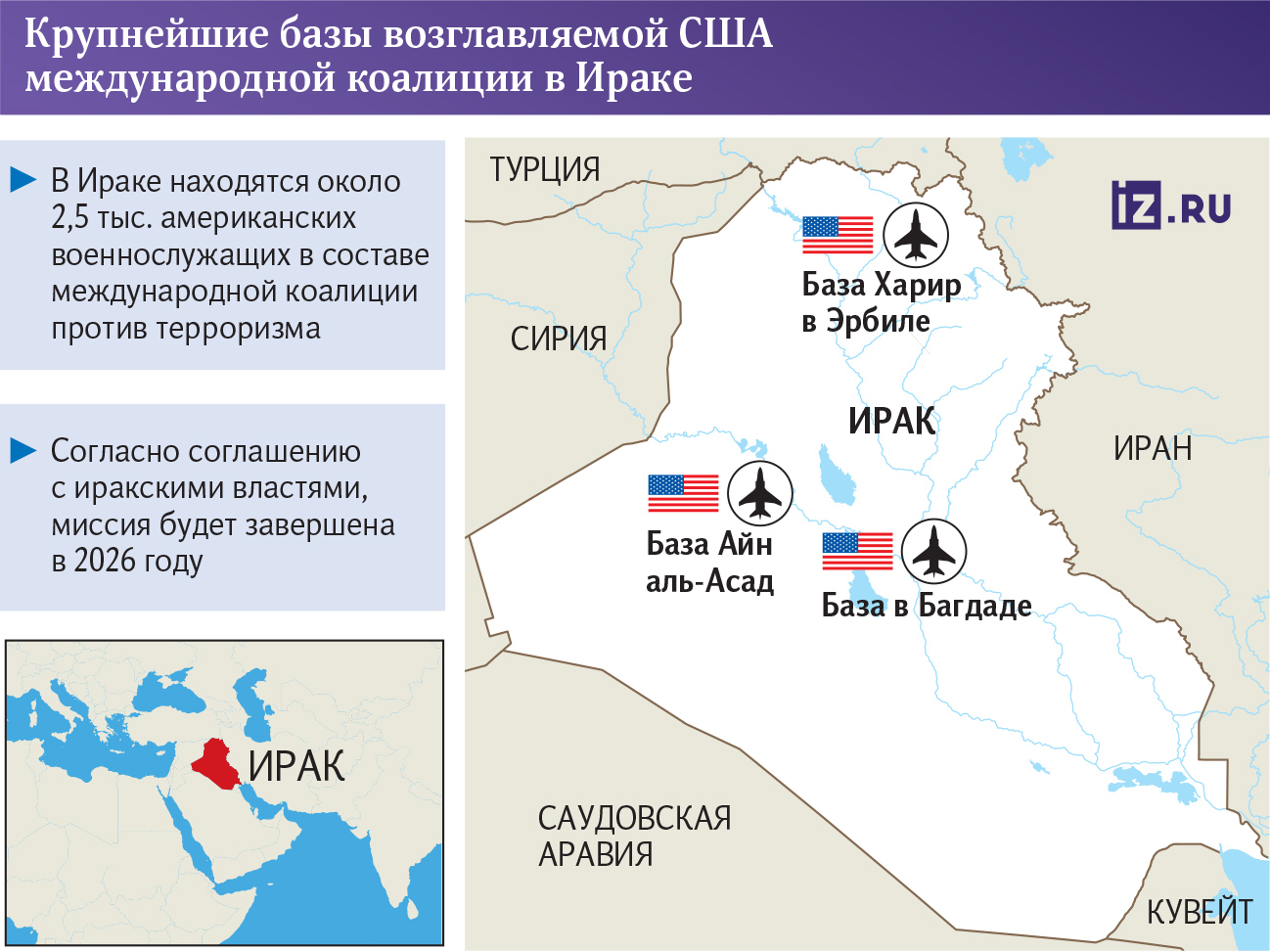
The Iraqi Shafaq news agency, citing security sources, clarifies that the Ain Asad base will be permanently closed on September 15.
Iraqi military expert Safaa al-Assam told Izvestia that part of the American forces went to Syria, and the bulk to the Harir base in the Kurdish Autonomous Region (all its units will finally leave in 2026).
Iraqi Prime Minister Hussein Alawi's adviser, in an interview with the state-run Al Iraqiya TV channel, confirmed that the coalition's mission in Baghdad and at the Ain al-Asad base will end in September. He stressed that the Cabinet of Ministers follows the stated government course. The Government is committed to the program of strengthening the armed forces, completing the mission of the international coalition and transferring relations with its countries to a bilateral defense basis.
There are about 2.5 thousand American troops in Iraq as part of the international coalition against terrorism. In addition to the coalition forces, there are NATO units operating in the country as part of the advisory mission.

Baghdad's cooperation with Moscow
Although the "Islamic State" (IS, ISIL, a terrorist organization banned in the Russian Federation) no longer poses a threat at the level of the mid-2010s, the activities of extremists remain a long-term problem for Iraq's security. About 60,000 ISIS members are being held in camps and prisons in Syria under the control of Kurdish forces.
The children living in these camps represent the second and third generation of radicals, which, according to al-Assam, is essentially a "time bomb." If the United States stops supporting the Kurds, prisons in these regions may be opened, which will create new risks for neighboring countries and Iraq in particular.
The reduction of support from the foreign coalition makes the country more vulnerable to terrorist attacks. At the same time, it opens up opportunities for other players to strengthen their influence.
Al-Assam drew attention to the fact that the withdrawal of the coalition is unlikely to be fully implemented if the Iraqi army does not fill the existing gaps in defense.
"Baghdad still has a shortage of air defense systems, intelligence, artillery and a number of other areas," the expert said.
Baghdad, balancing between the influence of Washington and Tehran, is actively diversifying its foreign policy ties. Russia can play a significant role here by offering Iraq increased military cooperation and access to modern weapons.
In particular, interest in Russian air defense systems has been maintained for a long time. The Iraqi government is paying attention to the S-400 air defense system, as reported by the republic's ambassador to the Russian Federation, Haidar Mansour Hadi, back in 2019. The Russian ambassador to Iraq, Elbrus Kutrashev, previously explained to Izvestia that the main obstacle to the purchase of such systems was the US position.

Strengthening cooperation with Russia will allow Iraq to increase its defense capability, gain access to advanced weapons and compensate for the reduction in capabilities after the withdrawal of American troops. According to Adviser to the Prime Minister of the Republic Fadi Al-Shamri, Moscow's experience in combating terrorism can be useful to Baghdad, which needs to cooperate with international partners to ensure that such organizations do not return to Iraqi soil.
The withdrawal of coalition troops from Iraq and its consequences will be an important test for the country. Baghdad, seeking to strengthen its own security and defense capabilities, is considering the possibility of diversifying partnerships that will increase the country's strategic stability.
Safaa al-Assam stressed that until 2003, Iraq's military doctrine was based on Eastern weapons, and after the overthrow of Saddam Hussein's regime, the army actually switched to Western standards, and the United States became the main supplier of weapons. He admitted that Russia could fill part of the deficit, but noted that such a decision depends not only on bilateral agreements, but also "on the balance of interests of the great powers, primarily the United States and Russia."
Переведено сервисом «Яндекс Переводчик»
