
Demand test: sales of new buildings in some regions have halved

Sales of new buildings in some regions of Russia have halved over the past year. The housing market in most million-plus cities has moved into the "red" zone: the share of unsold apartments has increased from 12% in mid-2024 to 29% now. The number of transactions fell the most in Krasnodar, Krasnoyarsk and Samara. This threatens developers with difficulties in paying off debts to banks for project financing. Reducing the key interest rate to 12-13% and new targeted mortgage subsidy programs, for example, for public sector employees, can change the market situation, developers say.
Russians began to buy fewer apartments
Sales of new buildings have more than doubled in a number of regions since the reduction of preferential mortgage programs. This is the conclusion reached by analysts of the real estate project "Movement.<url>" based on data from the Unified Housing Construction Information System.

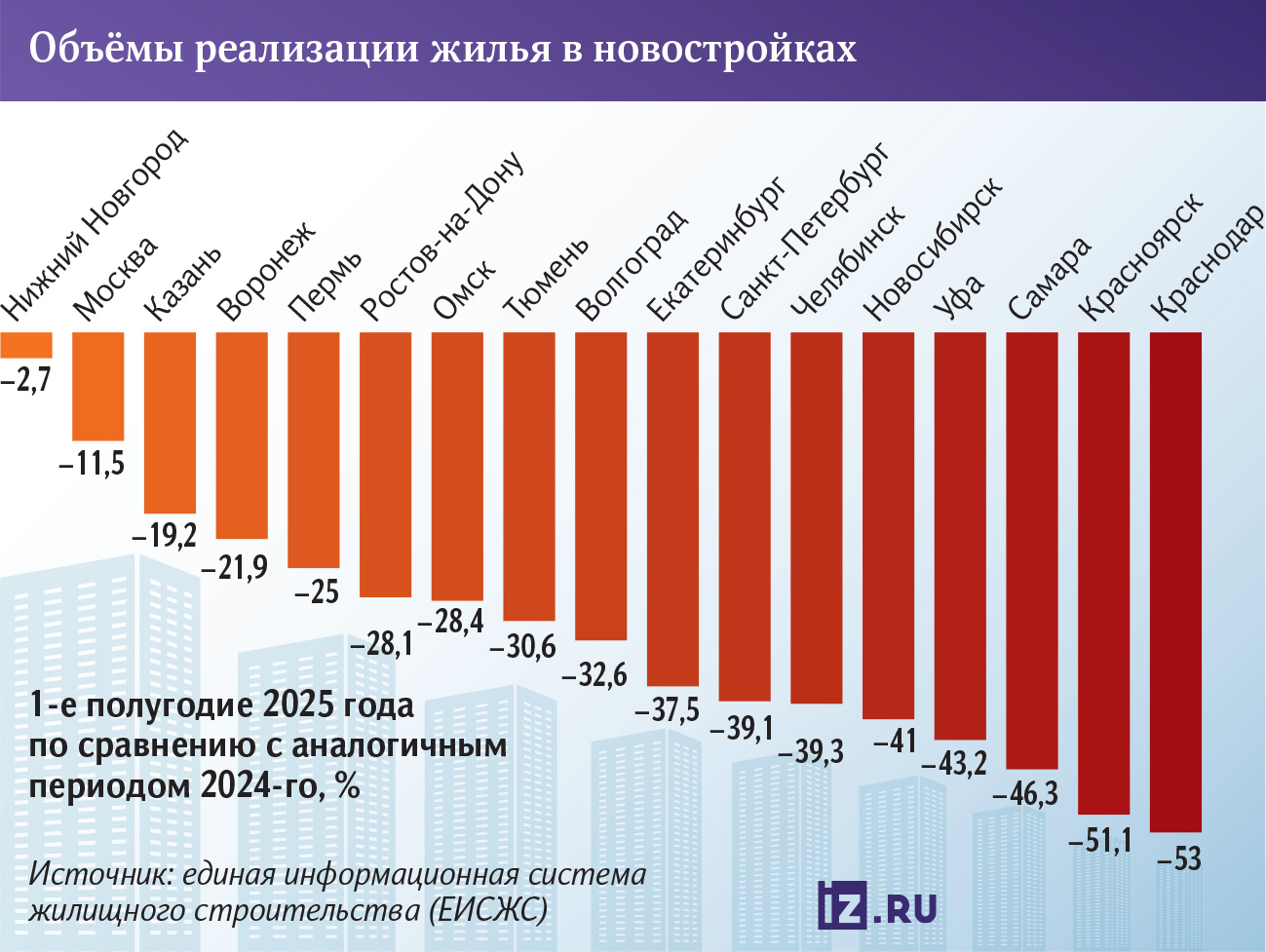
According to research data (available from Izvestia), of the million-plus cities, housing sales fell the most in Krasnodar — by 53% and Krasnoyarsk — by 51%. Significantly fewer transactions were recorded in Samara — by 46.3%, Ufa — by 43.2%, Novosibirsk — by 41%, Chelyabinsk — by 39.3%, St. Petersburg — by 39% and Yekaterinburg — by 37.5%. The least affected cities were Moscow (11.5%) and Nizhny Novgorod —2.7%).
The study also notes a decrease in the ratio of sales to building readiness. This indicator demonstrates whether developers manage to sell the housing they are building. If it decreases, developers face difficulties in paying off debts on project financing due to the high rate associated with insufficient filling of escrow accounts. According to the state corporation "Dom.Russian Federation", the optimal limits of this indicator are 70-80%.
"This key indicator of the housing construction market, reflecting the balanced sales of developers, decreased from 88% to 71% in Russia over the past year. On average, it has changed from 94% to 70% in the market of million-plus cities," the study says.
But in a number of cities, this indicator is already below the norm, they are in the so-called red zone. These include the analysts "Movement.ru" was attributed to Krasnodar — 47%, Ufa — 53%, Krasnoyarsk — 55%, Voronezh — 57%, Omsk — 59%, Chelyabinsk and Samara — 62% each, Novosibirsk, Tyumen and Perm — 64% each, Volgograd — 65%.

The decline in sales in all million-plus cities is taking place against the background of an increase in total construction volumes — by an average of 8% year-on-year. In some locations, the growth is significantly higher — construction areas in Nizhny Novgorod, Omsk and Perm increased by more than 20%.
"Cities with the largest real estate markets are continuing to increase the volume of ongoing construction, where demand for housing obviously does not cover the volumes available for sale, primarily in Tyumen and Yekaterinburg, where a significant mass of unrealized apartments in new buildings has accumulated," the authors of the study emphasize.

There are cities where construction areas are shrinking. Most significantly, in St. Petersburg and Krasnodar. But if in the case of the Northern Capital this is due to the administrative-territorial structure, then in Krasnodar the decrease is due to the overheating of the market and insufficient demand, unable to absorb the volume of accumulated housing, the authors of the study report.
Izvestia sent a request to the Ministry of Construction with a request to comment on the data provided, as well as to inform whether any measures are being prepared to support the industry.

Earlier, Deputy Prime Minister Marat Khusnullin, who oversees construction issues, said that about 20% of developers in Russia have bankruptcy risks. At the same time, the deadlines for commissioning have already been postponed for 19% of projects.
What measures do developers expect from the government?
Representatives of the construction industry recognize the problems in the market and believe that they cannot be solved without lowering the Central Bank's key rate and new preferential programs.
— The increased key interest rate has made mortgages unaffordable. Sales fell less in regions with high incomes or where there was a shortage of multi-family housing under construction. For example, Nizhny Novgorod turned out to be like this, which in recent years has pursued a very conservative urban planning policy," Maxim Fedorchenko, president of the Association of Construction Organizations of the Novosibirsk Region, told Izvestia.
According to him, positive changes can be expected either with a significant reduction in the key interest rate by 6-7 percentage points, or with the expansion of preferential mortgage programs.

—In 2020-2024, the market of Russian new buildings in the regions turned out to be overheated and oversaturated with supply due to the fact that demand was supported by preferential mortgage programs," admitted Dmitry Khalin, CEO and Managing partner of Intermark Urban Real Estate. — Those regions where the biggest decline is currently observed were previously leaders in launching new projects. Moreover, developers often counted solely on the demand that would be provided by preferential mortgage programs.

In the absence of profitable mortgage programs, there was an oversupply in these markets, which resulted in such an impressive drop in the number of transactions.
— Indeed, after the abolition of preferential loans and an increase in market mortgage rates, there has been a decrease in the volume of transactions. However, some developers also reacted in a timely manner to the current situation, temporarily suspending the launch of new projects," said Ksenia Rysenko, director of the Analytics and pricing department at the federal developer Neometria.
In her opinion, as a result, the market is not overheating, now those houses that were mortgaged earlier are being sold.
— According to the forecast of the Central Bank, in 2026 the rate will be 12-13%. A gradual return to lower rates will help stimulate demand from those who do not qualify for preferential loans. Now, pent—up demand is forming from these citizens, which will later return to the market and give an increase in transactions," Rysenko believes.

The reduction in sales of new buildings is a natural result of the completion of the preferential mortgage program and the tight monetary policy of the Central Bank, said Ruslan Syrtsov, Managing Director of Metrium.
— Given the unprecedented value of current rates on market programs and the relative limitations of family mortgages, the situation is not as bad as it could be. The marketing policy of developers, special mortgage conditions and installments help to maintain the activity of buyers necessary for the sustainability of the industry, but this cannot continue indefinitely," the industry representative notes.
According to him, the share of mortgage transactions in Russia decreased to 64% in the first half of the year, compared with 76% a year ago. The industry is highly dependent on credit, both in terms of demand and supply.
— Therefore, it is necessary to return to a moderate key rate below 15%. In order for the intensive recovery of the market to begin, mortgage rates at the level of 12-15% per annum are needed. As for measures to support the industry, new targeted mortgage subsidy programs are still needed, for example, for public sector specialists, Ruslan Syrtsov believes.

Currently, the main driver of demand in the primary market is the family mortgage, which also has a positive impact on the demographic situation, said Yaroslav Gutnov, founder of SIS Development. In his opinion, the government should expand this program as the key interest rate decreases.
— The authorities have already discussed its extension to families with children under the age of 14, but have temporarily postponed the implementation of the initiative. I am sure that we should return to the discussion of this issue. It would also be logical to additionally reduce the rate for each subsequent child born or adopted to large families," the developer believes.

Other support measures may include a reduction in the family mortgage rate for the purchase of multi-room apartments and state support for developers who sell residential complexes and neighborhoods with social facilities and places of employment, Gutnov added.
— Family mortgages account for more than 90% of mortgage transactions in new buildings. Any tightening of conditions, for example, granting a loan only at the place of registration or canceling mortgages in large cities, will lead to a decrease in sales," said Alexey Chapik, head of the Dombuk Plus new building sales platform (part of the Plus group).
In his opinion, reducing the key interest rate to levels where it would be beneficial for banks to issue loans at 12-13% without government support could improve the situation in the industry. And such factors as stricter conditions for obtaining a family mortgage by banks, reduced approvals and increased down payment requirements will negatively affect the market.
Переведено сервисом «Яндекс Переводчик»
