Travel novel: analysts have compiled a portrait of a fan of traveling by train


Most often, women traveled by train in the summer of 2025. The average passenger is 38.5 years old, she spends 16 hours on the road, and this year her vacation has shifted from August to June – July — this is the portrait compiled by analysts of Russian Railways – Digital Passenger Solutions. Among the most popular destinations among tourists who prefer trains are Moscow, St. Petersburg, Adler, Nizhny Novgorod, Tyumen and Kazan. Why women prefer railways more often, and men prefer airplanes and buses, is in the Izvestia article.
Who travels by train most often
In Russia, a "vacationer's rub" was compiled. Based on the data from the Innovative Mobility platform, analysts from Russian Railways – Digital Passenger Solutions concluded that the "average traveler" was a 38.5-year-old woman. Moreover, this year, vacationers have shifted the dates of their holidays — previously, the most popular departure date was August 16, and in 2025 — July 7.
In general, the fair sex uses the railway more often than men — 54.5% of them are passengers. The average age of male passengers is 34.8 years.
The average travel time was 16.3 hours — mostly Russians go on trips lasting from 10 to 20 hours.
Moscow and St. Petersburg remain the most popular destinations in 2025, with almost two thirds of passengers traveling there. Another part of the tourists concentrated on the southern destinations, traveling between Adler, Krasnodar, Rostov-on-Don and Simferopol. Nizhny Novgorod, Kazan and Yaroslavl are also among the top tourist destinations.
"The cities are located near Moscow, where the cultural and historical environment, gastronomy, sports and mass entertainment events are actively developing," said Evgenia Chukhnova, CEO of Russian Railways - Digital Passenger Solutions.
Voronezh and Kazan have shown the highest growth rate of popularity this year. And most often they began to leave Novosibirsk and Tyumen by train.
— This year, there has been a trend towards replacing summer holidays "in the south" with vacations spent in historical and tourist centers, — said Evgenia Chukhnova.
According to Yandex Travel, Muscovites, Petersburgers, residents of Rostov and residents of Krasnodar travel by train most often. On average, they spend from 2.5 thousand to 6.8 thousand rubles on tickets, and they travel by train to Moscow, St. Petersburg, Sochi, Yekaterinburg, Nizhny Novgorod and Kazan.
These data were confirmed in the Tutu service, adding that interest in railway trips to Dagestan and the Khabarovsk Territory has increased significantly — in June – August 2025, tickets are bought there twice as often as last year. The demand for travel to the Krasnoyarsk Territory increased by 54%, to the Khanty—Mansiysk Autonomous Okrug by 47%, and to the Irkutsk Region by 30%.
Emil Ziyadinov, Director of partner network Development at this travel service, noted that this summer, 32% of tickets were bought by young travelers aged 18 to 35. Another 17% of tickets were for tourists 36-45 years old, 20% — 46-60 years old, 12% — 60+. Children under the age of 18 made 18% of trips.
—Women prefer to travel by train — 55% of the time," he confirmed. — Young people began to travel more often, including by train. This can be seen from the statistics for the first half of 2025. Along with the growth of trips, the demand for digital services along the way is also growing: stable Internet, multimedia portals and convenient online services.
Why do women choose trains
Now the portrait of a tourist is really being transformed, experts noted. Changes in vacation time may be related to changes in children's vacation schedules, weather conditions, and an attempt to avoid high prices and congestion during peak season, says Ekaterina Kosareva, managing partner of the VMT Consult analytical agency.
"Everything is stable in the directions: residents of the regions go to Moscow, Muscovites go to the sea and to the old cultural centers," she said. — There is also an interest in less obvious routes, many choose trips to the Stavropol Territory, Karelia, and Altai. Traffic to Kaliningrad has increased both by connecting trains and direct trains through Lithuania, despite the difficult logistics.
Vacations vary not only in terms of dates, but also in format. More and more Russians prefer short but intense trips: 3-5 days with an emphasis on impressions rather than a long stay in one place.
"At the same time, the train remains the main ally of families with children and pensioners, who value accessibility, convenience and the familiar rhythm of the road," she added.
In addition, women perceive this type of transport as a predictable, reliable and often more budget-friendly option, especially when transporting family or luggage, said Anastasia Helemelya, a family psychologist. This meets the need for control and efficient use of resources.
"For women 35-45 years old, who often balance between work, family and home, a long train ride can be a rare opportunity for "forced rest" and time for themselves — to read, watch a TV series, sleep, just to observe the landscape without immediate responsibilities," the expert added. — This is a psychological respite. And 16 hours is enough time for psychological adaptation to the fact of travel, separation from routine. This is a transitional phase that promotes a mental reboot.
Women may also be more likely to look for more economical travel options, especially when planning a budget, said clinical psychologist Sergey Glagolev. A train is often cheaper than air travel.
"There is also a sense of security and predictability that is associated with a train, such as a stable schedule, the ability to walk around the car, and the absence of turbulence," he added. — There are no difficulties with luggage either: the train is more convenient for transporting more things.
When 38—year-old women choose a train to travel in the summer, it is most often a comprehensive decision dictated by their life stage and the pragmatism of building logistics, the expert said.
— Social dynamics on the train is a unique factor that can both enrich the trip and become a source of stress, — said Sergey Glagolev. — However, an early vacation and the travel process itself are both a fight against burnout and an investment in mental health.
What other routes do Russians choose?
Among the destinations for air travel, flights from Moscow to Baikal and back, as well as from mining regions to the sea and the sun, were the most in demand, the analysts added.
On planes, Russians fly on vacation along routes that include Moscow and St. Petersburg, Adler and Mineralnye Vody, as well as Tyumen, Surgut, Novy Urengoy and Nizhnevartovsk, Yekaterinburg, Krasnoyarsk, Irkutsk. At the same time, the share of the female audience in air travel has also increased. It accounts for 37.3% of all passengers, an increase of just over 10%.
Bus transportation also set a record for ticket sales this summer: the average trip time has more than doubled, from 18 to almost 40 hours. Besides Veliky Novgorod, Rostov-on-Don and Krasnodar have been added to popular destinations.
Buses from non-metropolitan cities began to travel more often on vacation, they showed an increase of tens of percent compared to 2024. The gender composition of passengers has also changed: in 2025, men began to actively participate in bus travel — 53% of them compared to 47% of women.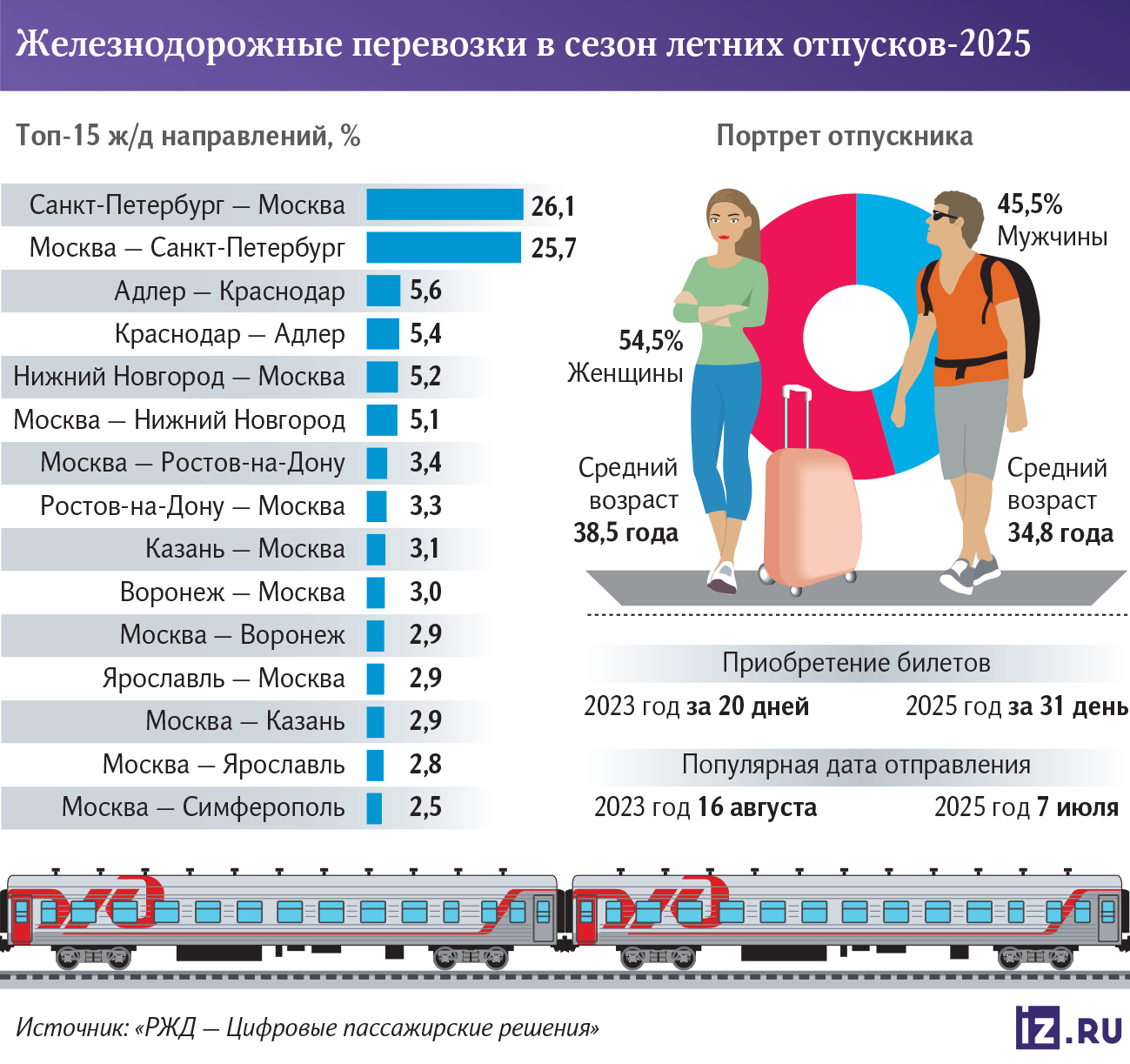
At the same time, many people choose to travel by car or by train, followed by renting a car, says Bulat Kilov, the founder of Krytex.
— The average car rental period for a trip of ten days or more is about 3-5 days. The greatest demand was recorded in Moscow, St. Petersburg, the cities of the Golden Ring, and the Krasnodar Territory," he noted.
The average rental receipt reaches about 15-20 thousand rubles in the economy segment, and over 100 thousand rubles in the business segment.
Переведено сервисом «Яндекс Переводчик»
