Did not arrive: the losses of the tourism industry from the accident at the Gorodetsky junction may exceed 1 billion
- Статьи
- Economy
- Did not arrive: the losses of the tourism industry from the accident at the Gorodetsky junction may exceed 1 billion


The losses of cruise operators from the accident at the Gorodetsky hydroelectric complex may exceed 1 billion rubles, representatives of the tourism industry told Izvestia. The authorities have not yet announced the time frame for restoring navigation. Cargo carriers are already losing about 300,000 per ship from forced downtime, industry sources said. Travelers are offered new routes, but it will not be easy to refund money for already paid tours in such a force majeure event, lawyers believe. How the situation is being resolved is in the Izvestia article.
Why can't ships pass Gorodets?
Dry cargo ships and barges are mass-accumulating near the Gorodetsky hydroelectric complex, where the lock chamber collapsed on July 22, 2025 and shipping stopped, industry sources told Izvestia. According to the Ministry of Transport, only at the time of the emergency, 10 passenger ships with 1.5 thousand people on board were preparing to lock up at the hydroelectric complex, and 14 more cruise ships may join them by the end of the week. In addition, dry cargo ships and oil tankers stop at the approaches to Gorodets.
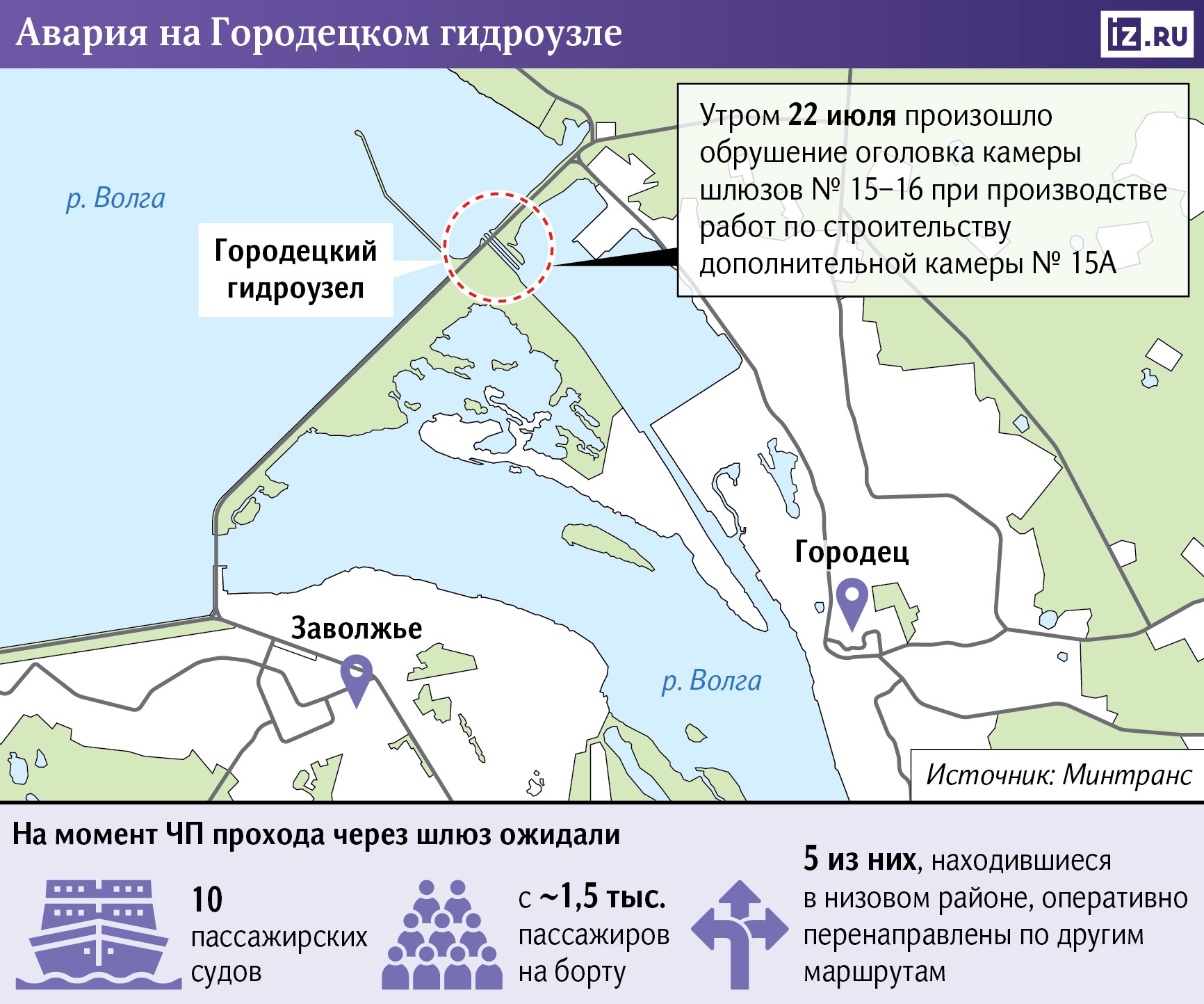
The accident at Gorodetsky junction occurred on July 22, 2025 at about 11:00 a.m. During the dismantling work, the lock chamber collapsed: one part was under water, the other blocked the passage. As a result, the 30-meter lock, which was under reconstruction, was flooded. Navigation on the site was suspended. On July 23, the Ministry of Transport created an operational headquarters, which included representatives of Rosmorrechflot, Rostransmodernizatsiya (the customer of the reconstruction of the hydroelectric complex) and other organizations. After the completion of the survey, a decision will be made on the possible timing of the restoration of navigation.
"Due to the accident, the Volga Shipping Route was temporarily blocked in its middle," Evgeny Reutov, a member of the transport committee of the Chamber of Commerce and Industry of the CCI of the Russian Federation, told Izvestia. — Through traffic on the Volga has been suspended.
Bulk, bulk and bulk cargoes (sand, crushed stone, scrap metal, petroleum products, grain, etc.) are transported along this river. Almost all cruises from Moscow and St. Petersburg to the cities on the Middle Volga pass through the Gorodetsky hydroelectric complex.
In 2024, according to Rosmorrechflot, more than 13 thousand ships passed through the locks of the Gorodetsky hydroelectric complex, including cruise ships, for which 6.5 thousand locks were performed. The total volume of passenger traffic exceeded 179 thousand people. The same order of numbers was expected in 2025. According to Nizhny Novgorod media, more than 40 vessels are already stationed near the waterworks.
It is possible that the forced shutdown could lead to considerable losses for shipping companies.
"The cost of chartering a cargo ship with a crew reaches 300 thousand rubles per day," an industry source told Izvestia. — The longer it stands, the greater the losses.
Based on these figures, for example, a month of downtime for one ship will cost the charterer about 9 million rubles, Izvestia estimated.
The economics of transportation are such that it is unprofitable to turn ships around and take them back to ports for unloading, says the source. The operation of river ports at the peak of navigation has a tight schedule and it is unlikely to be possible to find a free window for unloading. It is easier for customers to take a new shipment and ship it by rail. And the loaded vessels will remain waiting for the repair of the lock chambers of the Gorodetsky hydroelectric complex, he noted.
— If the case drags on, the owners of the cargo will try to resell it, but this applies more to bulk cargoes — crushed stone, sand, and so on, — he believes.
In the coming weeks, the vessels may go to unload at the ports of Chkalovsk, Kineshma and Kostroma. Dry cargo ships coming from the lower reaches up the Volga are in Kstovo, the Izvestia interlocutor noted.
— With the traffic through the Gorodetsky gateway stopped, the goods can be redirected to the railway, — suggested Evgeny Reutov from the CCI.
Russian Railways told Izvestia that they are ready to ensure cooperation with all interested parties to determine the necessary parameters for cargo transportation.
— But there are goods in transit going abroad and cleared for customs clearance. Such vessels can only wait for passage to Gorodets. This will not create a traffic jam. The ships will come off the main course and stand side by side until navigation is restored," the source believes.
Izvestia sent requests to the Ministry of Transport, tour operators and river carriers. Rosmorrechflot informed the editorial board that the exact dates for the resumption of navigation along the Volga in the Nizhny Novgorod region will be determined after carrying out a complex of research works, including a diving inspection of the underwater part of the hydroelectric facility.
According to the data on the website of the Federal State Institution "Rostransmodernization", the reconstruction of the locks, which was carried out at the hydroelectric complex, is designed to deepen the bottom to 4 m to improve navigation between Nizhny Novgorod and Gorodets. This will increase the capacity of the hydroelectric complex from 3.6 million tons to 20 million tons. In addition, during the work, it is planned not only to modernize airlock chambers No. 15 and No. 16, but also to build another one, No. 15A. The construction readiness of this chamber is 60%. In 2024, it was reported that the cost of the project would amount to more than 32 billion rubles. It was planned to finish the work before 2027.
How the accident affected cruise operators
Due to damage to the locks at the Gorodetsky hydroelectric complex, cruise operators may suffer enormous losses, Alexander Mkrtchyan, vice president of the Alliance of Travel Agencies (ATA) Association, told Izvestia. He clarified that we are talking about hundreds of millions of rubles.
"Depending on how much the accident is repaired, the damage to cruise operators may amount to 1 billion rubles," he added. — But after determining the culprit of the incident, they will be able to demand the expenses incurred from him.
Due to the closure of the Gorodetsky hydroelectric complex, tour operators began to actively adjust the programs of cruises that had already begun and change the routes of the next flights, Dmitry Gorin, vice president of the Russian Union of Travel Industry (PCT), told Izvestia.
"It is still unclear how many cruises will be affected, as it is not known how long the repair work will last," he stressed.
From 10 to 20 cruise ships pass through the hydroelectric complex per day, the expert said. In total, about 500 thousand people travel along various river routes, including this one.
At the time of the accident, ten passenger ships were planning to pass through the gateway, with about 1.5 thousand passengers traveling on them. Five ships were sent on other routes. Another 14 passenger ships planned to pass through the hub from July 23 to July 25. Their routes have been adjusted, the PCT clarified.
According to ATA and PCT, the closed section is used in the routes of almost all cruise operators. According to Alexander Mkrtchyan, it accounts for about 25% of cruise ship routes. Now cruise operators must refund the amount of 100% to those who were supposed to start such tours, but they refused them, the expert added.
According to him, cruise operators should pay money to those who were on the ships at the time of the accident and decided not to continue the journey.
Dmitry Gorin stressed that most tourists agree to alternative routes or a change of ship. According to him, there is no question of transferring passengers to buses.
"Cruise operators have a clear algorithm of actions, alternative routes have been worked out, so changing them is not a problem," he noted.
Andrey Mikhailovsky, CEO of the Infoflot cruise center, said that the operators make all changes in accordance with the circumstances, but with maximum attention to the interests of tourists.
— We are currently receiving official letters from tour operators about who is changing the next flights and how. It is difficult to say how many cruises will be affected, it all depends on the duration of the pause in traffic. So far, the ban has been announced for the next three days, while the situation is being assessed," he said.
Experts did not recommend tourists to abandon cruises on their own and urged them to wait for information from a travel agent.
Which companies are changing routes
Global changes in routes passing through the Gorodetsky hydroelectric complex concern only those cruises that have actually already begun, the Association of Tour Operators (ATOR) noted.
— In particular, flights Nizhny Novgorod — Yaroslavl and Yaroslavl — Nizhny Novgorod on the Meteor 120P high-speed vessel were canceled on July 25 and 27. Passengers have been offered a refund, they said.
The press service of the Vodohod company said that they had adjusted the schedule of motor ships that passed through the Gorodetsky Lock on July 22-23. They clarified that three of their vessels could not pass the lock and were forced to return to the berths in Nizhny Novgorod and Gorodets. And the Mstislav Rostropovich motor ship went on a modified route on July 23. Changes have also been made to the timetable of the ship "Leo Tolstoy" for the period from July 25 to August 6.
The Gama cruise company allowed possible deviations in the output of ships for a day. This is due to the fact that the ships sail along the Oka, not the Volga, which lengthens their route. And Mosturflot reported that adjustments were made to the voyage of the ship "Princess Victoria" from July 21 to 31, passengers will be transferred to Gorodets.
The changes also affected passengers of the Ilya Muromets motor ship from Caesar company — its route from Gorodets will be changed and supplemented with excursions, as well as the Maxim Litvinov motor ships from Doninturflot and Yuri Nikulin from VolgoVolga company, which were scheduled to depart from Yaroslavl to Nizhny Novgorod on July 23.
What compensation is due to passengers
As a rule, the contract stipulates the right of the tour operator to make changes to the excursion program or the procedure for providing services, Alina Laktionova, partner, head of the practice of private clients at Mitra Law Firm, reminded.
— However, any changes should not significantly affect the main conditions of travel: route, method of travel, place of stay. If the main goal of the tour is a river cruise on a motor ship along a certain route, and it becomes unattainable, we are talking about a significant change in the terms of the contract," she said.
But the expert stressed that the route change occurred as a result of an accident at the hydroelectric plant, that is, due to circumstances beyond the control of the tour operator. In such situations, the organizer is obliged to offer alternative options — to continue the tour with a change of route (for example, part of the way by bus instead of by boat) or to refuse further participation and refund funds for unproven services.
— If a tourist does not agree to replace the river part with bus transportation and refuses to change the route, he has the right to demand a refund for the services not provided, according to the law on consumer protection, — she said.
In the event of a significant change in the terms of the contract (for example, replacing a motor ship with bus transportation or reducing the program), passengers may cancel the trip altogether or demand compensation for part of the cruise cost if the route is shortened or services are provided to a lesser extent, added Evgeny Zharov, managing partner of the Zharov Group law firm. If the tourist is not satisfied with the cruise companies' offers, then he can contact the Nizhny Novgorod Transport Prosecutor's Office and Rospotrebnadzor.
"It is important for passengers to record all violations of agreements (for example, uncoordinated transport replacements) and send complaints to the operators, and in case of refusal, to the court," he said.
The situation of changing the cruise route looks like a significant violation of the terms of the contract, because the route is one of the main consumer properties of a tourist product. However, in practice, most companies still include in the contract the possibility of unilateral modification by the contractor of the terms of the contract, which actually violates the rights of consumers, said Daniil Chernykh-Aipov, lawyer, member of the Council of the Moscow Regional Branch of the Russian Bar Association, Deputy Chairman of the Sulim and Partners Bar Association.
—Even if the contract provides for the possibility of changing the route, such conditions may be considered infringing on consumer rights, in this regard, on paper, the consumer has something to fight for, but in practice, again, in such a force majeure situation as in this case, it will be extremely difficult," he believes.
The most effective way in this particular situation is to request compensation for the conditional amount of money that was paid for the service ordered but not fully provided, the expert said. Less effective is to demand a full refund, because the service has been partially provided, and the tour operator has already incurred part of the costs.
Переведено сервисом «Яндекс Переводчик»
