- Статьи
- Economy
- Leadership dispositions: will Russia manage to enter the top 3 economies of the world

Leadership dispositions: will Russia manage to enter the top 3 economies of the world

It will be difficult for Russia to enter the top 3 largest economies in the world, as the leaders of the World Bank ranking in China, the United States and India have come out ahead by a wide margin. However, this is possible in the next 10 years, experts interviewed by Izvestia are confident. The Russian economy is growing due to the adaptation of businesses to new conditions, as well as due to domestic investment and consumer demand. The top 3 is also expected to change in the coming years. This is due to the policies of US President Donald Trump: trade wars, huge government debt and interference in military conflicts.
Russian economic growth in 2024
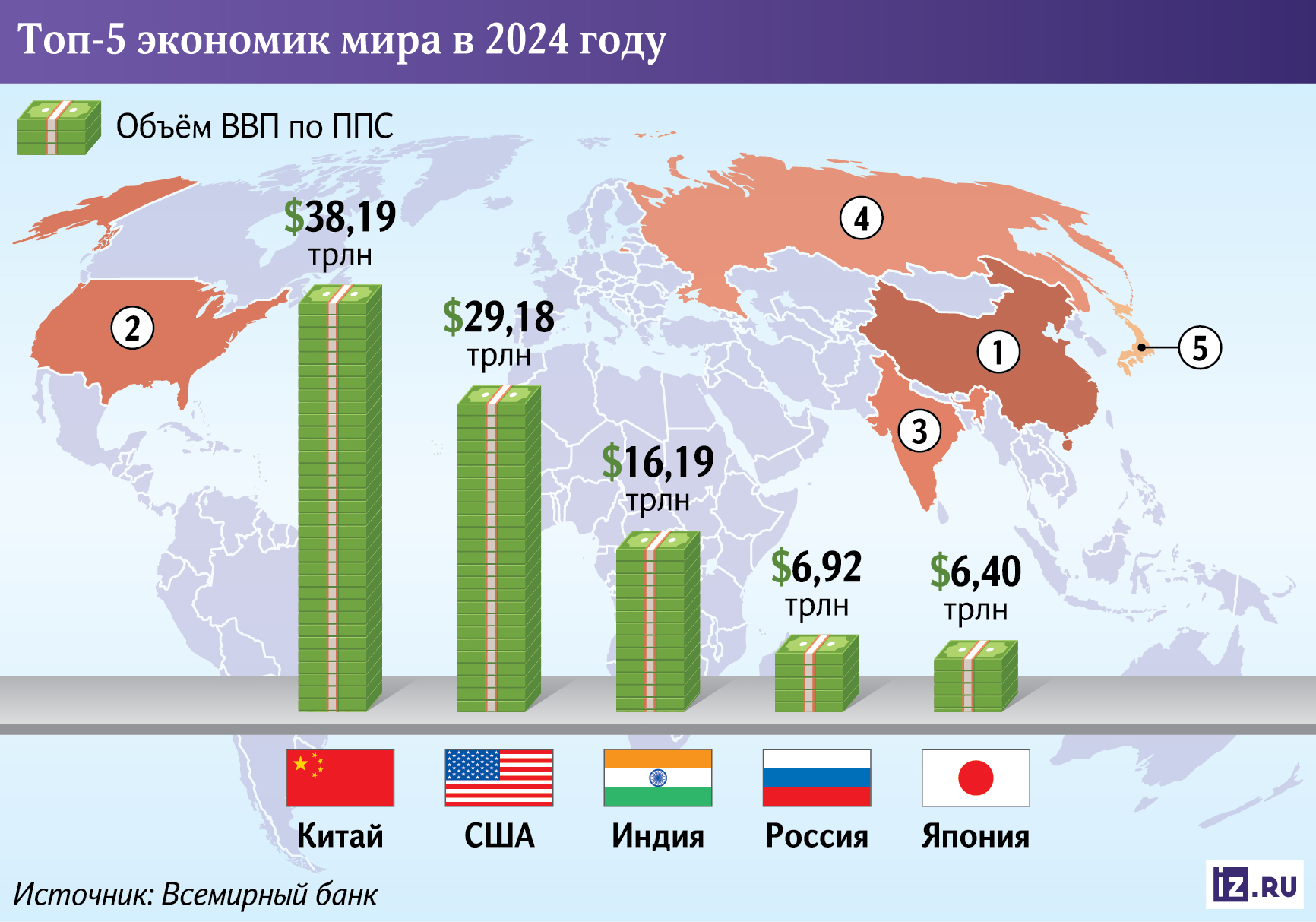
Russia has retained the fourth place among the world's economies in the World Bank's 2024 ranking. He updated the estimates of GDP at purchasing power parity (PPP). This indicator reflects the efficiency with which States use their economic resources to improve the wealth and standard of living of the population. According to the revised figures, the Russian economy was estimated at $6.92 trillion, which is 5.8% more than in 2023.

World Bank Headquarters
Russia was overtaken by China ($38.19 trillion), the United States ($29.18 trillion) and India ($16.19 trillion). Japan also entered the top 5, with its GDP rising to $6.40 trillion over the year.
According to experts interviewed by Izvestia, the top three came out ahead by a wide margin, so it will be difficult for our country to catch up with such a volume in the near future in order to enter the top 3. However, according to Yulia Kovalenko, deputy head of the Higher School of Finance, associate professor of the Basic Department of Financial Control, Analysis and Audit of the Main Control Department of the City of Moscow, there is still a possibility of this even in the next three years. According to Natalia Milchakova, a leading analyst at Freedom Finance Global, a period of 10 years looks more realistic.

Why is Russia's GDP rising
The steady economic growth in 2024 is the result of the work of Russian companies that were able to adapt to the new difficult conditions and increase the supply of goods and services, the press service of the Ministry of Economy told Izvestia. The government and the Central Bank provided business support, improved preferential mechanisms, improved regulations and the business climate, and created conditions for the development of technology and domestic production in general, they added.

This was also facilitated by effective solutions in the field of stimulating economic activity in the IT sector, agriculture, construction, and the manufacture of machinery and equipment, added Mikhail Khachaturian, Associate Professor of the Department of Strategic and Innovative Development at the Financial University.
At the same time, the Ministry of Economy continued, domestic investment and consumer demand became the main driver of economic growth. For example, investments in fixed assets increased by almost 7.5% in real terms last year. And the growth of real incomes of citizens amounted to 8.5%.
— In addition, the high rates of economic growth in Russia have been associated with the "fiscal impulse" for several years in a row. So, in 2021, when the Russian Federation entered the four largest economies in the world for the first time, growth was largely provided by budget subsidies aimed at supporting healthcare and combating coronavirus. For comparison, in 2023-2024, economic growth was provided by a "budgetary impulse" in industries operating under state defense orders, manufacturing dual—use products, as well as in industries related to import substitution, explained Natalia Milchakova from Freedom Finance Global.

Nevertheless, in 2025, the real growth rate of the Russian economy has already slowed significantly and by the end of the year will be lower than 4.3%, which were in the previous one. This is partly due to the high key rate, which the Central Bank kept at 21% for six months, until it lowered it by 1 percentage point in June, Natalia Milchakova noted. In addition, the impact of sanctions remains — they make it difficult to attract private investment, especially foreign investment, the expert added.
The Bank of Russia's forecast assumes GDP growth of 1-2% this year, and the Ministry of Economic Development — at 2.5%. As Izvestia wrote earlier, experts predict an increase in the economy of about 1.7%.

How will the growth of the US economy change due to the Trump trade war
China has managed to overtake the US economy this year precisely because of the higher growth rates associated with budget subsidies to its economy, Natalia Milchakova said. In addition, Beijing has been able to make Washington dependent on its products — for example, American companies have opened factories in China, as production costs are lower there.
Despite the fact that the United States and China have consistently led the way in economic growth, changes to the top 3 of this list are still possible in the next few years, says Mikhail Khachaturian from the University of Finance. This is due to the policy pursued by the newly elected American president.

Upon his return to the White House, Donald Trump launched a large-scale round of trade wars against a number of partner countries, in particular, the European Union, as well as Canada, China and Mexico. According to the Chinese customs, in April, the mutual trade turnover between Washington and Beijing has already dropped by 20%. Trump is resorting to such measures in order to protect the US economy, as well as solve the problem of the growing national debt, which has long exceeded the $37 trillion mark. In addition, in the United States, large expenditures are spent on the defense complex and the sponsorship of various conflicts, said Yulia Kovalenko from the Main Control Department of the city of Moscow.
On April 2, 2025, Donald Trump announced the introduction of import duties for 185 countries. However, on April 9, the fees for most of them were postponed for 90 days — the parties agreed to negotiate — then the measures were postponed again until August 1. The exception was China: the "trade truce" with it came into force on May 12 and is also designed for three months. In addition, duties on Chinese goods were reduced from 145% to 30%.
Mikhail Khachaturian is confident that as Trump continues his policy, which is harmful primarily to the United States itself, the situation in the country will only worsen, and the position of its economy as the largest in the world will weaken.
Overall, global GDP will continue to rise in 2025, but the growth rate will be volatile — about 2.4–3%. Andrey Smirnov, an expert on the stock market at BCS World of Investments, noted that a more stable trend is possible only if trade and geopolitical conflicts de-escalate.
Переведено сервисом «Яндекс Переводчик»
