Cold recalculation: additional tax payments to businesses increased by a third in 2025
- Статьи
- Economy
- Cold recalculation: additional tax payments to businesses increased by a third in 2025


Tax surcharges to businesses and citizens increased by a third in 2025: according to the results of inspections in January – March, 140 billion rubles were presented to them, Izvestia calculated according to the Federal Tax Service. The amount includes arrears, fines and penalties. Claims against the self-employed, as well as against citizens renting out housing or selling assets, have also increased significantly. The budget does not have enough money, it is logical that control has been tightened. Additional charges have also increased due to changes in the procedure for calculating penalties. The situation is getting worse due to the high rate (it affects the amount of fines). Why the attention of tax authorities is increasingly directed at self—employed people and how an amnesty for fragmentation can affect the situation is in the Izvestia article.
Who does the tax check most often?
In the first quarter of 2025, the tax service conducted 12,000 inspections. Compared to the same period last year, their number has hardly changed, but additional charges have increased by a third. In January – March, businesses and individuals were charged 140 billion rubles, including arrears, fines and penalties. In 2024, the amount was 106 billion, according to the Federal Tax Service (Izvestia studied them).
Most of the additional charges were for on—site inspections - 101 billion rubles. The rest was added by camera, that is, remote control.
According to the Federal Tax Service, the main arrears have been identified in organizations. At the same time, claims against individuals doubled to 604 million. This may indicate stricter control over the self-employed and citizens renting out housing, owning foreign assets or cryptocurrency, according to Vladimir Chernov, analyst at Freedom Finance Global.
— Construction, retail, catering, logistics and services are most often under increased control — areas with a high proportion of cash payments, business fragmentation and VAT avoidance schemes. Increased attention is also being paid to sole proprietors and the self—employed, especially those who formally use preferential treatment, but in fact operate as a medium-sized business," the expert said.
Additional charges also often affect legal entities engaged in the production of petroleum products and the wholesale trade of raw materials, added Evgeny Pantaziy, partner of Leges Bureau, member of the Russian Bar Association. These industries are traditionally under the close attention of the tax authorities due to the high turnover.

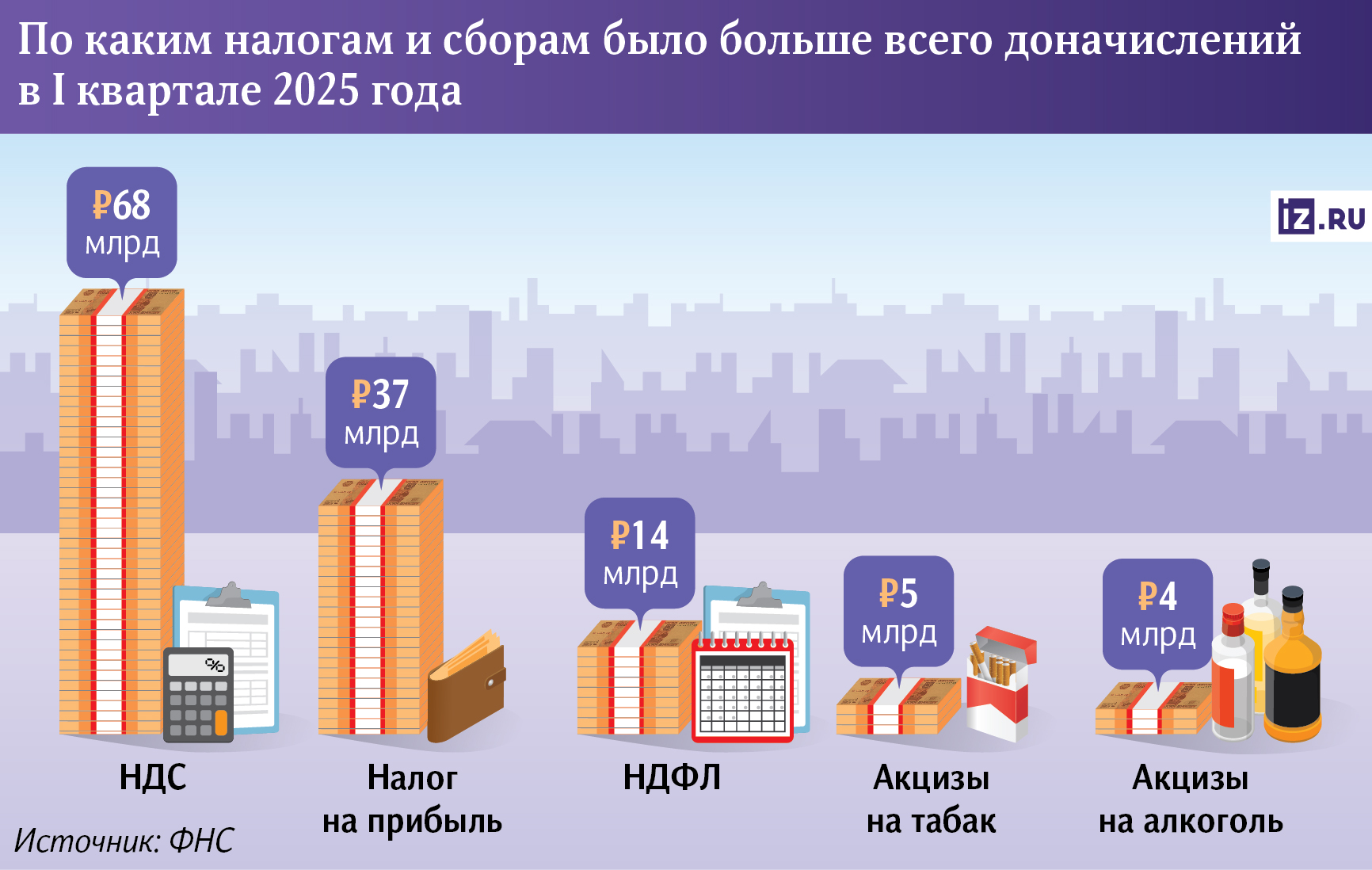
The recalculation mainly affected violations of value-added taxes, on profits and incomes of individuals, according to the data of the service. All three training camps have undergone changes this year. Small companies on the simplified list with an income of over 60 million are now required to pay VAT. The income tax rate was increased from 20% to 25%, and a progressive scale was introduced for personal income tax.
The most frequent violations are business fragmentation, obtaining unjustified tax benefits through fictitious counterparties, overstating expenses and incomplete revenue recognition, Vladimir Chernov listed. Also, tax authorities often identify errors in payroll accounting and disclose the use of gray schemes through sole proprietors and the self-employed. For individuals, this is usually the non—reflection of income from the sale of property or rent.
When choosing companies for on—site inspections, the focus is primarily on those with the greatest tax risks, regardless of their field of activity and industry, the press service of the Federal Tax Service told Izvestia.
Most on-site inspections of individuals are related to the fact that they previously conducted business as sole proprietors, the tax service shared. By the time of the audit, they had already ceased to be entrepreneurs, but the Federal Tax Service still had questions about previous periods. At the same time, the number of such inspections has halved: from 32 in the first quarter of 2024 to 16 in January -March 2025, they added.
Why are tax surcharges increasing?
One of the reasons for the increase in additional charges is the change in the procedure for calculating penalties. They are accrued for each day of late payment. Since this year, the temporary procedure for calculating the penalty at a fixed rate of 1/300 of the key central bank per day has ceased to operate, Evgeny Pantaziy from AYUR recalled. Instead, a differentiated approach was introduced: for the first 30 days — 1/300, from the 31st to the 90th day - 1/150, and then 1/300 again. That is, if the delay is longer than a month, you have to pay twice as much.
The key rate itself has increased, which determines the amount of the penalty. Last year, the Central Bank raised it from 16% to 21%. And only in June 2025, the regulator lowered the figure to 20%.
— Another reason for the increase in additional charges is increased control. Inspections are becoming more targeted and effective: there may be fewer of them, but due to risk analysis, digital footprint, bank transactions and mutual settlements between legal entities and individuals, the Federal Tax Service reaches out to obviously "problematic" taxpayers. This allows us to move away from mass checks "for luck" and focus on specific violations," explained Vladimir Chernov from Freedom Finance Global.
Digitalization enhances this process: the Federal Tax Service is increasingly using preliminary analytics, automatic models for detecting evasion schemes, and tools for interdepartmental exchange, the expert added. It helps to find violations better.

Despite the priority of automated control, the Federal Tax Service has recently tightened its approach to "risky" payers, confirmed Andrey Shubin, executive director of Opora Russia. This is due, among other things, to the amnesty on fragmentation and digitalization of tax monitoring. In addition, several industry projects are currently underway, for example, to whitewash the areas of cleaning and catering, the expert shared.
At the same time, the business itself began to commit more violations — many are unfairly reporting and incorrectly registering employees, said Yulia Kovalenko, Associate Professor at Plekhanov Russian University of Economics. According to her, cases of tax avoidance schemes have also become more frequent. As a rule, they do not specify the OKVED or allow discrepancies between documents and actual data.
— There is a steady trend: when rates rise, businesses try to reduce their tax base in order to pay less. Hence, there may be more violations," agreed Andrei Barkhota, PhD in Economics.
How does increased control affect business
Strengthening tax control is becoming a serious challenge for small and medium—sized businesses, especially against the background of high costs, weak demand, rising costs and the harsh policy of the Central Bank, said Vladimir Chernov from Freedom Finance Global. According to him, additional charges and fines often relate to past periods when companies no longer have either liquidity or the ability to fix something. At the same time, large businesses as a whole have managed to adapt by building a more transparent tax model.
"In the future, increased control may increase fiscal discipline," the expert added.
Over the past 10 years, the role of tax revenues in the budget has grown significantly. An increase in non-payments threatens to reduce revenues and widen the treasury deficit, economist Andrei Barkhota warned. Therefore, the service is increasingly monitoring violators.
 Along with the tightening of control, the authorities introduced a relaxation of the most common violation — an amnesty for fragmentation. Starting this year, if a business voluntarily stops using illegal schemes, taxes, penalties and fines for 2022-2024 will be automatically deducted from it — without applications.
An amnesty for fragmentation may partially reduce the number of disputes with the Federal Tax Service, Vladimir Chernov believes. Companies that have voluntarily legalized receive temporary protection from additional charges from previous years, which will reduce their workload. In the future, the amnesty may slow down the growth of additional requirements of the Federal Tax Service, says Yulia Kovalenko from the Russian University of Economics. However, the effect will be limited — no more than 5% of the total volume.
Переведено сервисом «Яндекс Переводчик»
