
Get into a penalty: the tax service charged twice as many penalties in 2025

The tax service accrued twice as many penalties this year: 183 billion in the first quarter alone, according to the Federal Tax Service (Izvestia studied them). The reasons are that the penalty rate for delays has increased, the key one (based on which penalties are calculated) has increased, and control over unscrupulous business has generally increased. How is the whitewashing of companies going on and whether there is a risk that there will be more bankruptcies, because it is becoming more difficult for businesses to work in conditions of a slowing economy, — in the Izvestia article.
Penalties for non-payment of taxes in 2025
From January to March 2025, the volume of accruals for tax violations (including fines, penalties and interest) amounted to 190 billion rubles. Most of them were formed due to penalties — 183 billion rubles. During the year, their size almost doubled (from 102 billion) and reached a historic maximum, Izvestia calculated based on data from the Federal Tax Service.

Penalties are accrued for each day of late payment. Since 2025, the temporary procedure for calculating the penalty at a fixed rate of 1/300 of the key central bank per day has ceased to apply.
Now a differentiated approach has been introduced: for the first 30 days of the delay, the same 1/300 is applied, from the 31st to the 90th day - 1/150, after three months - 1/300 again, explained Alexey Krylov, an expert at the Council on Financial, Industrial and Investment policy of the Chamber of Commerce and Industry, a tax consultant. This, according to him, has become the main factor in the growth of charges. That is, those who have overdue fees for more than a month now have to pay twice as much.

In addition, the key rate itself has increased, on which the amount of the penalty depends, the press service of the Federal Tax Service reminded Izvestia. In 2024, it increased from 16% to 21%.
Another reason is that desk control has increased (that is, remote control, based on submitted reports), said Irina Mikheeva, KSK Group's leading legal adviser. Emphasis is also placed on a pre-verification analysis, according to which the payer is invited to voluntarily confess, provide explanations and pay taxes and penalties in advance, she added.

All this corresponds to the previously presented plans of the Ministry of Finance. In the document on tax policy for 2025, he outlined the goal of increasing the efficiency of tax administration, that is, to improve the collection of payments to the budget.
— In addition, the FTS system sometimes mistakenly charges penalties for arrears of previous periods for which the recovery period has passed according to the law, — Irina Mikheeva added.
The lawyer said that in her practice there was a client who was charged penalties for unpaid insurance premiums in 2025 a long time ago — back in 2018. Suing the tax service is long and expensive, and in such cases, some people prefer to just pay, Irina Mikheeva said.
An additional effect in tax collection was provided by the collaboration of marketplaces and the Federal Tax Service, which started working at the end of 2024, Irina Mikheeva added: online platforms began to identify risk factors among sellers and share the results with the tax service.
Company bankruptcy risks
The main part of debts to the Federal Tax Service, as a rule, falls on organizations. Additional charges most often relate to VAT, income tax and excise taxes, said Ekaterina Golubtsova, Associate Professor of the Department of State and Municipal Finance at Plekhanov Russian University of Economics.

If the increase in penalty accruals continues this year, by the end of 2025, their amount may reach a historic maximum of 800 billion, the expert predicts. For the budget, this is a significant revenue item, comparable to spending on a number of national projects (for example, economics and transport). Given that the Ministry of Finance has increased the budget deficit forecast to 3.8 trillion rubles for this year, this amount could support the financial plan.

But against the background of high inflation, rising costs and corporate taxes, business liquidity is decreasing and cash gaps are worsening, said Vladimir Chernov, analyst at Freedom Finance Global. Due to a shortage of working capital, companies are increasingly delaying payments.
— The increase in accrued penalties is an additional burden for the business. Against this background, the risks of defaults and corporate bankruptcies are increasing, especially in low-margin sectors. In some cases, the Federal Tax Service may initiate the collection and blocking of accounts, which worsens payment discipline and business activity, — said Vladimir Chernov.

However, it is still important that penalties are charged to businesses for a reason, but because they committed violations and did not pay to the budget on time, Ekaterina Golubtsova noted. As a result, companies have to whitewash themselves, which in itself is very useful for the economy.
The Federal Tax Service said that the results of this work are already there: the number of debtors is decreasing due to the simplification of the payment procedure, as well as the introduction of a single tax bill. They added: compared to the beginning of 2023, they have halved: among legal entities — 2.5 times, among individuals (including sole proprietors) — 1.8 times.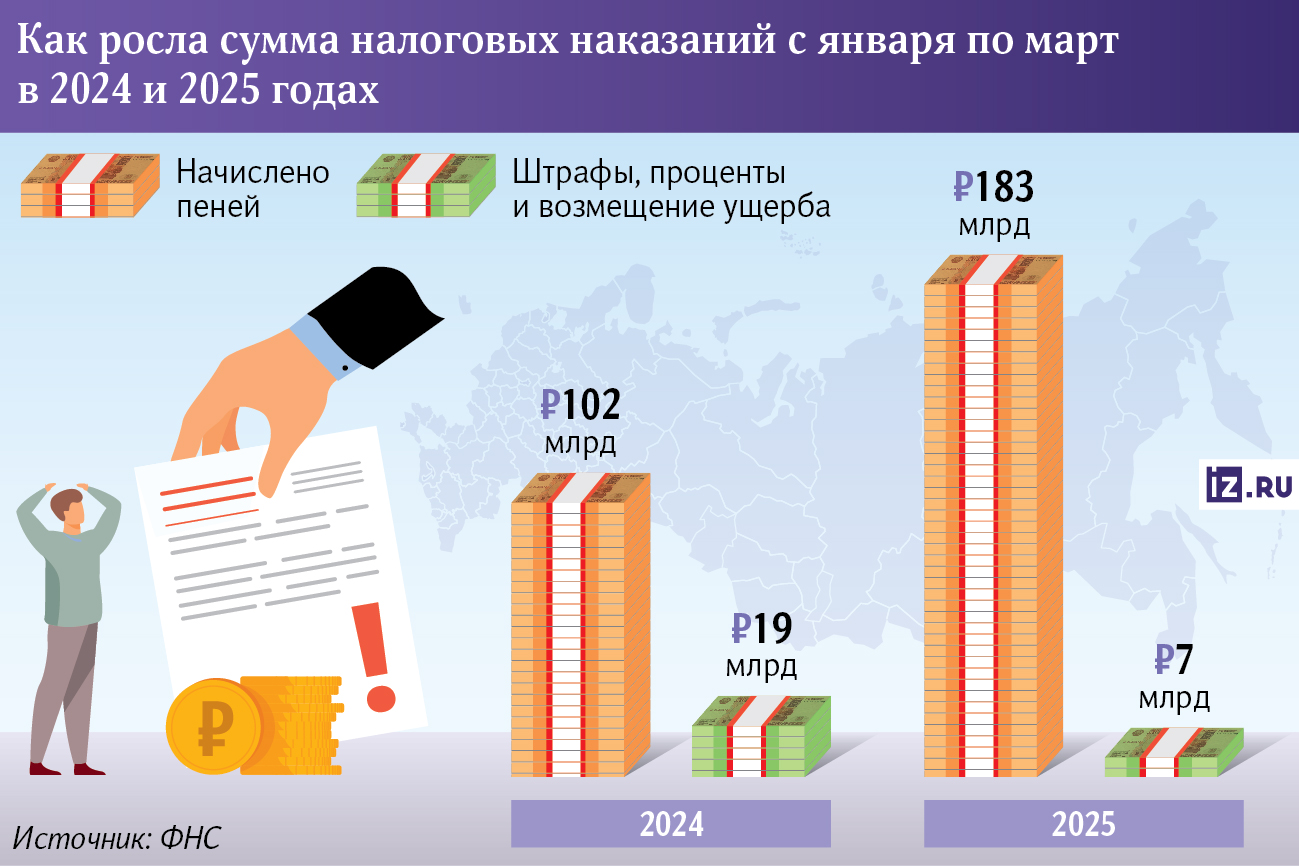
In the same year, a tax amnesty for fragmentation was introduced to encourage companies to come out of the shadows, said Evgeny Pantaziy, a member of the Russian Bar Association and partner at Leges Bureau. He explained that if taxpayers voluntarily stop using such schemes in 2025 and 2026, additional taxes, penalties and fines based on the results of inspections for 2022-2024 will be written off.
Переведено сервисом «Яндекс Переводчик»
