- Статьи
- World
- Don't step on the gas: the EU is slowing down the adoption of the 18th package of sanctions due to oil

Don't step on the gas: the EU is slowing down the adoption of the 18th package of sanctions due to oil

It is becoming increasingly difficult for the European Union to impose new sanctions against Russia. Brussels is unable to agree on another package of restrictions this time due to Malta's position, Politico reports. Its representatives do not agree with the EC's proposal to introduce a ceiling on prices for Russian oil exports at 15% below market value. According to experts, the oil ceiling is the most "non—working" type of sanctions of all the restrictions that were introduced after 2022. In addition to Malta, Slovakia and Hungary are not satisfied with the pressure on the Russian energy sector. Nevertheless, the EU is already developing a 19th package of restrictions, the European Parliament told Izvestia. Why disagreements are intensifying in the EU is in the Izvestia article.
The EU fails to adopt the 18th package of sanctions
The 18th package of anti–Russian sanctions, which the European Union cannot agree on, includes a ban on the use of the infrastructure of the Nord Stream 1 and Nord Stream 2 gas pipelines. The restrictions will also affect two Chinese banks that cooperate with Moscow, and a Russian oil refinery in India.

Apparently, Malta's position is hindering the agreement. As reported in Politico, its representatives were not ready to support lowering the price ceiling for Russian energy carriers, and this is one of the main economic restrictions in the new package. Izvestia also sent a request to the European Commission to clarify the details.
According to Western media reports, the new proposal involves setting a limit of 15% below the ten-week average of market prices, which could lower it to about $50 per barrel. The current ceiling on oil prices has been in effect since December 2022. In February 2023, it was $100 per barrel for "light" petroleum products (diesel fuel, gasoline) and $45 per barrel for "dark" (fuel oil).

It was assumed that the functioning of the mechanism would be assessed every two months based on the market situation, and the ceiling would be set at the rate of -5% of the average market price for Russian oil and petroleum products, calculated based on data from the International Energy Agency.
In addition, after each change in the marginal price, there should have been a transition period of 90 days until its entry into force. But the restrictions set in late 2022 and early 2023 have not changed since their introduction. And this is despite the fact that, according to Infotech estimates, by the end of 2023, no more than 30% of Russian oil was transported within the ceiling.

Before the sanctions were imposed on resources, Russia exported about 4 million barrels of oil and 3 million barrels of petroleum products, says Ekaterina Kosareva, managing partner of VMT Consult. Now, according to her, the main flows of Russian oil go to China and India, which practically divide these exports from the Russian Federation in half.
The oil ceiling is the most "non—working" type of sanctions among all the restrictions that were introduced after 2022, says Sergey Tereshkin, CEO of Open Oil Market. In his opinion, EU countries follow bureaucratic logic: the adoption of each new package creates the appearance that "something is being done," regardless of how appropriate certain measures are.
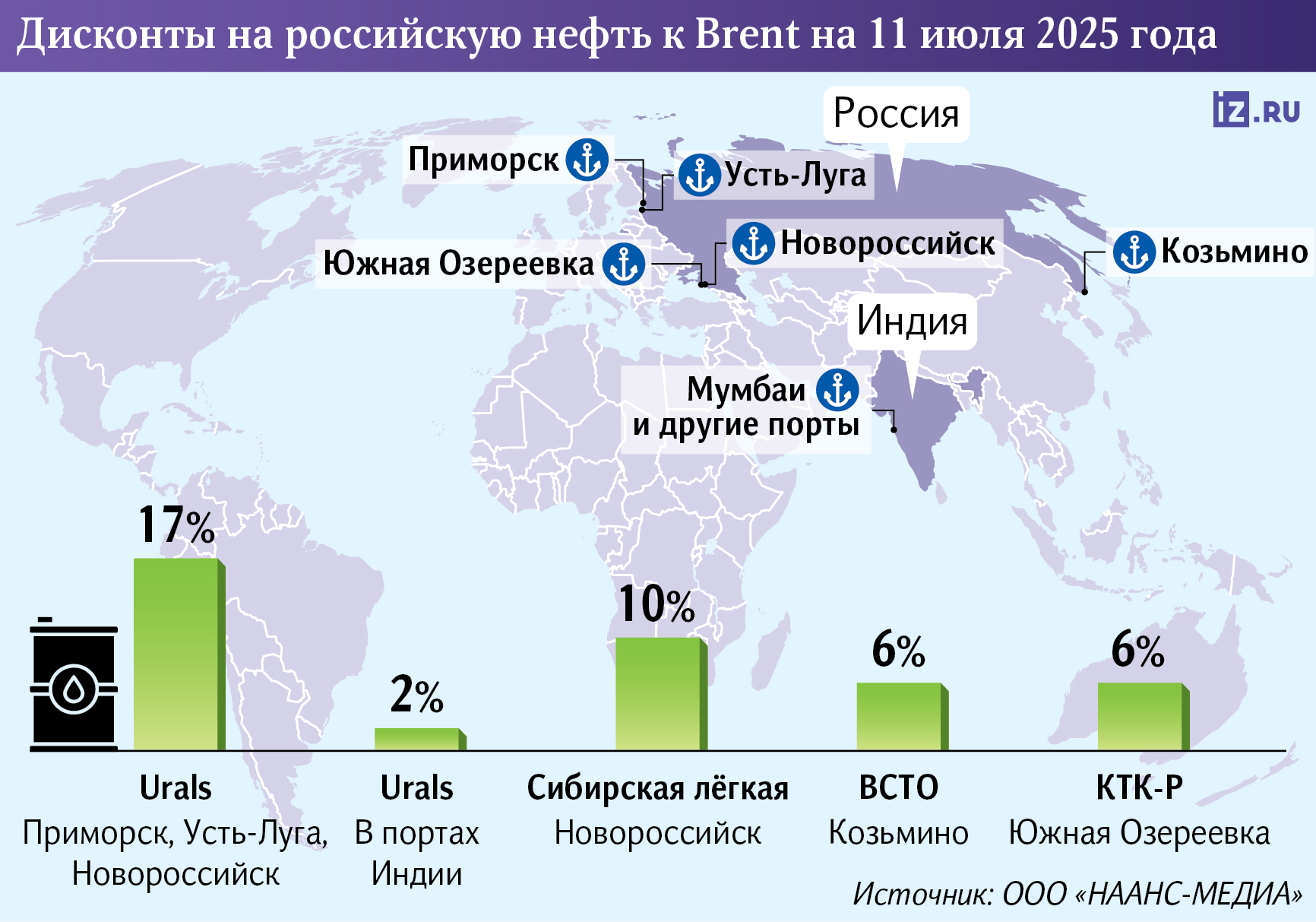
In addition, the key impact on compliance with the price ceiling is not the restrictions of the EU and the G7 countries, but the fundamental factors of the oil market: the dynamics of Urals prices, in general, repeats the dynamics of Brent prices, adjusted for a discount of $ 10-12 per barrel. The Urals price drops below $60 when the Brent price is below $70.
— Accordingly, the Urals price may fall below $50 per barrel only if Brent quotes are near $ 60. However, the fundamental factors have not yet matured for this, even despite the slowdown in demand and the increase in OPEC+ quotas," adds Tereshkin.

There is no exact data yet on how the mechanism will work, says Olga Orlova, head of the Industry department at the Institute of Oil and Gas Technologies. According to her, it is not entirely clear whether the representatives of the European Commission took into account the geopolitical risks and the possible increase in world prices to $ 100 per barrel.
Who else is against the new anti-Russian sanctions
The previous, 17th package of sanctions was adopted by the EU in May. Despite the fact that the overwhelming majority of the association's members support continued pressure on Russia, it is becoming increasingly difficult to coordinate new restrictions.
— The differences that arise relate more to the technical details and the scale of the measures than to the very principle of sanctions against Russia. Some member states are increasingly concerned about the unintended economic consequences for their national industries, especially in areas such as energy, logistics and dual—use goods, Member of the European Parliament Tomasz Zdechowski tells Izvestia.

In addition to Malta, some Mediterranean countries, including Greece and Cyprus, opposed lowering the ceiling, demanding the approval of all G7 participants. Disagreement with the renewal of the price ceiling was expressed, in particular, in the United States.
So far, Slovakia has mainly been hindering the introduction of new sanctions, which has recently opposed the frenzied policy of pressure on the Russian Federation. In early June, the Prime Minister of the republic, Robert Fico, stated that she would not support the 18th package of sanctions if the EC did not resolve the problem with Russian energy resources. Bratislava is not satisfied with the EU's decision to abandon the resources of the Russian Federation. As a result, on July 9, Bratislava refused to accept the package for the third time.

Hungary also opposes pressure on the Russian energy sector. So, at the end of June, Hungary and Slovakia opposed the adoption of the 18th package of sanctions against Russia at a meeting of EU foreign ministers in Brussels.
In addition to Malta, Slovakia and Hungary, some other countries may express concerns about specific sectors (for example, maritime trade or finance), Zdechowski notes.
— However, there is no broad coordinated opposition outside these three countries. The general consensus is still strong, although taking into account a more subtle internal dialogue," the MEP pointed out.

Moreover, Estonia threatened to block the 18th package of sanctions if it excluded the establishment of a lower price ceiling for Russian oil. This was stated by the country's Foreign Minister Margus Tsakhkna.
"If Trump did not support the idea of lowering the ceiling for political reasons and because he himself pursues the goal of lowering oil prices, then Estonians express their dissatisfaction solely out of harmfulness," Kosareva notes.
Russia will take both defensive and countermeasures in response to the 18th package of sanctions, Russian Deputy Foreign Minister Alexander Grushko told Izvestia.
"We will have to see what sanctions they have come up with. We will respond to the sanctions as we have previously responded. With these sanctions, they very often shoot themselves in the foot, sometimes even higher. We are far from the practice of causing damage or sawing at the branch we are sitting on, but nevertheless retaliatory measures, both protective and countermeasures, will be taken," the diplomat said.
Despite all the differences, the EU has already started discussing new sanctions.
— Discussions on the 19th package are already underway, although they are at an early and informal stage. The main problem is the fatigue from sanctions — not political, but technical. After 18 months, restrictions were imposed on most of the obvious targets of the sanctions. Now the focus is on tightening controls (for example, regarding circumvention of sanctions through third countries), expanding secondary restrictions, and clarifying export and import controls," Zdekhovsky tells Izvestia.
At the same time, he emphasizes that coordination is becoming increasingly difficult, since measures must be targeted, legally justified and feasible.
Переведено сервисом «Яндекс Переводчик»
