Analysis of the results: with the help of a laser, the cause of infertility in men will be determined by almost 100%
- Статьи
- Science and technology
- Analysis of the results: with the help of a laser, the cause of infertility in men will be determined by almost 100%


Russian scientists have developed a new high-precision method for the diagnosis of male infertility, which detects anomalies that are unnoticed by standard semen analysis. The new method will allow not only to identify pathology, but also to better understand its causes. For the analysis, the specialists used the method of Raman spectroscopy — the study of matter from the spectrum of the reflected laser beam. They revealed differences in the chemical composition of healthy and problematic samples. The results will help improve the diagnosis of infertility and find new ways of treatment, experts believe. At the same time, they note that affordable equipment is needed for mass adoption of the technology.
Methods of infertility diagnosis
According to the World Health Organization, infertility affects about 15% of couples of reproductive age. And in almost half of the cases, the male factor becomes the cause. Solving this problem, scientists from the Lebedev Physical Institute of the Russian Academy of Sciences and the Kulakov National Research Medical Center of Obstetrics, Gynecology and Perinatology have developed a new high-precision method for diagnosing male infertility.
According to experts, the proposed algorithm involves the use of laser technology in semen analysis. Namely, Raman spectroscopy— a method that allows using a powerful directional beam of light (laser) to "see" individual molecules of a substance, as well as to discern their composition.
— Seminal fluid makes up 95% of the ejaculate. It is a complex mixture of secretions from several sources, including testicular cells, testicular appendages, seminal vesicles, prostate gland, and various glands. Currently, more and more evidence indicates that it plays a crucial role in regulating sperm functions and, consequently, affects male fertility," said Elena Rimskaya, a researcher at the Laboratory of Laser Nanophysics and Biomedicine at the Lebedev Physical Institute of the Russian Academy of Sciences.
In particular, seminal fluid improves the quality and motility of spermatozoa, supports their viability, provides protection from external stress factors, and regulates key physiological processes. In addition, it contains many biochemical components that can serve as markers of fertility, she explained.
Traditional approaches to the diagnosis of male infertility include collecting a detailed medical history, hormonal examination and a spermogram, which determines the total volume of seminal fluid, the number of spermatozoa in it, their shape, mobility and concentration, the specialist said. Such studies make it possible to determine the condition of the ejaculate, but they do not make it possible to identify abnormalities that occur at the molecular level and to establish the main causes of pathology.
— There is a need for more sophisticated diagnostic tools that will better identify the prerequisites for male infertility. Raman spectroscopy makes it possible to analyze the molecular composition, revealing even minor deviations that go unnoticed in standard studies,— explained Elena Rimskaya.
How to determine the chemical composition of sperm
The proposed method is that a laser beam is directed at a material and, upon reflection, the oscillation frequency of the light particles changes slightly, the scientist noted. These deviations are unique for each substance, like fingerprints." Therefore, experts, analyzing them, understand what molecules it consists of.
According to the expert, Raman spectroscopy does not require the destruction of the material. Therefore, it is widely used in medicine, chemistry and even criminology. In the study, this technology helped identify subtle differences in the chemical composition of normal and problematic samples.
— In the course of the work, three key components that are contained in semen were identified. These are tyrosine, spermine phosphate hexahydrate, and a protein-rich component. Based on the analysis of 70 samples, it was found that the spectra of normal and abnormal samples differ significantly. This allowed us to separate them with 95% accuracy," the scientist shared.
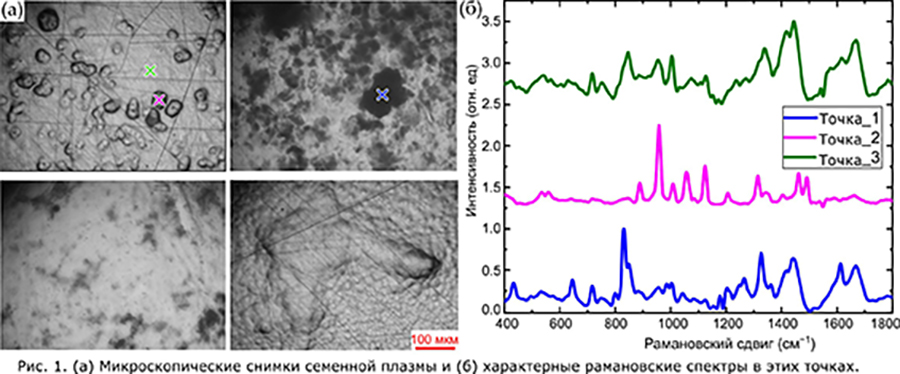
The results obtained confirm that the method can become a powerful tool for the diagnosis of male infertility, Elena Rimskaya said. It also makes it possible to perform the analysis many times and track changes in the composition of seminal plasma during treatment. This opens up new avenues for personalized medicine.
— The proposed method is efficient and does not require complex sample preparation. Whereas in traditional clinical analyses (such as blood or other biological fluids), it is necessary to perform many preparatory stages," Ivan Bratchenko, professor at the Department of Laser and Biotechnical Systems at Samara University, told Izvestia.
In the case of Raman spectroscopy, it is enough to direct laser radiation at a sample to obtain complete information about its biochemical composition, he explained. This makes the method more convenient than its analogues.
At the same time, he stressed that affordable appropriate equipment is needed for the mass implementation of the technology. It is also necessary to develop complex mathematical algorithms for the correct interpretation of the obtained spectral data.
— Raman spectroscopy, discovered back in 1928, has become one of the most common methods of analyzing matter. It is used in various fields, from the study of minerals to the characterization of new materials. There are even compact spectrometers with ready—made libraries of compounds for rapid identification of substances," said a senior researcher at the Institute of Automation and Electrometry SB RAS Laboratory of Condensed Matter Spectroscopy.
Specifically in biomedicine, the method finds application, for example, in cancer research, where it helps to analyze changes in the composition of cancer cells, the scientist noted. Work on the study of living cells and the composition of biological fluids is also promising.
— For the first time, the study shows a clear relationship between the molecular composition of plasma and the quality of sperm according to WHO criteria. And on a significant amount of clinical material. Previously, Raman spectroscopy was applied to spermatozoa or tissues, but not to seminal plasma in such a strict design and scale," commented Albert Rizvanov, head of the Personalized Medicine Center of Excellence at Kazan (Volga Region) Federal University, corresponding member of the Academy of Sciences of the Republic of Tatarstan.
According to him, unlike traditional approaches, the proposed method provides high sensitivity, specificity and reproducibility of the analysis, which allows for accurate classification of samples and fine diagnostics. However, the widespread use of Raman spectroscopy is limited by the high cost of equipment, the complexity of data interpretation, and the need to train qualified personnel.
Переведено сервисом «Яндекс Переводчик»
