- Статьи
- Economy
- We argued for money: which ruble exchange rate did the SPIEF participants call the equilibrium exchange rate?

We argued for money: which ruble exchange rate did the SPIEF participants call the equilibrium exchange rate?
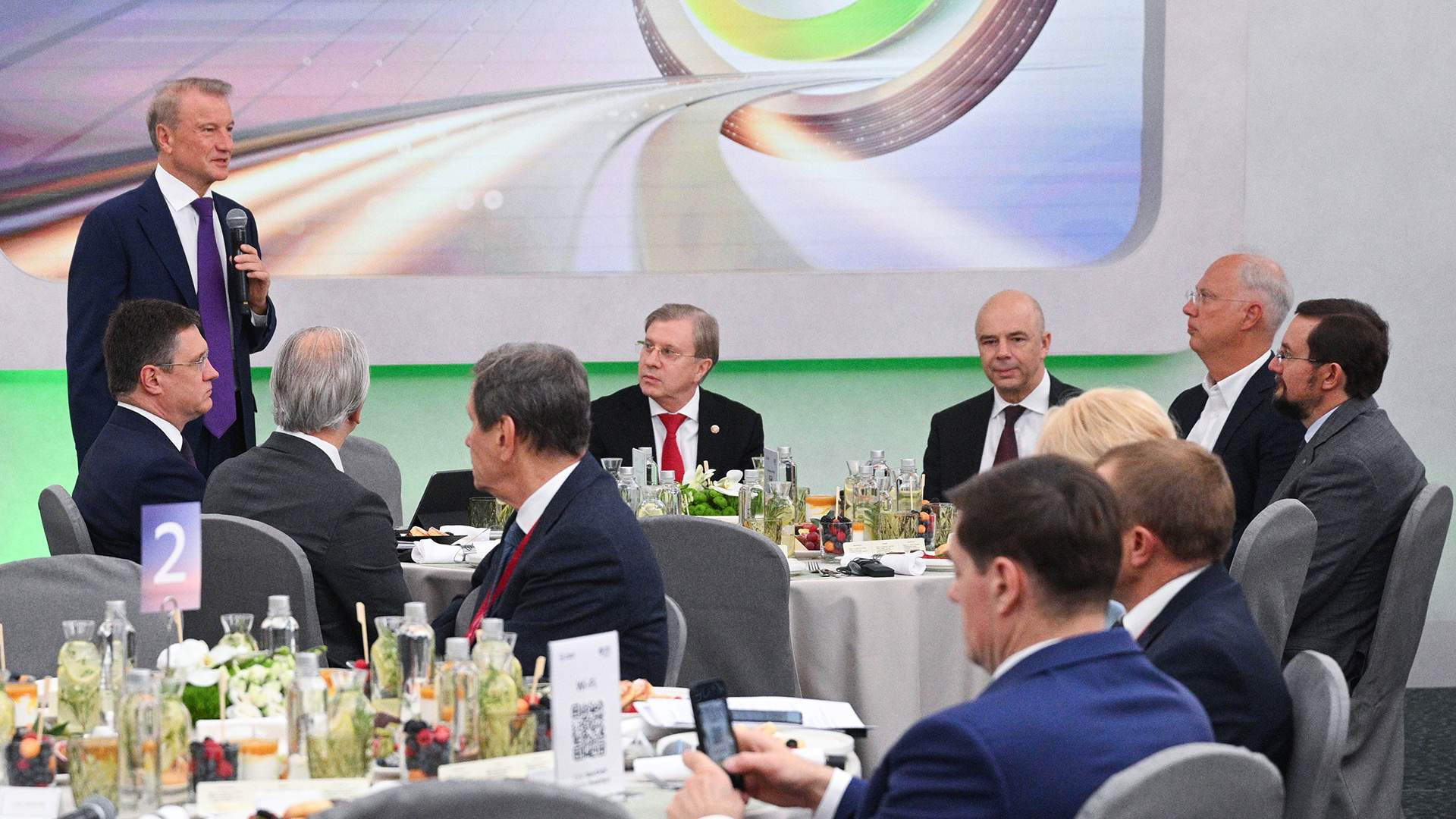
The ruble exchange rate, which would satisfy both the state, business, and citizens, was at the center of the discussion on the third day of SPIEF 2025 - the heads of the largest banks and representatives of regulators spoke on this topic. According to the head of the Savings Bank, German Gref, the equilibrium exchange rate is now above 100 rubles / $. While the Central Bank believes that the current values of 80 rubles / $ reflect real supply and demand for the currency, therefore they are the most suitable. In addition, on the eve of the plenary session with the participation of the president, the forum continued to discuss the slowdown in the economy — Deputy Prime Minister Alexander Novak called the situation a "controlled cooling." What will happen to the runway and the ruble exchange rate by the end of the year is in the Izvestia article.
The ideal ruble exchange rate for Russia
One of the most striking business events of this year's SPIEF was traditionally the Sberbank business breakfast. In addition to the head of the largest bank, German Gref, Finance Minister Anton Siluanov, head of the State Duma Committee on Budget and Taxes Andrei Makarov and Deputy Prime Minister Alexander Novak took part in it. The theme of the breakfast is "Betting against growth."
As German Gref stated, the ruble's exchange rate against the dollar is currently undervalued — the equilibrium level is 100+.
— Of course, all our export industries and, first of all, the budget feel this very strongly. We see that the budget is facing an increased deficit," said German Gref.
According to Gref, two key export commodities, metals and hydrocarbons, are being harmed by the current course, and their decline is already reaching about 10%. The record fall in coal prices (by 27%) creates a big problem for the development of basic industries, he stated.
The banker added: at the end of the year, the Ministry of Finance will face the need to cover the deficit with new sources. However, the head of the department, Anton Siluanov, apparently took the hint and immediately denied such a prospect. He said that the ministry is not planning new adjustments to the tax system, despite the fact that the Russian budget is "seriously stormy."
The head of the Savings Bank is not the only one who pointed out the importance of weakening the ruble. VTB President and Chairman of the Management Board Andrey Kostin said yesterday that the current strengthening of the national currency is harmful to the Russian economy. In an interview with Izvestia at the SPIEF, he called for "taxiing" to the exchange rate at 90+ per dollar.
Deputy Prime Minister Denis Manturov joined the discussion in absentia. In response to a question from journalists, he called the exchange rate of 100 rubles/$ optimal for export and import.
In turn, Andrey Gangan, director of the Monetary Policy Department of the Bank of Russia, said on the sidelines of the SPIEF that the equilibrium exchange rate of the ruble is the result of a balance of supply and demand in the foreign exchange market. This means that the current level — that is, a strong ruble — is an equilibrium level.
— A high key rate restrains overheating of demand, including demand for imports, makes the ruble attractive — money goes into ruble assets. This not only strengthens the ruble, but also dampens inflation, reduces the cost of importing equipment and helps businesses upgrade their capacities," said Andrei Gangan.
Even if a weak exchange rate is beneficial to exporters, as it allows them to maintain profits in the face of deteriorating external conditions, this is not an argument that it is optimal for the economy as a whole, Andrei Gangan added.
Nevertheless, the ruble is likely to weaken in the coming months, according to independent expert Andrey Barkhota. At the end of summer, we can expect a rate of 79-84 rubles / $, at the end of autumn — 88-93 rubles / $, and by the end of 2025, it will drop just in the region of 90-100 rubles / $. As Izvestia's experts explained, the national currency will weaken as the authorities begin to gradually reduce the key rate (and the attractiveness of ruble assets will decrease), and geopolitical tensions may, on the contrary, worsen.
Lowering the exchange rate to 100 rubles per dollar will have a negative effect in the fight against inflation, Lazar Badalov, associate professor at the Faculty of Economics at RUDN University, warned. The cycle of raising the key rate began with the weakening of the ruble last year, he recalled.
— On the other hand, let the exchange rate be at 80, 90 or even 100, the main thing is that the rate stays close to this level for a long time and fluctuations are within 5%. Only in this case, adequate planning and forecasting is possible, and exporters and importers will not lay a buffer to minimize currency risk," concluded Lazar Badalov.
Are there any risks of recession in the Russian Federation
On the third day of the SPIEF, the panelists continued to argue: is the economy just cooling down now, or has it already gone into recession. As Deputy Prime Minister Alexander Novak stated on June 20, inflation in Russia over the past seven weeks has been at 2.6% year-on-year, which is below the Central Bank's target.
According to him, Russia is in a state of "controlled cooling of the economy." Accordingly, it is time to lower the key rate, the Deputy Prime Minister said. He called for faster decisions that would not freeze the economy, but give it the opportunity to move forward.
Experts interviewed by Izvestia believe that it is too early to sound the alarm. The data from the macroeconomic survey of the Bank of Russia for May 2025 predict a decrease in GDP growth only this year. And in the next two years they will increase. All this indicates a certain "cooling" rather than a recession, said Ekaterina Golubtsova, associate professor of the Department of State and Municipal Finance at Plekhanov Russian University of Economics. So far, negative dynamics are present in certain sectors — in the extractive industry, wholesale trade and freight transport, she said.
Formally, a recession is two consecutive quarters of a decline in GDP, which is currently not observed, said Vladimir Eremkin, senior researcher at the IPEI Structural Research Laboratory at the Presidential Academy.
— The structure of economic growth is heterogeneous, it is supported mainly by government spending. While consumer and investment demand from the private sector remain weak, some sectors have already entered the recession phase, while in others the upward trend continues.
The President summed up the discussion at the plenary session: Vladimir Putin instructed in no case to prevent stagnation or recession of the Russian economy. The President pointed out the need to conduct a competent and thoughtful fiscal and monetary policy.
— To adjust their mechanisms primarily to support and stimulate growth. Naturally, while ensuring macroeconomic, inflationary and financial stability," Putin stressed.
He noted that the strategic vector is precisely to actively, consistently, step by step change the structure of the domestic economy.
Переведено сервисом «Яндекс Переводчик»
