Nitrogen of civilization: electricity will help create "green" fuel for satellites
- Статьи
- Science and technology
- Nitrogen of civilization: electricity will help create "green" fuel for satellites

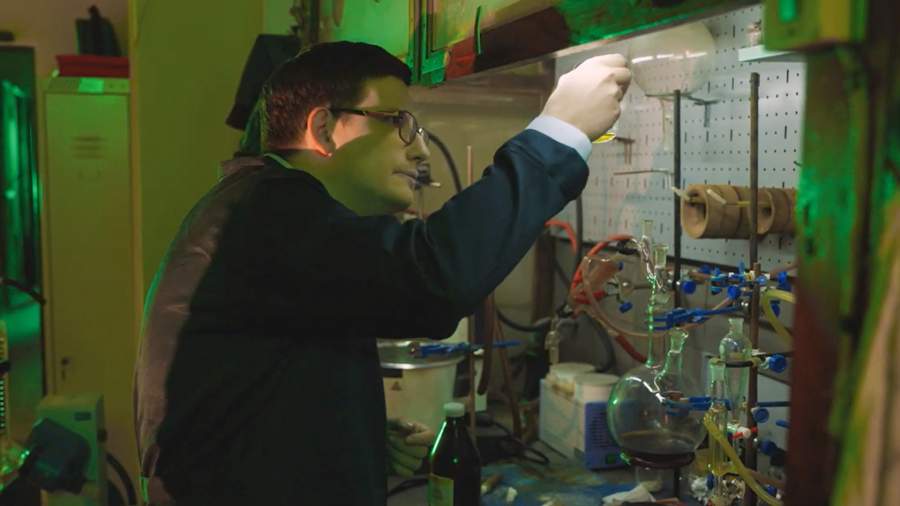
Russian scientists have found a way to create new "green" fuels for spacecraft and the mining industry. They have developed approaches to the synthesis of special high-energy substances that, upon decomposition, release molecular nitrogen, which is contained in the air. Researchers receive them in an environmentally friendly mode using electricity, which means they will not harm the environment. However, according to experts interviewed by Izvestia, a number of tasks still need to be solved for the mass introduction of promising technology: it is the scalability of synthesis for use in low-tonnage production, as well as the stability of compounds during storage.
What are polyazote heterocycles?
Scientists at the Zelinsky Institute of Organic Chemistry of the Russian Academy of Sciences (IOH RAS) have developed new approaches to the electrochemical synthesis of special substances from which it is possible to create environmentally friendly fuels for spacecraft and the mining industry, as well as to obtain various photoactive materials. We are talking about polyazotic heterocycles, compounds whose molecules contain a closed cycle with two or more nitrogen atoms.
Due to their structure, polyazote heterocycles are used in various fields, including the creation of new energy materials, medicines and as dyes. They can be used as components of explosives and rocket fuels due to the high energy that is released during their decay.
For the first time, experts used electric current as an environmentally friendly oxidizer. And we have obtained unique compounds — mesoionic molecules, which themselves are electroneutral, but they contain positive and negative charges.
— Before our research, there were literally three such compounds known in old works. And it was unclear whether these substances really exist, how to obtain them, etc. But we created such a general method. We have received a series of 25 such structures. And we found that they are still quite heat-resistant. The temperature of the beginning of decomposition is above 270 °C," Leonid Fershtat, head of the Laboratory of Nitrogen—containing Compounds at the Institute of Chemical Sciences of the Russian Academy of Sciences, winner of the Challenge Award, told Izvestia.
Due to the fact that the new compounds turned out to be so heat-resistant, they will find application as fuel components for the aerospace industry, the scientist said. They are primarily suitable for launching small spacecraft, such as satellites, research probes, and navigation systems, into low-Earth orbit. The resulting compounds will also be useful in mining.
— These substances contain quite a lot of nitrogen atoms. They have stored chemical energy that can be released in a controlled manner and, accordingly, used in mines to control the direct process of a directed explosion," Leonid Fershtat said.
Environmentally friendly fuels
It is important that from the point of view of chemistry, scientists obtain them in an environmentally safe mode and a significant percentage of the substance consists of nitrogen atoms. This means that by themselves, when burned, they will also release mainly molecular nitrogen, which is contained in the air we breathe. The exploitation of such substances will not lead to any serious environmental harm, Leonid Ferstat said.
The work of organic chemists from IOH on the synthesis of mesoionic heterocycles containing three nitrogen atoms is distinguished by an original approach using electrochemical activation of reagents, which follows the basic requirement of green chemistry - environmental safety, said Anton Muravyov, Candidate of Chemical Sciences, Associate Professor at the ITMO Scientific and Educational Center for Infochemistry.
— The high thermal stability of these compounds — the temperature of the beginning of decomposition is about 270 ° C — opens up broad prospects for using the library of the obtained compounds in the aerospace industry, including for launching spacecraft into Earth orbit. However, the immediate use of the obtained laboratory samples of energy-intensive heterocycles currently has the following potential limitations: the scalability of synthesis for use in low-tonnage production, as well as the stability of compounds during storage. The resulting variety of heterocyclic compounds makes it possible to further study the structure–property relationship in more detail and optimize the structure of the molecule to create promising raw materials for environmentally friendly fuels in spacecraft," he added.
Heterocycles are rings of atoms in which atoms of carbon and other elements are connected, explained Igor Shkradyuk, coordinator of the industrial greening program at the Wildlife Conservation Center. The compounds created in IOH have four important features.
— During the decomposition of nitrogen-containing heterocycles, more energy is released during the formation of molecular nitrogen than during the formation of nitrogen oxides. And nitric oxide is a toxic gas (if you've seen red tails of smoke from chimneys, then it's nitric oxide). That is, it is possible to burn fuel so that carbon dioxide, water and safe molecular nitrogen are released. By using new substances in rocket fuel, we can get more environmentally friendly rocket launches," he concluded.
Now scientists will have to scale the method of synthesizing "green" compounds and launch the production of a pilot batch. Since scientists do not need any serious biological tests in the case of fuels, such as in medicines, the technology can enter the market within a few years.
In 2025, 632 applications from 40 countries were submitted for the national award in the field of future technologies "Challenge". The international Discovery nomination is of the greatest interest — 155 applications have been received from scientists from abroad. This is 38% more than in 2024. Among the countries where the applications came from: China, Kazakhstan, Turkey, USA, Switzerland, Italy, Germany, Brazil, India, Indonesia, Australia. The presentation will take place on December 19th.
Переведено сервисом «Яндекс Переводчик»
