
"The value of the key rate should be less than 10%"
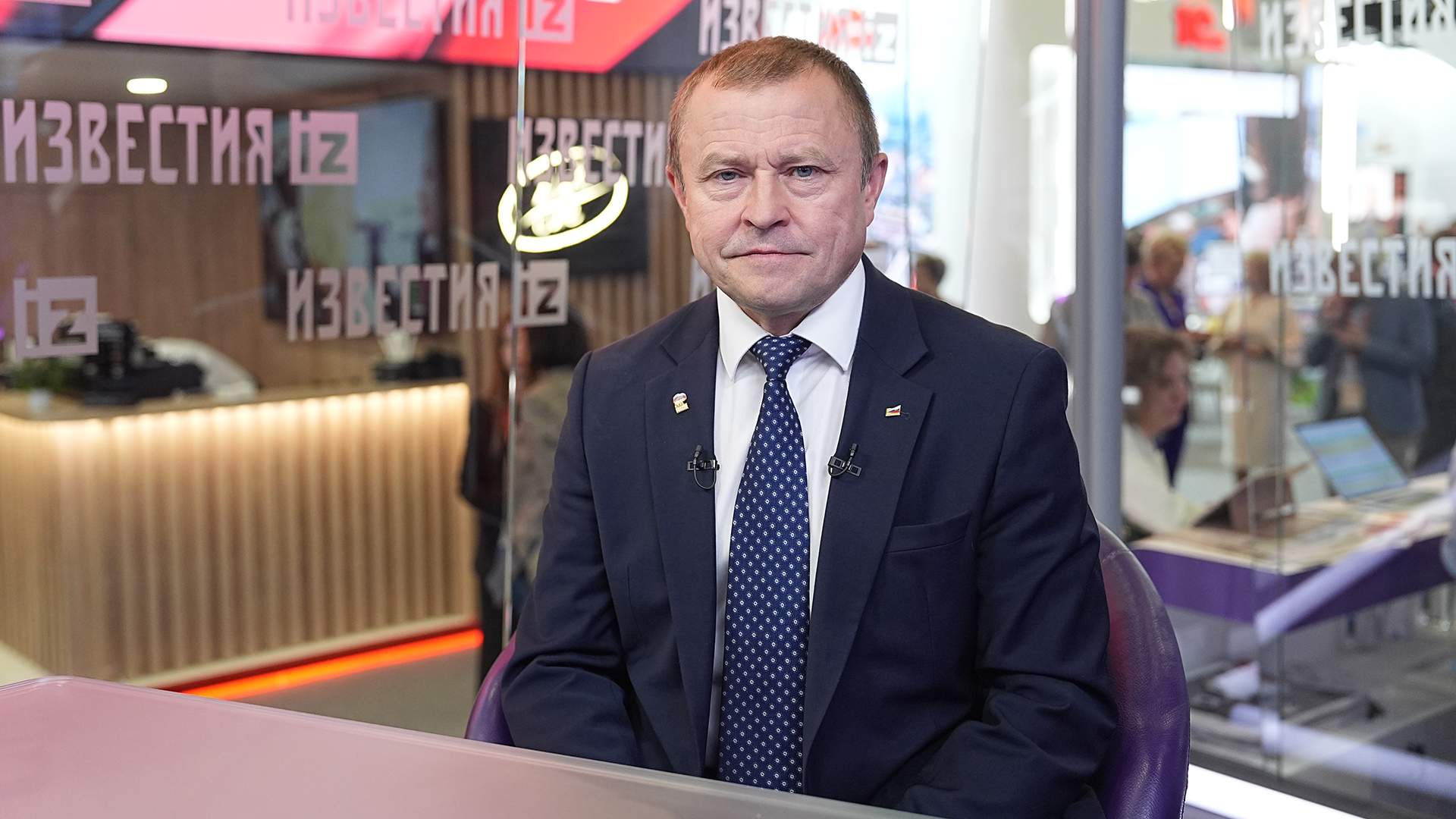
China is reconfiguring its investment activity, changing it from Western countries to Russia — this is due to the new round of trade wars that Donald Trump has unleashed. In an interview with Izvestia, Alexander Kalinin, president of the NGO SME Opora Rossii, told about this. According to him, Russian and Chinese enterprises are already creating joint projects. However, it is still difficult for companies to actively develop — despite the recent reduction in the key interest rate, loans remain expensive. Alexander Kalinin told Izvestia at SPIEF 2025 about what support measures small and medium-sized enterprises (SMEs) need and whether the country should work more actively with migrants.
"America has a record imbalance — Trump is forced to use cowboy methods"
— The newly elected President of the United States, Donald Trump, expanded import duties to 185 countries in the spring, the most severe of which affected China. Despite the fact that tariffs have now been frozen for 90 days and they have not affected our country as a whole, there is still an impact on the global economy. How does Russian business feel in the new round of trade wars?
— America now has a record imbalance — the country is actually heading for bankruptcy, it is difficult for it to service a large public debt, which is almost close to $ 37 trillion. Therefore, President Trump is forced to resort to such, one might say, cowboy methods.
If we talk about Russia, a record number of sanctions and restrictions have already been imposed on our country. The level of our economic ties with the so-called West has probably dropped by more than 10 times.
The United States has now agreed on reasonable tariffs with China, but the Chinese leadership and business have realized their dependence on Western countries — they invested there before. Beijing is changing priorities today and understands that at any moment it may find itself as a toy in the hands of, so to speak, the bigwigs of the Western world.
China's small enterprises create 60% of the country's gross domestic product, meaning it is a small business economy. Now their investments are aimed at the Russian economy. We see great prospects in this.
— Are there any examples of Chinese investments in Russia?
— For example, the ski lift manufacturing business comes to mind. For him, the SKADO company from Samara makes the project itself, and the Chinese manufacturer makes the electronics and the movement mechanism. Together, they have already launched about four major investment projects in resorts in the Russian Federation.
"We are experiencing an acute hunger for investment money"
— Let's return to the situation in Russia. What are the main problems of small and medium-sized businesses that you would highlight now? What support measures does the sector need?
— According to the latest data, the availability of financial resources is at an all-time low. The business does not have enough working capital, and borrowing funds is very expensive, and something needs to be done about it.
In addition, labor costs have increased dramatically — there is a shortage of labor resources not only in large businesses, but also in small ones. And businesses are also recording rising costs — tariffs have increased significantly.
There is also an increase in cost, including inflationary, in purchases of various manufactured goods.
All this is aimed at cooling the economy. The fact that the Bank of Russia lowered the rate for the first time in three years is, of course, a positive signal, but it is not enough. That is, the difference in the rate between 21% and 20% does not fundamentally change the situation with the availability of financial resources. Other support measures are needed, especially in priority sectors.
This will be discussed at the SPIEF. We expect that Deputy Prime Minister Alexander Novak will talk about the national project. In particular, he will focus on budget constraints and the growing fiscal burden on small businesses. This assistance should be provided in sectors that are considered a priority.
— Are there any digital indicators of how business activity is decreasing due to the continued high key interest rate?
— Recently, Prime Minister Mikhail Mishustin spoke about this — our economy is growing by about 1.5%. Although the country faces the task of making it higher than the global average. And this is at least 3.5-4%. This is the most important result of the expensive monetary policy. Nevertheless, in these situations, it may be necessary to find new solutions to restart economic growth.
Maxim Oreshkin, Deputy head of the Presidential Administration of the Russian Federation, recently spoke about this in his article on the St. Petersburg Forum. There is actually a technological revolution going on in the world right now. This applies not only to digitalization, marketplaces, but also to artificial intelligence, robotics, energy transmission and transformation systems, recycling, and waste.
That is, in fact, we are moving towards new technological trends and a new way of life. And this is where small businesses need to be on trend. For this purpose, there is such a thing as a "community economy" — when a company is in the business community and also communicates with entrepreneurs from other countries. They share information and understand what is happening in a particular sector.
— And what, in your opinion, is the key rate acceptable for business?
— The value of the key rate should be unambiguous — that is, less than 10%. Otherwise, there is no point in investing. The central Bank itself records that a record number of deposits have been opened today. In addition, people are changing their behavioral strategy — they understand that they do not need to invest, they can simply place funds in banks at 20% per annum.
We are currently experiencing an acute hunger for investment money. There will be no development without investments.
"For 20% of loans, businesses are experiencing maintenance problems today"
— President Vladimir Putin announced the introduction of credit holidays for SMEs in the winter of 2024, but the initiative's entry into force has been delayed — the draft has not yet passed the second reading in the State Duma. What is the reason for this? Which industries need this mechanism the most?
— I think there was some fear that the business would abuse the credit holidays. But I think we will hear the banks' opinions on this issue at the forum. Because for every fifth loan, a business today has problems with servicing. This is due not only to loan restructuring, but also to late payments.
The law on business credit holidays must be adopted, it cannot be postponed. Right now, we are eligible for credit holidays only if the loan is without government support. However, more than 1 trillion rubles of concessional loans have been issued, but there may be difficulties with them.
— New tax requirements for SMEs have been in effect since this year. Now more companies have to pay value added tax (VAT). And many experts are confident that businesses will split up in an attempt to avoid paying taxes. Do you notice this? How has this mechanism affected the business as a whole?
— When the tax reform was discussed in detail, including with businesses, she proposed several different blocks at once. Not only VAT has been introduced for small companies, but the simplified tax threshold has also been almost doubled.
At the same time, a tax amnesty was introduced. If the Federal Tax Service sees certain signs that a business is splitting up, it suggests that it switch to a common taxation system. And as, let's say, not only a stick, but also a carrot.: "We will not calculate for you in three years what, in our opinion, you have not paid extra. It will all be written off if you switch to a common system and work on it."
— So there is no punitive orientation? What is the best way to resolve this?
"Exactly. Now companies have two options — either switch to the new system without additional charges for previous years, or go to court to challenge and prove that there was no fragmentation.
But they rarely go to court, because the Federal Tax Service today has an extensive database. Therefore, business prefers to sign an agreement and choose an amnesty mechanism, but we do not have statistics yet.
"If a person wants to work more, they will be paid twice as much"
— I would also like to touch upon the issue of developing a large-scale draft law on systemic changes to the Labor Code. In particular, the amendments provide for the possibility to increase overtime rates from 120 to 240 hours per year, determine the procedure for paying overtime, simplify the rules of dismissals. Do you expect the changes to take effect? How does business feel about these changes and are they in demand in the context of record low unemployment?
— We consider them extremely important — there is no need to delay them. These changes generally do not violate the labor rights of employees, they offer an alternative. If a person wants to work more, they will be paid twice as much. And if he doesn't want to, then he won't do it.
In addition, now, including at the initiative of Opora Russia, a bill was submitted to the State Duma at the end of May exempting migrant workers from the Russian language exam. But if we are not talking about people who came to Russia under a quota, but about citizens of Vietnam, India, Indonesia, then this is not so advantageous. The employees came for specific projects, did everything necessary and left.
We are now seeing illustrative situations. For example, on Sakhalin, an entrepreneur owns a construction company. To do the work, he brought in Vietnamese and paid them everything they needed — not only labor, but also housing and exams. At the same time, 80% of these migrants will not pass the Russian language, and the company owner will have to transport them back to Vietnam at his own expense. No one will benefit from this.
Переведено сервисом «Яндекс Переводчик»
